



If you’re wondering what questions to ask a home infusion provider, it’s reasonable to want clear answers about who will guide your care, how treatment will be monitored, and what to do if a concern arises. Home infusion isn’t the right fit for every patient, so understanding how care would work for you matters.
A thoughtful conversation can help you compare providers without needing to know all the clinical details in advance. Ask who coordinates your treatment, how training and home safety are addressed, how insurance authorization and costs are explained, and whether the provider supports your therapy and address.
This checklist covers clinical support, safety, coordination, coverage, and local availability. For people in Syracuse and nearby New York communities, Vital Care of Syracuse is one provider you can evaluate alongside other options. Confirm directly whether your therapy and preferred care setting are currently supported. The questions ahead can help you leave each conversation with a clearer understanding of responsibilities and next steps.
Key Takeaways
- Use what questions to ask a home infusion provider to compare clinical experience, medication handling, and safety instructions.
- Ask who coordinates your care and how to reach the right contact with treatment questions or concerns.
- Compare answers about medication, equipment, and supply delivery, including how delivery problems are handled.
- Request a benefits review and written cost details before assuming your plan covers a particular therapy or service.
- Evaluate how clearly each provider explains next steps, and confirm that your therapy, care setting, and address are supported.
Start with the right questions: Is home infusion a fit for your care?
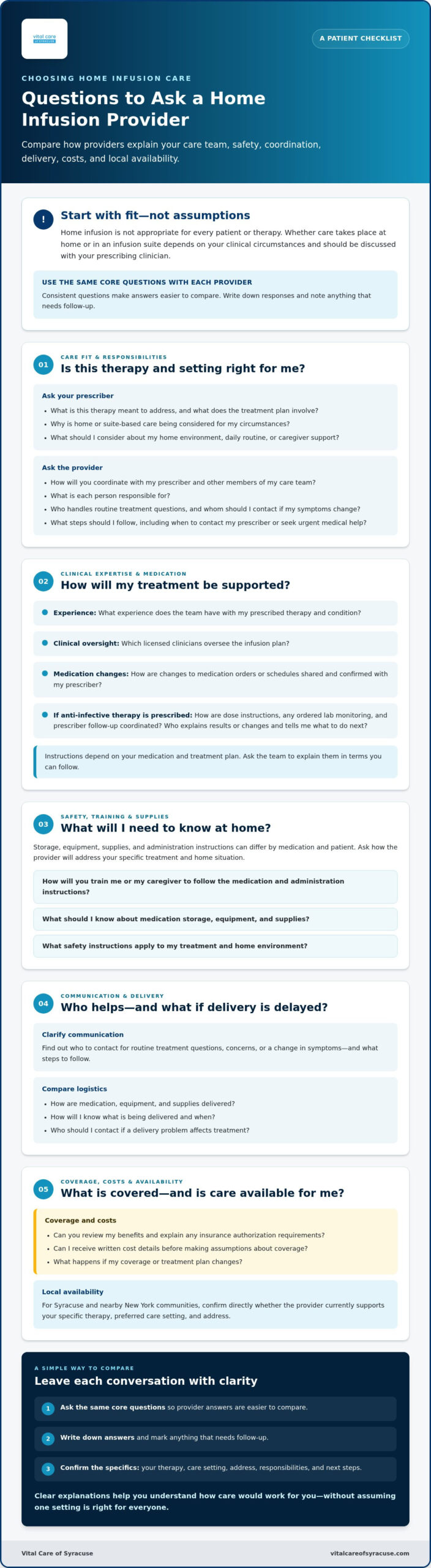
Comparing care options can feel complicated, especially when you’re managing a new treatment alongside everyday responsibilities. Home infusion may offer care outside a hospital, but it isn’t appropriate for every patient or therapy. Whether treatment can take place at home or in an infusion suite depends on your clinical circumstances and should be discussed with your prescribing clinician.
Ask your prescriber why a particular therapy and care setting are being considered, and what the plan involves. A general overview of intravenous therapy can explain the treatment method, but your care team should answer questions about how it applies to you. To make comparisons useful, ask each provider the same core questions and note how clearly they respond.
This Spanish-language video from Johns Hopkins Medicine offers an introduction to home infusion therapy:
Ask why this therapy and care setting are being recommended
Ask what the prescribed therapy is intended to treat, what the treatment plan involves, and why home or suite-based infusion may suit your circumstances. Share your preferences and any concerns about your home environment, daily routine, or available caregiver support. These details can help your prescriber and provider discuss what the plan requires and whether another setting should be considered.
Find out who is involved in the care team
Care can involve the provider, the prescribing clinician, you, and possibly a caregiver. Ask how the provider coordinates with your prescriber and other members of your care team, and request a clear explanation of each person’s responsibilities. Find out who handles routine treatment questions and whom to contact if your symptoms change. Ask what steps to follow, including when to contact your prescriber or seek urgent medical help.
Use the same prompts in each conversation to make comparisons more meaningful. For example, ask:
- What is this therapy meant to address, and what does the plan involve?
- Why is home or suite-based care being considered for my circumstances?
- How will you coordinate with my prescriber, and what is each person responsible for?
- Who should I contact with routine questions, and what should I do if my condition changes?
Write down the answers and note what needs follow-up. If you’re evaluating a provider serving Syracuse or nearby New York communities, confirm that your specific therapy, care setting, and address are currently supported. Clear explanations can help you decide what to ask next without assuming one care setting is right for everyone.
Ask about clinical expertise, medication handling, and infusion safety
Once you understand why a care setting is being considered, ask how the provider will support your specific therapy. The team should explain its experience, medication instructions, and safety procedures in terms you can follow. As you consider what questions to ask a home infusion provider, focus on how the team will tailor its guidance to your medication, health needs, and treatment plan.
Questions about the clinical team and treatment plan
Ask what experience the team has with your prescribed therapy and condition, and which licensed clinicians oversee the infusion plan. Find out how the provider communicates with your prescriber, including how medication-order or schedule changes are shared and confirmed. Clear coordination helps you understand which instructions are current and who is responsible for following up.
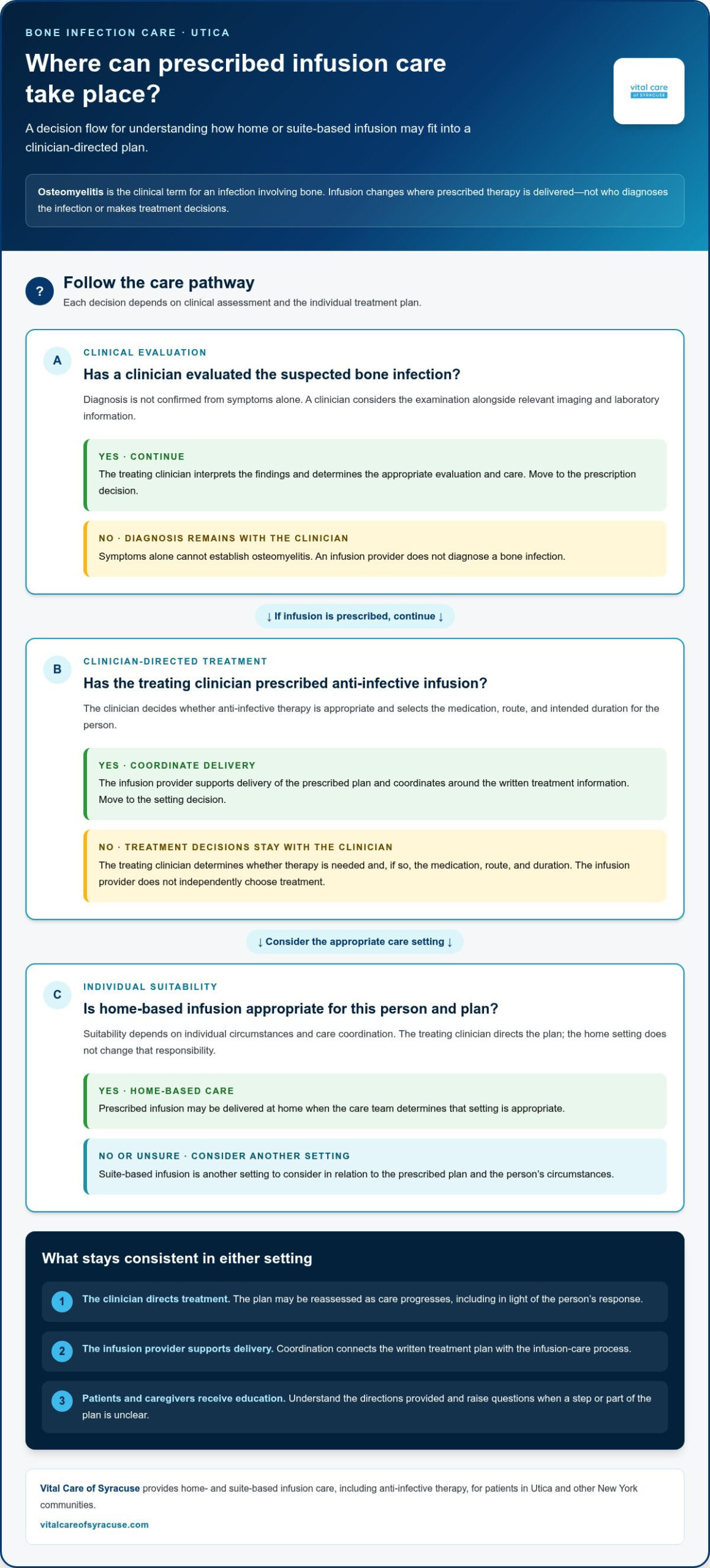
If you’re prescribed anti-infective therapy, ask how dose instructions, any ordered lab monitoring, and follow-up with your prescriber are coordinated. Details depend on your treatment plan, so ask who explains results or changes and how you’ll be told what to do next. The National Home Infusion Association offers home infusion practice standards and clinical resources that can provide useful background for your conversation.
Questions about home preparation and safety instructions
Storage, equipment, supplies, and administration instructions can differ by medication and patient. Ask what your specific therapy requires at home, including any storage conditions or space for equipment. Request clear instructions for handling supplies and preventing infection, and ask what training you and any caregiver will receive. You can also ask how the team checks your understanding, such as inviting you to explain or demonstrate the steps in your own words.
Before treatment begins, ask for written guidance that covers:
- How to store the medication and organize the required supplies.
- How to follow the administration instructions provided for your therapy.
- Which side effects or warning signs should prompt a call to the care team.
- Whom to contact with clinical questions, and what to do if symptoms change.
Don’t assume the provider is an emergency service. Ask about its clinical contact procedures and when you should instead seek urgent medical help. If you’re evaluating Vital Care of Syracuse, you can review its home infusion services and confirm directly whether your prescribed therapy and care setting are currently supported for your address.
Compare communication, delivery, and support before choosing
Good coordination should be clear before treatment begins. To compare providers fairly, record each answer in a simple side-by-side table with columns for contact procedures, care coordination, training, delivery, and the setting offered. Note what’s confirmed, what depends on your treatment plan, and what still needs follow-up. This makes it easier to compare practical details instead of relying on a general impression.
Check how the provider communicates and coordinates care
Ask which contact method to use for routine questions and what follow-up process to expect. Find out how the provider shares treatment progress or concerns with your prescriber, and how you’ll be informed about relevant updates. If you’d like a caregiver involved, ask how they can participate in communications with your permission. UNC Health also offers practical questions about your infusion therapy that can help you prepare for provider conversations.
Compare the answers closely. Does each provider explain who will follow up on a question and how you’ll know what happens next? Record the contact process rather than assuming every provider handles communication in the same way.
Check delivery arrangements and local availability
Ask who coordinates medication, equipment, and supply delivery, how you’ll be notified of delivery arrangements, and what to do if something is delayed, missing, or needs to be rescheduled. Clarify whether care would take place at home, in an infusion suite, or in another setting, and whether the setting could change during treatment.
Local service depends on the therapy, care setting, and address. If you live in Syracuse, Albany, Rochester, Utica, Buffalo, Auburn, or Binghampton, ask each provider directly whether your address is currently supported for your prescribed therapy and preferred setting. Don’t assume that service in one city means every nearby community or treatment is available.
A provider based in East Syracuse, such as Vital Care of Syracuse, can be one option to assess using the same questions as other providers. Its discussion of the benefits of a local home infusion company offers context on local coordination, but confirm current service details directly for your situation.
Before choosing, review your comparison notes with your prescriber or caregiver if helpful. Clear answers about contacts, delivery steps, and location-specific service can make the day-to-day plan easier to understand.
Understand coverage, costs, and what happens when plans change
Insurance details can be difficult to sort through because coverage may depend on your plan, prescribed therapy, care setting, and how services are billed. Before treatment begins, request a benefits review and a written explanation of what’s known. A benefits check isn’t a guarantee of payment, so confirm details with your insurer and ask the provider to explain any remaining uncertainties.
Ask specific questions about insurance and authorization
As part of what questions to ask a home infusion provider, find out whether the provider checks benefits and whether your plan may require prior authorization. Ask what insurance information, prescription details, or other documents you need to supply, and how you’ll be told about a coverage decision or a request for more information. If approval is pending, clarify what that means for the proposed treatment schedule and who will update you.
Clarify billing and changes to the treatment plan
Ask which items may be billed by the infusion provider and which may appear on statements from other parties. Depending on the arrangement, medication, supplies, delivery, and professional services may not all appear on the same bill. Ask whom to contact if an explanation of benefits doesn’t seem to match a bill, and what information to have ready when you call.
Changes to a prescription, schedule, or care setting can affect coordination and may prompt new insurance questions. For example, people prescribed anti-infective therapy at home can ask how treatment instructions and related coordination are handled if the prescriber changes the plan. This guide to anti-infective therapy at home provides additional context, but confirm your own coverage and billing details for your plan.
Use this sequence to keep the discussion organized:
- Confirm benefits: Ask what the provider has checked and verify plan details with your insurer.
- Clarify responsibility: Find out which organization may bill for each part of care.
- Document answers: Save written explanations, reference details, and notes from calls.
- Revisit open questions: Follow up on pending authorization, unclear charges, or changes to the treatment plan.
Coverage can’t be assumed, and providers can’t promise how an insurer will process a claim. For help understanding which questions to raise about home infusion coverage, contact Vital Care of Syracuse and confirm current details for your therapy and situation.
Use the checklist to choose a provider and plan your next conversation
You don’t need to make a decision based on one impressive claim or a quick first impression. Use the same checklist with each provider, then compare how clearly they answer, whether they explain what happens next, and how they handle questions they can’t resolve immediately. The goal is to understand how care would work for your situation, not to assume every provider or setting is the right fit.
Turn provider answers into a practical comparison
For each item, mark the answer clear, needs follow-up, or not applicable to your prescribed therapy. Note unanswered questions and consider sharing them with your prescriber. Pay particular attention to coordination with the clinical team, instructions you can understand and follow, and a clear contact pathway for questions or concerns.
- Clinical care: Who oversees the infusion plan, and how does the provider coordinate with the prescriber?
- Safety: What therapy-specific instructions, training, and written guidance will you receive?
- Communication: Whom should you contact with routine questions, and how are updates shared?
- Logistics: What care setting is being considered, and how are medication, equipment, and supplies coordinated?
- Coverage: What benefits or authorization details have been checked, and what still needs confirmation?
“Not applicable” can be a useful answer if the provider explains why an item doesn’t apply to your treatment. If an answer is unclear, ask for an explanation in plain language or request written information to review later. Responsiveness matters, as does a willingness to acknowledge uncertainty and explain how an open question will be addressed.
Prepare for a conversation with a local infusion team
Before speaking with a provider, have your prescription or therapy details, insurer information, treatment location, and notes about your preferences or concerns available. Use the list above to guide the conversation, then confirm directly whether the specific therapy and care setting are currently available for your address. Location alone doesn’t establish eligibility or service availability.
Vital Care of Syracuse is one provider you can evaluate with the same checklist. Ask whether it can support your prescribed therapy and preferred setting locally, and clarify any answers that depend on your clinical or insurance circumstances. A conversation can help identify the right next questions, but your prescriber should guide decisions about clinical suitability.
If you’d like to discuss your questions with a local provider, speak with the Vital Care of Syracuse team and confirm the current details for your situation.
Take your next step with confidence
Choosing a home infusion provider starts with understanding whether the therapy and care setting suit your clinical needs. Asking what questions to ask a home infusion provider can help you compare clinical oversight, safety instructions, communication, delivery arrangements, and coverage. Use the same checklist for each conversation, write down what’s confirmed, and follow up on anything unclear with the provider, your prescriber, or your insurer.
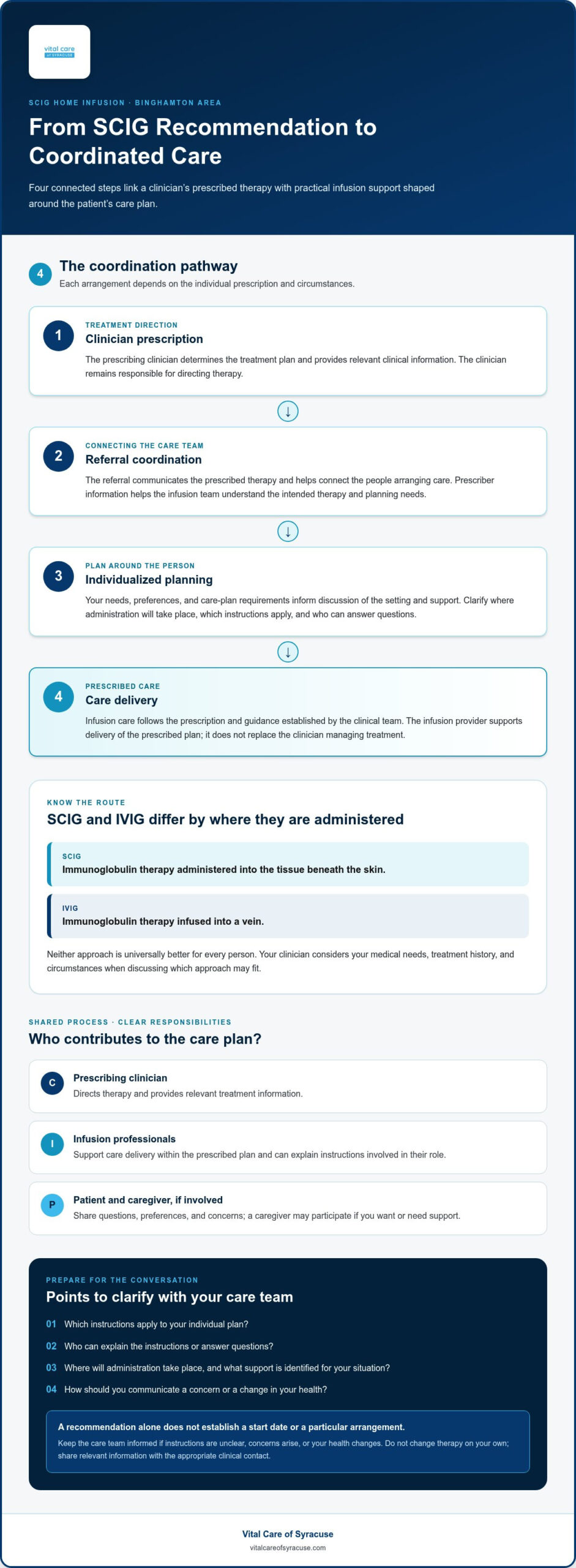
Vital Care of Syracuse is a locally owned and operated provider within the Vital Care network. Its listed specialty therapies include anti-infective therapy, IVIG/SCIG, and parenteral nutrition, with home-based and suite-based infusion among its described care settings. These details are a starting point, not confirmation that a specific therapy or setting is available for your address, so ask directly about your circumstances.
If you’re ready to discuss your questions, contact the Vital Care of Syracuse team to discuss your home infusion questions. A clear conversation can help you identify next steps and feel more prepared to make a care decision with your clinical team.
Frequently Asked Questions
What questions should I ask a home infusion provider before starting treatment?
Ask what the therapy is intended to treat, why home or suite-based care is being considered, and who will oversee and coordinate your treatment plan. Find out what training, medication and supply instructions, delivery arrangements, contact procedures, and insurance checks to expect. Asking what questions to ask a home infusion provider is a useful starting point, but tailor the conversation to your prescription, home circumstances, and concerns.
How do I know if a home infusion provider is qualified to manage my therapy?
Ask about the team’s experience with your prescribed therapy and condition, which clinicians oversee the infusion plan, and how the provider coordinates with your prescriber. Request an explanation of the safety procedures, patient and caregiver training, and written instructions relevant to your medication. Compare how clearly providers answer and whether they explain what needs follow-up. Confirm that the provider currently supports your specific therapy and care setting.
Can a home infusion provider coordinate care with my doctor and insurer?
Ask the provider how it communicates with your prescribing clinician, shares relevant treatment updates, and handles changes to orders or schedules. You can also ask whether it checks insurance benefits, whether prior authorization may be needed, what information you must provide, and how coverage updates are communicated. Coordination processes and insurance decisions can vary, so confirm responsibilities with both the provider and insurer rather than assuming approval or coverage.
What happens if my medication or infusion supplies are delayed?
Ask who coordinates medication, equipment, and supply delivery, how schedule changes are communicated, and whom to contact if an item is delayed or missing. Before treatment, clarify what to do if a delivery problem could affect a planned infusion. Contact the provider using the agreed procedure and ask for guidance before changing your treatment schedule or handling medication differently. Keep written contact details and delivery instructions accessible.
Does insurance cover home infusion, and who can explain my benefits?
Coverage depends on your specific insurance plan, prescribed therapy, and care arrangements, so don’t assume a service is covered. Ask the provider whether it can review your benefits and identify any authorization steps, then confirm details with your insurer. Request written explanations of what’s known, which organization may bill for different parts of care, and what remains uncertain. A benefits review is helpful, but it isn’t a guarantee of payment.
Is home infusion available in Syracuse and other parts of Central New York?
Availability depends on your prescribed therapy, care setting, and exact address, so confirm directly with each provider. Vital Care of Syracuse is based in East Syracuse and describes home-based and suite-based infusion care. Ask whether your therapy and preferred setting are currently supported in Syracuse, Albany, Rochester, Utica, Buffalo, Auburn, or Binghampton. Don’t assume that service in one community means every nearby address or therapy is available.
What should I do if I have a concern during a home infusion?
Follow the written instructions provided for your treatment and use the clinical contact procedure your provider gave you. Before starting, ask which symptoms or concerns warrant contacting the care team and when to seek urgent medical help. A home infusion provider isn’t an emergency medical service. If you believe you’re facing a medical emergency, contact local emergency services. Don’t change your medication or infusion plan without guidance from your care team.
Leave a Reply