



Could prescribed inotropic therapy be managed at home, or is hospital-based care still the better fit? If “home infusion for heart failure patients Rochester” is the question bringing you here, it’s understandable to want clear answers before considering a specialized treatment outside the hospital. Whether home infusion is appropriate depends first on the patient’s clinical needs and the plan established by their heart failure team.
Inotropic therapy is a specialized part of heart failure care, not a one-size-fits-all option or a replacement for hospital care when that’s needed. A move to home-based treatment also raises practical questions: what the care plan involves, how the infusion provider coordinates with the clinical team, and what support caregivers may need.
This article explains what inotropic home infusion means and the clinical and day-to-day questions to discuss with your care team. You’ll also learn how Vital Care of Syracuse supports home-based and suite-based infusion care for Rochester patients as part of an individualized, prescribed plan, helping you consider a clear next step with greater confidence.
Key Takeaways
- Home inotropic therapy is a specialized option guided by the prescribing clinician, not a replacement for hospital care when that’s needed.
- Understand the steps from clinical recommendation through care planning and treatment start, including each team member’s role.
- Compare home, infusion-suite, and hospital settings by considering clinical oversight, treatment needs, home circumstances, and patient preference.
- Use practical questions about treatment instructions, caregiver responsibilities, home suitability, and follow-up to prepare for conversations with your care team.
- Learn how home infusion for heart failure patients Rochester may fit into an individualized plan, including home-based and suite-based infusion options from Vital Care of Syracuse.
Rochester Heart Failure Home Infusion: What to Expect
For some people with heart failure, a clinician may prescribe inotropic therapy as part of an individualized care plan. The medication is delivered by infusion, which may take place at home or in an infusion suite. Home infusion means receiving prescribed medication therapy in one of these settings rather than automatically receiving every treatment in a hospital. The right setting depends on the patient’s clinical circumstances and the plan made by their prescribing team.
It’s reasonable to have questions about what this treatment involves, how it may fit into everyday routines, and what support a caregiver might provide. Home infusion for heart failure patients Rochester is a care option to discuss with the clinical team, not a decision to make based on convenience alone. The prescribing team determines whether inotropic therapy and a home or suite setting are appropriate for an individual.
For broader context on heart-failure care at home, watch this video:
What does inotropic therapy mean in heart-failure care?
Inotropic medicines affect the strength of the heart’s contractions. In heart-failure care, a clinician may prescribe this type of therapy when it fits the person’s specific medical needs and overall treatment plan. The term inotropic agent describes medicines that influence the force of muscular contraction; the choice and use of any medication belong to the treating clinician. Heart failure varies from person to person, so this therapy isn’t suitable for everyone with the condition.
The prescribing clinical team decides whether inotropic therapy is appropriate and which care setting best supports the plan. That decision may take into account the patient’s health needs, the treatment being prescribed, and the practicalities of care at home or in a suite. An infusion provider can support delivery within that prescribed plan, but it doesn’t replace the clinician responsible for treatment decisions.
Why might a Rochester patient explore infusion outside the hospital?
A home or infusion-suite setting may be considered when the clinical team believes it fits the prescribed treatment plan. For patients and caregivers, discussing these settings can bring practical concerns into the conversation: how treatment may fit into daily routines, what the space or visit involves, and what support may be needed. These are useful topics to raise early, so the care plan can account for both clinical direction and the patient’s circumstances.
Home infusion is planned treatment, not emergency care. It does not replace urgent evaluation if a new or worsening concern needs immediate medical attention. If you’re exploring inotropic therapy, begin with the prescribing heart-failure team; they can guide the clinical decision and coordinate with an infusion provider about home-based or suite-based care in Rochester.
How Rochester home inotropic infusion fits into the care plan
Moving toward infusion outside the hospital is a coordinated clinical decision, not simply a change of location. The prescribing team determines whether inotropic therapy is appropriate and whether home or suite-based care fits the patient’s needs. If this approach is recommended, the infusion provider works with the clinical team to organize care around the prescription and help the patient and caregiver understand their roles.
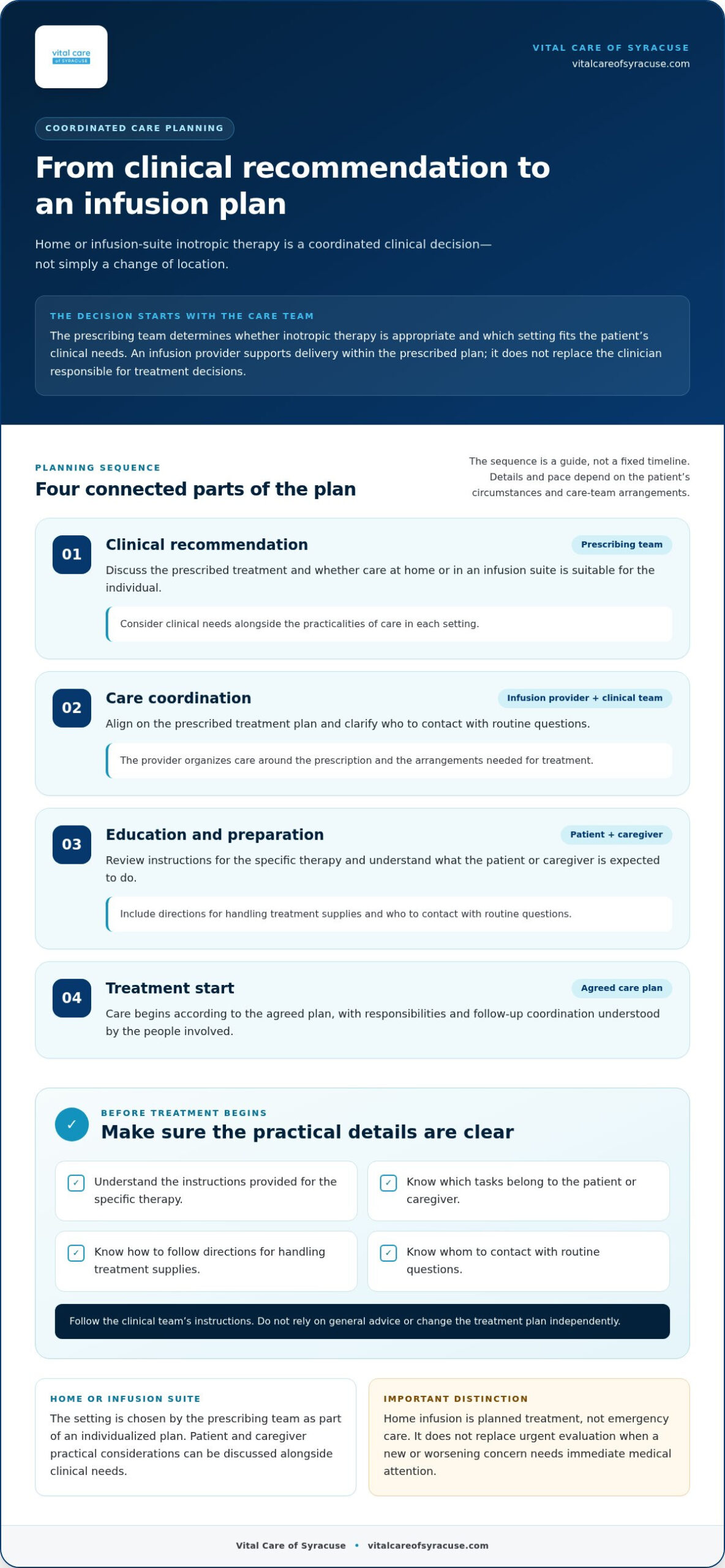
From clinical recommendation to an infusion plan
The treating clinician makes the medical decisions, including whether to prescribe therapy and which setting to recommend. The infusion provider then coordinates with the clinical team on the prescribed plan and the arrangements needed for care. The patient and caregiver can share practical considerations, such as whether home routines or a suite visit feels manageable, so these can be discussed alongside clinical needs.
Although each person’s path may differ, planning commonly involves these connected steps:
- Clinical recommendation: The prescribing team discusses the treatment and whether care at home or in an infusion suite is suitable for the individual.
- Care coordination: The infusion provider and clinical team align on the prescribed treatment plan and clarify who to contact with routine questions.
- Education and preparation: The patient and caregiver receive instructions relevant to the prescribed treatment and understand what they’re expected to do.
- Treatment start: Care begins according to the agreed plan, with responsibilities and follow-up coordination understood by the people involved.
This sequence is a guide, not a fixed timeline. The details and pace depend on the patient’s clinical circumstances and the arrangements made by their care team.
What patient and caregiver education should cover
Before treatment begins, patients and caregivers should understand the instructions provided for the specific therapy. Education should explain what tasks belong to the patient or caregiver, how to follow directions for handling treatment supplies, and whom to contact with routine questions. Follow the clinical team’s instructions rather than relying on general advice or changing the treatment plan independently.
Clear roles can help reduce uncertainty. The prescribing team directs medical decisions; the infusion provider coordinates care around the prescription; and the patient and caregiver follow the instructions they’ve been given and communicate concerns through the appropriate channels. Ask the care team to clarify anything that feels unclear before treatment starts.
Home-infusion planning is coordinated around the prescribed treatment plan, with the care setting and support shaped by clinical direction.
New or severe symptoms need prompt attention through appropriate medical channels. Routine treatment questions should go to the contact identified by the care team, while urgent concerns should be directed to appropriate urgent or emergency care. Home infusion isn’t emergency care, and the infusion provider doesn’t replace the prescribing clinician.
For Rochester patients and caregivers exploring this process, Vital Care of Syracuse provides inotropic therapy through home-based and suite-based infusion options within the prescribed plan. Learn about Rochester inotropic infusion care as one step in a discussion led by the patient’s clinical team. That shared planning helps keep the treatment setting, education, and responsibilities connected to the patient’s individual care needs.
Home infusion or another care setting? Compare the decision factors
Home infusion can be a helpful option for some patients, but it isn’t automatically appropriate for everyone receiving inotropic therapy. The prescribing team weighs the treatment plan and the patient’s needs before recommending a setting. A home, infusion suite, or hospital may each be considered; this comparison can help you prepare for that conversation, but it can’t determine which option is right for an individual.
Use the table as a starting point for questions, not as a scorecard. The level of clinical oversight and support depends on the prescribed plan and care arrangements.
| Factor | Home | Infusion suite | Hospital |
|---|---|---|---|
| Clinical oversight | Ask how the clinical team and infusion provider coordinate care and which contact handles routine questions. | Discuss what support is available during the planned infusion visit and how follow-up is coordinated. | Ask whether the patient’s treatment needs call for hospital-based assessment or care. |
| Treatment needs | Consider whether the prescribed plan can be carried out in a home setting as directed by the team. | Discuss whether receiving treatment in a designated suite better fits the plan or practical needs. | May be considered when the clinical team determines that hospital care is needed. |
| Home circumstances | Talk through the home environment, available caregiver support, and the responsibilities involved. | Consider travel to and from the suite and how visits fit the patient’s routine. | Discuss the practical implications of receiving care in a hospital setting. |
| Patient preference | Share whether receiving care at home feels comfortable and manageable. | Consider whether a suite setting feels like a better fit. | Raise concerns or preferences with the treating team while following its clinical recommendation. |
Which factors can shape the recommended infusion setting?
The prescribed therapy and the clinician’s assessment come first. The team can also discuss practical factors, such as whether the home environment is suitable for the planned care, what support is available, and whether travel to a suite is manageable. For example, a patient may prefer the familiarity of home while a caregiver has questions about their role. Those concerns belong in the planning discussion, alongside clinical needs.
For people researching home infusion for heart failure patients Rochester, the central question isn’t simply which location feels most convenient. It’s which setting aligns with the clinician-directed plan and can be supported in the patient’s circumstances.
How to understand the safety and oversight question
Receiving care at home doesn’t automatically make treatment safer or less safe than receiving it elsewhere. The care plan should make responsibilities clear, including who provides routine infusion support, whom to contact with treatment questions, and what steps to take if concerns arise. Ask the team to explain those instructions in language you and your caregiver understand.
Routine infusion support isn’t emergency assessment or treatment. If symptoms are new or severe, use the appropriate urgent or emergency medical channels rather than relying on the infusion arrangement. The prescribing team, not a comparison table or article, determines the appropriate setting and can revisit the plan if the patient’s needs change.
A Rochester patient’s checklist before starting heart-failure infusion care
Preparing for inotropic infusion care is easier when questions are written down and discussed with the prescribing team and infusion provider. This checklist can help patients and caregivers clarify the treatment plan, home arrangements, responsibilities, and follow-up before care begins. Bring it to a conversation with the people coordinating treatment, and ask them to explain anything that isn’t clear.
Questions to discuss with the prescribing clinical team
Start with the purpose of the prescribed therapy and how it fits the individual care plan. Then clarify how treatment questions and concerns will be handled. The answers should reflect the patient’s own instructions, not general assumptions about heart failure or infusion care.
- Treatment purpose: What is this therapy intended to do as part of my care plan?
- Symptoms and concerns: Which changes or treatment concerns should I report, and whom should I contact?
- Urgent situations: What should I do if symptoms are new or severe, and which appropriate urgent or emergency medical channel should I use?
- Follow-up: How will follow-up be arranged, and how will the prescribing team and infusion provider share relevant information?
- Care setting: What clinical needs support the recommended setting, and what might prompt the team to reassess the plan?
Practical details to plan with the care team
Once the clinical plan is clear, talk through the day-to-day arrangements. Home suitability and caregiver involvement are part of planning, not tests a patient must pass alone. Ask the care team to explain what the patient and caregiver are expected to handle, what the infusion provider coordinates, and which questions belong with the prescribing team.
- Home environment: What should we consider about the space where treatment will take place?
- Caregiver role: Is a caregiver involved, and what responsibilities or training should they expect under the prescribed plan?
- Instructions and supplies: Which treatment instructions should we follow, what supplies are part of the plan, and whom should we contact if something is unclear?
- Communication: Who is the point of contact for routine treatment questions, and how should concerns be shared across the care team?
- Coverage questions: Who can explain insurance authorization, benefits, and any plan-specific coverage details?
For additional context on how a local infusion provider can support coordinated care, explore the benefits of a local home infusion company. A prepared conversation can help Rochester patients understand whether home infusion for heart failure patients Rochester fits the clinician-directed plan and what support the next steps involve.
If you’re discussing prescribed inotropic therapy in Rochester, explore home-infusion support with Vital Care, including home-based and suite-based care coordinated around the treatment plan.
Explore home inotropic therapy with Vital Care in Rochester
For Rochester patients whose clinical team has prescribed inotropic therapy, planning infusion care involves more than choosing a location. It means understanding how treatment will fit into the prescribed plan, who is involved in coordinating care, and which questions need answers before moving forward. Vital Care of Syracuse is a locally owned and operated home-infusion provider serving Rochester, with inotropic therapy available through home-based and suite-based infusion options.
These options give patients and caregivers a way to discuss setting and practical needs with the care team. They don’t determine clinical suitability on their own. The prescribing clinician remains responsible for decisions about therapy and the recommended care setting, while the infusion provider supports delivery within that plan.
What Vital Care contributes to a coordinated infusion plan
Vital Care provides specialized infusion therapy and can coordinate with the patient’s clinical team around the prescribed plan. This creates a local point of connection for Rochester patients and caregivers as they work through care arrangements and questions about home-based or suite-based infusion. The provider’s role supports the plan; it doesn’t replace the patient’s cardiologist, prescribing clinician, or other members of the clinical team.
That distinction matters. A conversation about home infusion for heart failure patients Rochester should begin with the treating clinician’s recommendation, then include practical planning with the infusion provider. Patients and caregivers can share their preferences and concerns, such as whether home treatment feels manageable or a suite setting may better suit their circumstances. The care team can consider those details alongside the prescribed therapy and the patient’s needs.
As you prepare to talk with the teams involved, it may help to keep a short list of items to clarify:
- Which setting is recommended as part of the prescribed plan, and why?
- Who should the patient or caregiver contact with routine treatment questions?
- What instructions and responsibilities should be understood before treatment begins?
- How will the infusion provider and prescribing team coordinate care?
Clear answers can help patients and caregivers feel more prepared to take part in planning. They also help keep expectations grounded: inotropic infusion is specialized care guided by the prescriber, and home-based or suite-based treatment isn’t appropriate for every person or every situation. If urgent or severe symptoms arise, seek appropriate urgent or emergency medical care rather than relying on an infusion provider for emergency response.
A clear next step for patients and caregivers
If inotropic therapy is being considered or has been prescribed, start by discussing the treatment and care setting with the patient’s clinical team. Once there is a clinical direction, Vital Care can be part of the conversation about local infusion support in Rochester. Treatment decisions remain individualized, and the prescribing team continues to guide the medical plan.
For a calm next step, connect with Vital Care to discuss its Rochester-area inotropic infusion services alongside the prescribing team. Patients and caregivers can bring their questions and consider how home-based or suite-based care may fit the clinician-directed plan.
Take the next step with a clear care-team conversation
Choosing whether to explore home infusion begins with an open conversation, not a commitment to a particular setting. Bring your questions to the prescribing clinician and share what matters most to you and your caregiver, including comfort, daily routines, and the support you may need. That discussion can help clarify whether home infusion for heart failure patients Rochester fits the individual treatment plan and what questions remain before care arrangements move forward.
Vital Care of Syracuse is a locally owned and operated provider within the Vital Care, Inc. network. Its inotropic therapy and home-based or suite-based infusion options can be part of a coordinated plan when directed by the prescribing team. Care decisions remain personal and clinical, and your clinician should guide whether this treatment and setting are appropriate.
If you’re ready to learn more about local infusion support, connect with Vital Care to discuss home infusion in Rochester alongside your care-team conversations. One thoughtful next step can help you move forward with greater clarity and confidence.
Frequently Asked Questions
Can heart failure patients receive inotropic therapy at home?
Some patients may receive prescribed inotropic therapy at home if their treating clinician considers it appropriate. It isn’t a routine option for everyone with heart failure, and an online article can’t assess an individual’s suitability. If you’re exploring home infusion for heart failure patients Rochester, ask the clinical team what factors shape its recommendation and whether a home or suite setting fits the specific treatment plan.
Is home infusion a replacement for hospital care for heart failure?
No. Home infusion is a setting for a prescribed treatment, not a substitute for hospital assessment or treatment when those are needed. A scheduled infusion plan doesn’t cover unexpected medical emergencies. If symptoms are new, severe, or rapidly worsening, seek prompt medical attention and follow the urgent-care instructions provided by the patient’s clinical team. Ask in advance which channel to use for urgent concerns.
How does home inotropic infusion work?
The treating clinician prescribes the therapy and coordinates the plan with the infusion provider. The patient and caregiver then follow instructions specific to that prescription, while the provider supports infusion delivery and care coordination. For example, before treatment starts, ask where the written instructions can be found and whom to call if they’re unclear. The exact process depends on the treatment and the patient’s clinical needs.
Who decides whether a heart failure patient can receive infusion care at home?
The treating clinician decides based on the patient’s medical needs and prescribed plan. A patient or caregiver can help by sharing practical details, such as whether someone can assist at home or whether the environment presents concerns. Vital Care of Syracuse serves communities including Syracuse, Albany, Rochester, Utica, Buffalo, Auburn, and Binghampton. A general checklist can prepare questions, but it can’t determine individual eligibility.
What should caregivers ask before home infusion begins?
Caregivers can ask what the therapy is intended to do in this patient’s plan, which written instructions to follow, and what responsibilities are expected of them. It’s also useful to clarify whom to contact with routine questions and what to do if the patient’s condition changes. For instance, keep the care team’s contact guidance with the treatment instructions so it’s easy to find when needed.
Does insurance cover home infusion for heart failure?
Coverage depends on the patient’s plan, prescribed treatment, and any authorization requirements. Before treatment begins, contact the insurer and care team to clarify whether authorization is needed, what services the plan considers, and how coverage decisions are communicated. Don’t assume that a particular medication or setting is covered based on another person’s experience. Keep notes about whom you spoke with and any next steps they provide.
Leave a Reply