



What if your IVIG schedule could be planned around your clinical needs and day-to-day life? If you’re searching for “IVIG treatment schedule at home Albany,” you likely want clear answers about how often infusions happen, how much time to set aside, and whether home care fits your needs.
There isn’t one schedule for everyone. Your prescribing clinician sets the plan based on your condition and response to treatment. The care team then follows those orders when arranging infusion care. This article explains what may shape an individualized schedule and what to expect before, during, and after an infusion.
Vital Care of Syracuse provides IVIG and SCIG infusion services, including home and suite-based care for patients in Albany. Understanding how the schedule and setting fit together can help you prepare questions for your care team.
Key Takeaways
- Your IVIG treatment schedule at home Albany is based on your prescriber’s plan, not a one-size-fits-all timetable.
- Treatment response and tolerability are among the clinical considerations that may inform schedule planning.
- Comparing home and suite-based care can help you understand how each setting may shape your treatment-day routine.
- A practical checklist can help you organize your space, confirm timing, and prepare questions for your care team.
- Vital Care of Syracuse provides IVIG and SCIG infusion care in home and suite-based settings for Albany patients.
What an IVIG treatment schedule at home in Albany can involve
It’s understandable to have questions about how often IVIG infusions happen and how much time to set aside. Your prescriber determines the treatment plan according to your clinical needs. The care team follows those orders when arranging infusion-day details. When researching an IVIG treatment schedule at home in Albany, separate the prescribed timing from the practical arrangements for receiving care at home.
IVIG is given intravenously, through a vein. Subcutaneous immunoglobulin (SCIG) is administered under the skin. These are distinct forms of immunoglobulin therapy, so their schedules and administration plans aren’t interchangeable. This overview of intravenous immunoglobulin (IVIG) therapy provides general background on IVIG.
The following Johns Hopkins Medicine video is in Spanish and demonstrates an IV push device. It is general educational material, not IVIG-specific instructions. Follow the directions provided for your own prescribed treatment.
What does an at-home IVIG schedule mean?
An at-home schedule has several parts. Knowing what each one refers to can make planning more manageable:
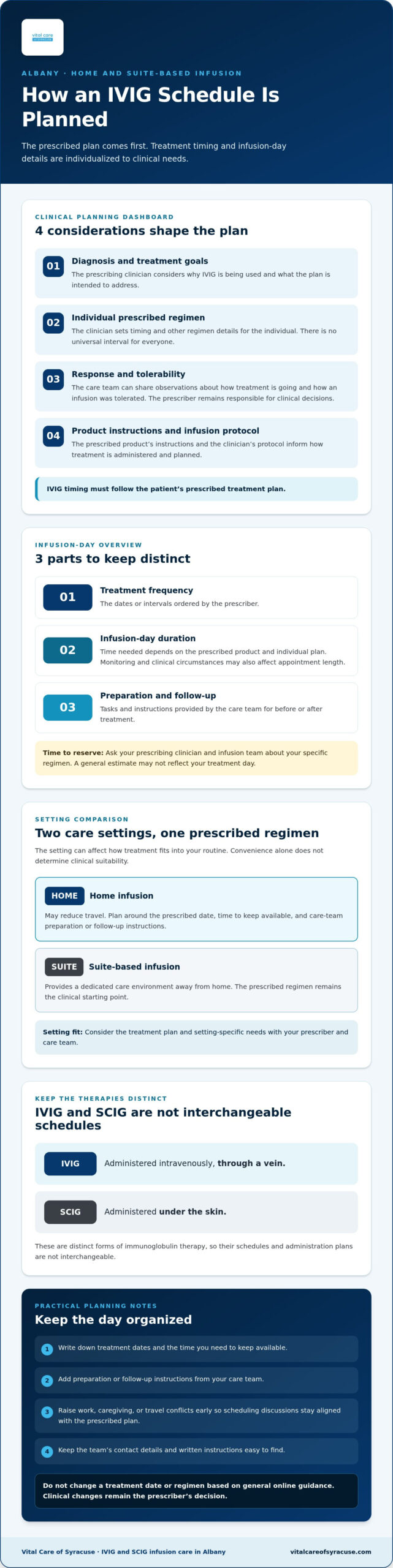
- Treatment frequency: The dates or intervals ordered by your prescriber.
- Infusion-day duration: The time needed for the infusion, based on the prescribed product and your individual plan.
- Preparation and follow-up: Tasks or instructions your care team has provided for before or after treatment.
The prescribed product, condition being treated, and individual care plan influence these details. The infusion team follows the prescriber’s orders and does not independently set or change the regimen.
How home infusion fits Albany-area care
Home infusion is one setting for receiving prescribed IVIG; suite-based infusion is another. Vital Care of Syracuse provides IVIG and SCIG infusion care in both home and suite-based settings for patients in Albany. Clinical considerations, as well as convenience, inform which setting is appropriate.
For practical planning, write down your treatment dates and the time you need to keep available. Add any preparation or follow-up instructions from your care team. If work, caregiving, or travel could affect a planned date, raise the issue early so scheduling discussions stay aligned with your prescribed plan. Keep the team’s contact details and written instructions somewhere easy to find. This helps clarify treatment-day expectations without relying on a general online schedule for individual guidance.
How clinicians determine IVIG frequency and infusion-day timing
For people searching “IVIG treatment schedule at home Albany,” the key point is that the prescriber, not a general timetable, determines the treatment plan. Diagnosis and treatment goals help guide that decision. The care team supports treatment according to the prescriber’s orders. IVIG timing must follow the patient’s prescribed treatment plan.
Schedule planning is a clinical process, not simply a choice of convenient dates. It may involve these considerations:
- Review the diagnosis and treatment goals. The prescribing clinician considers why IVIG is being used and what the plan is intended to address.
- Set the prescribed regimen. The clinician determines the timing and other regimen details for the individual patient. There is no universal interval that applies to everyone.
- Review response and tolerability. The care team observes how treatment is going and shares relevant information with the prescriber, who remains responsible for clinical decisions.
- Apply product instructions. The prescribed product’s instructions and the clinician’s infusion protocol inform how treatment is administered and planned.
Which clinical factors can affect IVIG timing?
The diagnosis and treatment goals inform the prescriber’s plan. The patient’s clinical response and experience with treatment can also be reviewed over time. The care team may share observations about how an infusion was tolerated so the prescriber can consider them alongside other relevant clinical information. These decisions are individualized: one person’s schedule isn’t a recommendation for someone else. Don’t change a treatment date or regimen based on general online guidance.
Why infusion-day duration can vary
The time reserved for an infusion depends on the prescribed plan, product instructions, and infusion protocol. Monitoring during the visit and individual clinical circumstances may also affect the appointment length. A general estimate may not reflect your treatment day. If you’re planning around work, family responsibilities, or transportation, ask your prescribing clinician and infusion team how much time to reserve for your specific regimen, and follow their instructions.
Keep your current written treatment plan accessible and note questions about timing, infusion-day expectations, or what to do if a scheduled date becomes difficult. The team can clarify practical steps within the prescribed plan; clinical changes remain the prescriber’s decision. Albany patients can learn about Vital Care of Syracuse’s home IVIG and SCIG infusion services.
Home IVIG or an infusion suite in Albany: comparing the schedule
The prescribed IVIG regimen is the clinical starting point, but the setting can affect how treatment fits into your routine. Home treatment may reduce travel, while a suite provides a dedicated care environment away from home. Neither option is right for every patient, and convenience alone doesn’t determine clinical suitability. Your prescriber and care team can help consider your treatment plan and setting-specific needs.
| Planning factor | Home infusion | Infusion suite |
|---|---|---|
| Routine | May reduce travel and let you plan around familiar household routines. | Requires travel to the suite, so the visit and journey both factor into the day. |
| Environment | Treatment takes place in a home setting, with space prepared for the visit. | Treatment takes place in a designated infusion setting, separate from home. |
| Coordination | The visit is arranged around the prescribed plan and the home-care process. | The visit is arranged around the prescribed plan and the suite’s care setting. |
Care-team oversight is relevant in either setting, but the people involved and practical arrangements may differ. Don’t assume monitoring or coordination will be identical. Discuss what applies to your plan with your clinician and infusion team. Vital Care of Syracuse provides home-based and suite-based infusion care, including IVIG and SCIG, for Albany patients. This is part of its regional infusion care, which also serves Syracuse, Rochester, Utica, Buffalo, Auburn, and Binghampton.
When might home infusion suit a patient’s routine?
Receiving treatment at home may reduce the need to travel to an infusion location. That can make it easier to plan around household routines, work responsibilities, or caregiver support, though the visit still requires time and preparation. Consider who can be present, where treatment would take place, and what support is practical. A clinical assessment and the prescribed plan, not convenience alone, guide whether home infusion is appropriate.
What can an infusion suite offer?
A suite is another setting that may be considered as part of an individualized care plan. It provides a dedicated treatment environment outside the home, which some patients may prefer for practical or personal reasons. Neither setting is automatically the better choice. Ask your clinician and infusion team how the arrangements for each setting align with your care needs, treatment plan, and daily circumstances.
As you compare an IVIG treatment schedule at home in Albany with a suite-based routine, consider the full treatment day: travel, preparation, household needs, and available support. Vital Care of Syracuse provides home and suite-based IVIG care for Albany patients to discuss in relation to their prescribed plan.
How to prepare for a scheduled home IVIG infusion in Albany
Preparing ahead can make a home infusion day feel more predictable. For an IVIG treatment schedule at home in Albany, follow the instructions for your prescribed treatment, not general online advice. Your care team can explain what applies to your plan, what to expect during the visit, and whom to contact with questions.
Before infusion day
Review the care team’s instructions and appointment details before the visit. Write down anything unclear so you can ask about it rather than using a general checklist to make clinical decisions. A clean, comfortable area with enough room for the infusion visit can also help you feel settled.
Use this checklist to organize practical details and questions:
- Review the appointment information. Keep the scheduled date and care-team instructions easy to access. If anything seems inconsistent or unclear, ask the team to clarify it.
- Prepare the space. Choose a clean, comfortable area where the infusion can take place, with enough room for the planned visit.
- Keep contact details nearby. Have the relevant care-team contact information and written instructions accessible during the appointment.
- Share health or medication changes. Tell the care team about changes since your last infusion, including medication changes, so they can provide guidance for your treatment plan.
- Record questions and concerns. Note questions about timing, how the visit is expected to proceed, or concerns after a previous infusion. Bring your notes to the conversation with the clinical team.
Preparation advice can vary with the prescribed product and individual care plan. Don’t add steps or change medications based on generic online suggestions. Your personalized instructions are the reference point.
During and after the infusion
During the visit, the clinical team follows the prescribed protocol and provides monitoring as appropriate to the plan. Tell the team about concerns or changes you notice during the infusion rather than waiting until the appointment has ended. The team can respond according to the instructions and care procedures for your treatment.
Afterward, follow the care team’s guidance for any follow-up or observations. If you have a question later, use the contact information they provided and describe what you noticed, when it occurred, and what you’d like to ask. This record can help you communicate clearly with the team. Don’t rely on online instructions to manage a possible treatment reaction; follow the guidance provided by your clinicians.
Preparation can help organize treatment day, while your clinical team remains the source of individualized direction. Learn about Vital Care’s home-infusion support for IVIG in Albany, including its home-based and suite-based infusion care.
How Vital Care supports home IVIG scheduling for Albany patients
Planning treatment at home involves more than selecting a date. The schedule must reflect the prescriber’s orders, and practical expectations help patients fit care into everyday life. Vital Care of Syracuse provides IVIG and SCIG infusion care in home and suite-based settings for patients in Albany. The prescribing clinician remains responsible for the regimen and clinical decisions.
For patients considering an IVIG treatment schedule at home in Albany, coordination supports the prescribed plan; it doesn’t create or change it. Clear information about what to expect can help you plan around work, family responsibilities, and other commitments. Arrangements will differ from patient to patient.
What personalized coordination should help clarify
Before treatment, it helps to understand how the planned visit relates to your prescribed regimen. These practical questions can clarify expectations while leaving clinical decisions with the prescriber and care team:
- Which treatment date and timing are part of my current prescribed plan?
- What should I have ready for the infusion visit?
- Who should I contact if I have a question about the visit or my instructions?
- What information should I share if my health or medication situation changes?
These questions support planning; they don’t replace individualized instructions or authorize treatment changes. Keep the answers with your written care information so you can refer to them when arranging household routines or other responsibilities around an infusion.
Taking the next step with confidence
If you’re considering home infusion, discuss its suitability with the clinician who prescribes your IVIG. They can evaluate clinical considerations and determine your treatment plan. You can also talk with the infusion team about practical aspects of home or suite-based care, including what to expect in the setting that fits your prescribed plan. Vital Care serves Albany with home and suite-based infusion care that includes IVIG and SCIG.
Knowing each person’s role can make planning clearer: the prescriber guides clinical decisions, and infusion care is organized around those instructions. Keep a short list of questions about your routine, treatment-day expectations, and care setting to make conversations focused and useful. Your plan should reflect your clinical needs, not a standard timetable.
Explore home infusion support with Vital Care to learn more about the care process for prescribed IVIG and SCIG in Albany.
Take the next step toward a workable care plan
Planning treatment is also an opportunity to consider what would help you feel prepared and supported. Before speaking with your prescribing clinician, think about the parts of infusion day that matter most to you: fitting treatment around responsibilities, feeling comfortable in the care setting, or knowing how to raise questions. These priorities can guide a practical discussion about whether home infusion suits your individual needs.
If you’re considering an IVIG treatment schedule at home in Albany, keep your clinician’s treatment plan at the center of the conversation. Vital Care of Syracuse provides IVIG and SCIG infusion care in home and suite-based settings for patients in Albany. Learning how the care process works can help you take the next step with greater clarity.
Explore home IVIG support with Vital Care and learn about infusion care options. With thoughtful planning and guidance from your care team, you can feel more prepared for the questions ahead.
Frequently Asked Questions
How often is IVIG given at home?
Your prescribing clinician sets IVIG frequency based on your diagnosis, treatment goals, and individual response. There isn’t a schedule that applies to every patient. If you’re searching “IVIG treatment schedule at home Albany,” use general information as background, not as a regimen to follow. Ask your clinician to explain your next planned treatment date and how you’ll be informed if your prescribed schedule changes.
How long does a home IVIG infusion take?
The infusion and the full visit can take different amounts of time for different patients. The prescribed product, infusion protocol, and individual clinical circumstances all influence timing, so another patient’s experience may not predict yours. Before arranging your day, ask the infusion team how much time to reserve, whether the visit includes steps before or after the infusion, and when you can resume your usual plans.
Can IVIG be given at home in Albany?
Yes. Vital Care of Syracuse provides home-based IVIG infusion care for patients in Albany. Home infusion is one possible setting, but your prescribing clinician determines whether it fits your treatment plan. Vital Care also serves Syracuse, Rochester, Utica, Buffalo, Auburn, and Binghampton. Location alone doesn’t determine clinical suitability; your care needs and prescribed plan remain central to that decision.
What should I do if I need to reschedule an IVIG infusion?
If you need to change an appointment, contact your infusion team as soon as you can and explain the scheduling conflict. Don’t skip, delay, or move a prescribed treatment date on your own. The team can help address appointment logistics, while any clinical decision about timing belongs to your prescriber. If the reason involves a health or medication change, share that information with the care team so they can advise you appropriately.
Is home IVIG as closely monitored as an infusion suite?
Monitoring arrangements depend on your prescribed protocol and care setting, so don’t assume they’re identical. The clinical team follows the plan and monitors as appropriate during home or suite-based care. Ask who will be involved during your infusion, what monitoring is part of your specific visit, and whom to tell if something concerns you. Your clinician can help determine which setting aligns with your clinical needs.
Can I work or travel on the day of a home IVIG infusion?
Whether work or travel is practical depends on the expected visit length, how you feel, and your care team’s guidance. Avoid scheduling important commitments too close to the infusion until you know what your treatment day involves. Mention work, caregiving, or travel constraints when discussing appointment planning. Follow your personalized instructions about activities, and ask the team before making plans that could interfere with treatment or follow-up.
What should I ask before starting home IVIG?
Ask your prescribing clinician why IVIG is part of your plan, what schedule they’ve prescribed, and how they’ll review your response. Clarify what the home visit involves, what information to share if your health or medications change, and whom to contact with appointment questions. You can also ask what would make a suite setting preferable for your circumstances. Writing down the answers can make them easier to refer to later.
Leave a Reply