


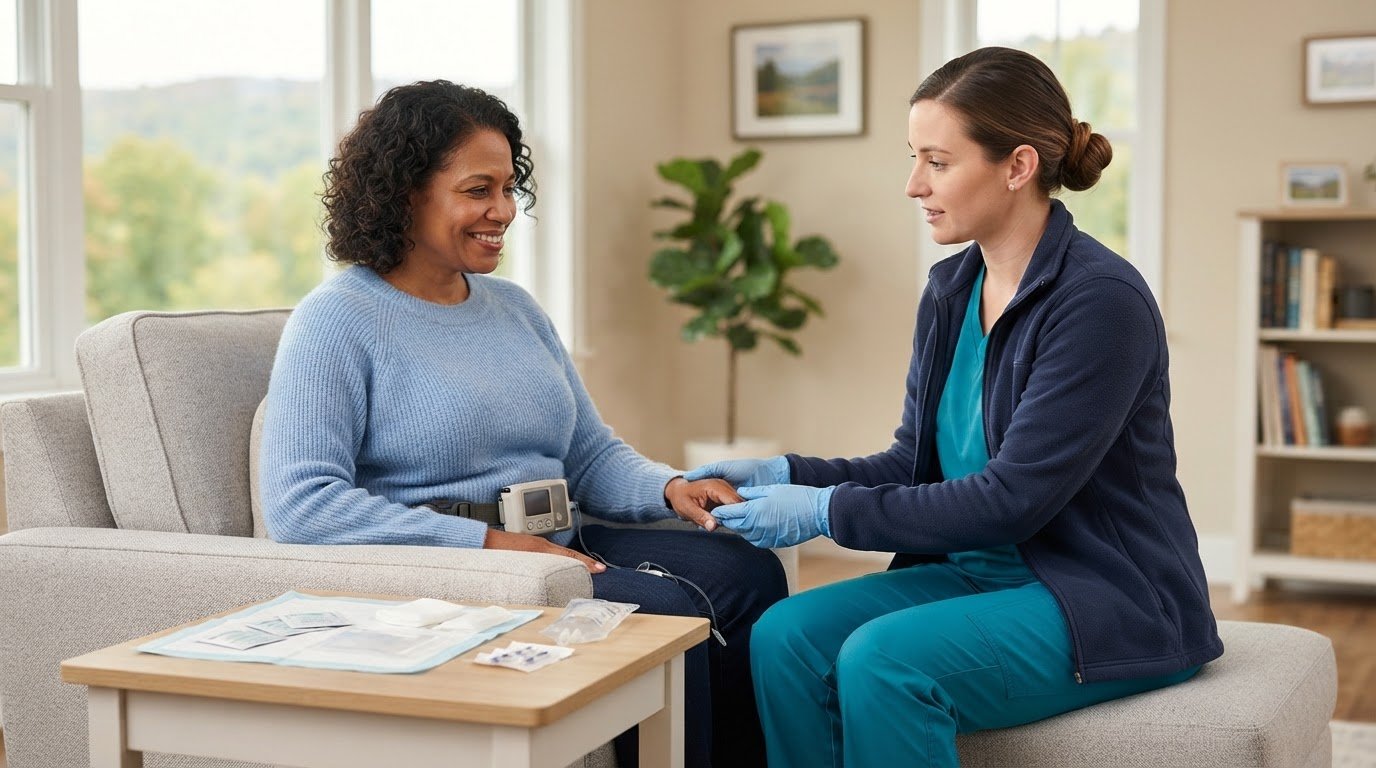
If you’re considering SCIG home infusion Binghamton NY, you may have questions about how treatment works, what support is involved, and how it differs from IVIG. SCIG is administered into the tissue beneath the skin, while IVIG is given into a vein. Your prescribing clinician can explain which approach fits your individual treatment plan.
This guide covers practical questions to discuss before starting, including administration, education, coverage, and the roles of your care team. Knowing what to ask can help you understand the process and take an active role in decisions about your care.
Vital Care of Syracuse provides home-based and suite-based infusion services, including SCIG, for patients in the Binghamton area. The team supports prescribed care alongside your prescribing clinician. The sections below explain the route of administration, care coordination, and ways to prepare for infusion support.
Key Takeaways
- Understand how SCIG is administered and how its route differs from IVIG. Your individual prescription guides your care.
- Learn how your prescribing clinician, referral coordination, and infusion support can contribute to a coordinated care plan.
- Prepare practical questions about instructions, support, coverage, and who to contact.
- Vital Care of Syracuse provides home-based and suite-based immunoglobulin services, including SCIG, for patients in the Binghamton area.
- Clinical support can help clarify the steps involved in home infusion without replacing guidance from your prescribing clinician.
SCIG Home Infusion in Binghamton, NY: What the Treatment Involves
New infusion terminology can make a treatment plan feel complicated, especially when you’re also working out where and how care will take place. The basic distinction is simple: SCIG is immunoglobulin therapy administered into the tissue beneath the skin, rather than directly into a vein. The medication and instructions are based on an individual prescription.
SCIG isn’t one identical routine for every patient. Your prescription and care needs guide how treatment is arranged. The prescribing clinician determines whether SCIG is appropriate and directs your therapy. An infusion provider supports delivery of the prescribed plan, but does not replace the clinician managing your treatment.
How is SCIG different from IVIG?
The main difference is the route: SCIG is administered under the skin, while IVIG is infused into a vein. Both are prescribed immunoglobulin therapies, but neither is universally better for every person. Your clinician considers your medical needs, treatment history, and circumstances when discussing which approach may fit. Ask how the route affects your care plan and what practical steps it involves.
Consider more than the name of the therapy. The route can affect where treatment takes place and what instructions or support are needed, but those details depend on your prescription. If you’ve received IVIG before, tell your clinician what worked well and what was difficult. If this is your first immunoglobulin treatment, ask the care team to explain unfamiliar terms and clarify who to contact with questions.
What does home infusion mean for Binghamton patients?
Home infusion means receiving prescribed infusion care in a home setting. It can provide an alternative to making each visit to a hospital, while keeping your prescription and care-team guidance central. Home treatment doesn’t mean you have to work everything out alone. The arrangements should reflect your care plan and the support identified for your situation.
Before treatment, clarify where administration will take place, which instructions apply, and how your care team will coordinate the plan. Ask who will explain the instructions and where to direct questions. The method, supplies, and support can differ between patients, so follow the guidance provided for your individual prescription.
For people exploring SCIG home infusion Binghamton NY, Vital Care of Syracuse provides home-based and suite-based infusion services, including SCIG, for patients in the Binghamton area. Its clinical support complements the direction of your prescribing clinician. Understanding the treatment is a useful first step; next, discuss how the prescribed plan will be coordinated around your needs.
How SCIG Home Infusion Care Is Coordinated for Binghamton Patients
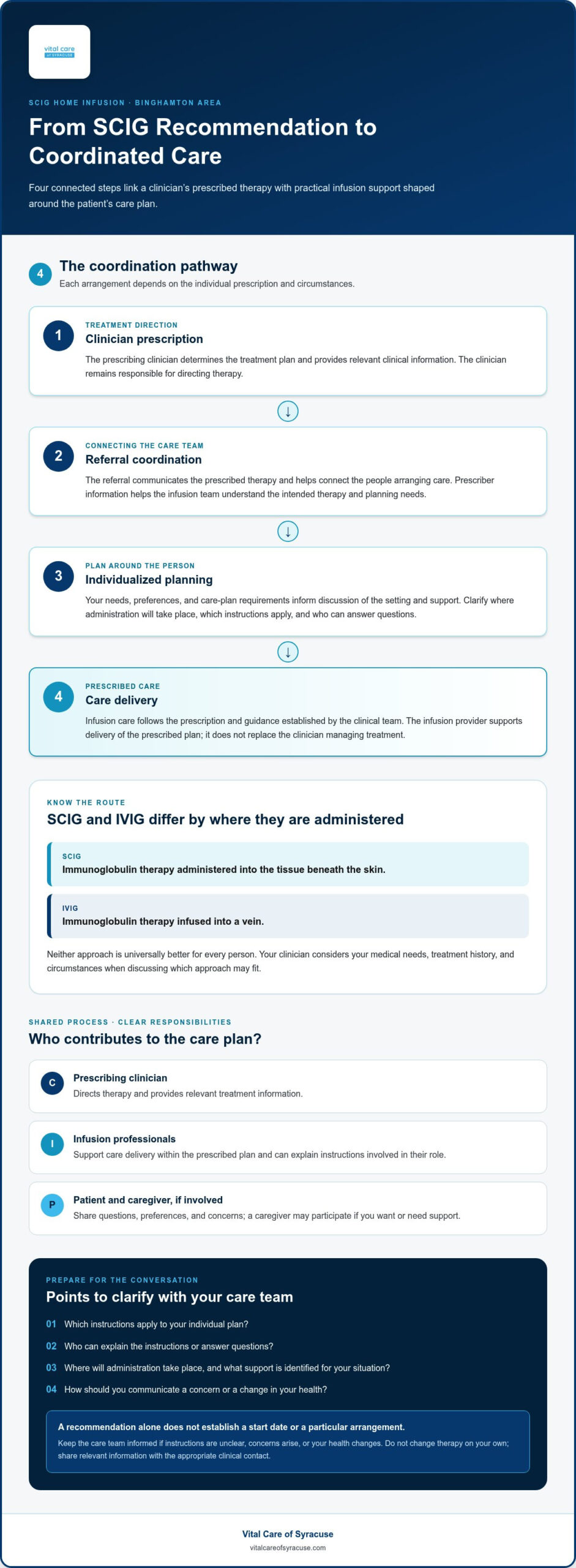
A recommendation for SCIG starts a coordination process. It doesn’t mean every treatment detail is already settled. The prescribing clinician directs therapy and shares relevant information to guide planning. The patient, prescriber, and infusion team then work through the steps needed to connect the prescription with an appropriate care arrangement:
- Clinician prescription: The prescribing clinician determines the treatment plan and provides relevant clinical information.
- Referral coordination: The referral communicates the prescribed therapy and helps connect the people arranging care.
- Individualized planning: Your needs, preferences, and care-plan requirements inform discussion of the setting and support.
- Care delivery: Infusion care follows the prescription and guidance established by the clinical team.
Coordinated home infusion connects a clinician’s prescribed therapy with practical support shaped around the patient’s care plan. The steps provide a shared framework, while specific arrangements depend on your prescription and circumstances. SCIG home infusion Binghamton NY patients receive is a collaborative process, with the prescribing clinician responsible for directing therapy.
What happens after a clinician recommends SCIG?
The referral and treatment plan guide the next coordination steps. Information from the prescriber helps the infusion team understand the intended therapy and what needs to be considered when planning care. You can make these conversations more useful by raising questions early, sharing preferences, and describing practical concerns, such as what support would help you feel prepared. A recommendation alone doesn’t establish a start date or a particular arrangement.
Write down questions before speaking with your care team. Ask which instructions apply to your plan, who can clarify them, and how to communicate a concern or a change in your health. For general background on the two immunoglobulin approaches, the American College of Rheumatology’s overview of IVIG and SCIG can help you prepare for a discussion with your clinician.
Who may be involved in the care plan?
Your prescribing clinician directs therapy and provides relevant treatment information. Infusion professionals support care delivery within the prescribed plan and can explain the instructions involved in their role. You can share questions, preferences, and concerns; a caregiver may also participate if you want or need their support. Clear communication helps everyone understand their responsibilities while keeping clinical decisions with the prescriber.
Keep the care team informed if instructions are unclear, concerns arise, or your health changes. Don’t change the therapy on your own. Share relevant information with the appropriate clinical contact so the professionals directing your care can address it. Learn about Vital Care of Syracuse’s infusion care and how infusion support fits alongside prescribed treatment.
Home SCIG vs. IVIG: Questions About Suitability, Safety, and Support
Choosing between home SCIG and IVIG isn’t simply a decision about where treatment takes place. Home treatment follows a prescribed plan and does not remove clinical oversight. Your prescribing clinician continues to direct therapy, while the infusion team supports care according to the plan. Suitability depends on clinical assessment, treatment needs, and individual circumstances. Use a comparison to prepare for a conversation, not to decide which option is right for you.
SCIG-versus-IVIG decisions are individualized clinical decisions, based on a person’s medical needs and circumstances. Neither route is universally superior. Ask your clinician why a particular approach is being considered and how its setting and requirements fit your care.
| Topic | SCIG | IVIG |
|---|---|---|
| Route | Immunoglobulin is administered under the skin. | Immunoglobulin is administered into a vein. |
| Setting to discuss | Home or another care setting may be considered as part of the prescribed plan. | The clinician can explain the appropriate setting for the individual plan. |
| Key discussion | Ask what instructions, education, and support your plan involves. | Ask how the route and setting relate to your treatment needs and history. |
Is home SCIG manageable for patients and caregivers?
Manageability depends on the person, the prescribed plan, and the support available. Discuss your comfort with the proposed arrangements, what education you need, and whether caregiver involvement would help. Ask the infusion team to explain your instructions in practical terms. If something feels difficult or unclear, raise it early rather than changing or pausing treatment on your own.
For example, ask who will explain the steps in your plan, whom to contact if an instruction is unclear, and how a caregiver can participate. These are planning questions, not signs that you must manage therapy without guidance. Care arrangements should follow your prescription and the directions provided by your care team.
What safety questions should patients raise?
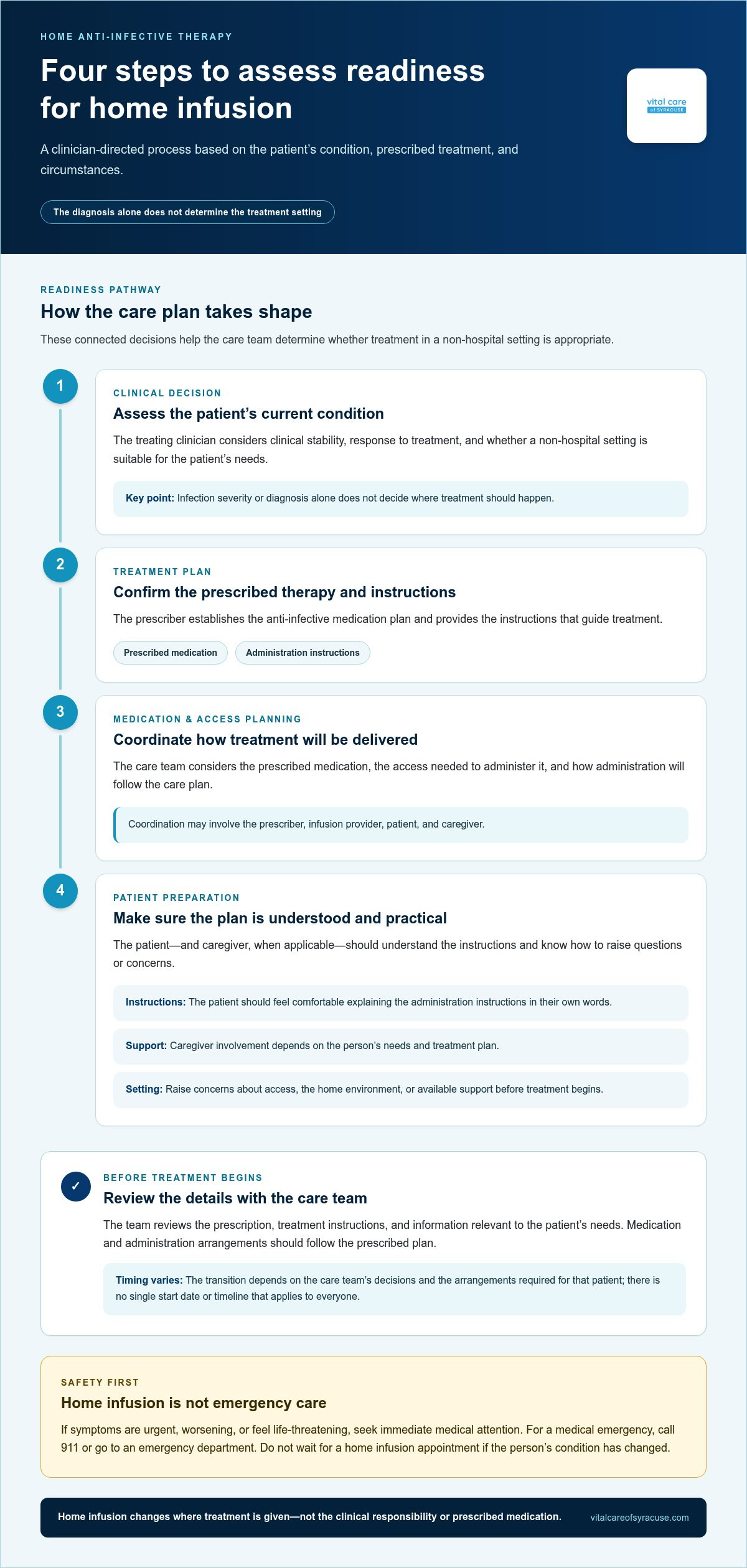
Before treatment, make sure you understand the instructions for your therapy and know whom to contact with non-emergency treatment questions or concerns. Ask how to report a change in your health and what information the team needs. If symptoms feel urgent or concerning, seek appropriate medical attention. For an emergency, contact emergency services. An infusion provider is not an emergency-care service.
Keep your care-team contact information and written instructions somewhere easy to find, and note questions as they arise. If you’re considering SCIG home infusion Binghamton NY, discuss your preferences, concerns, and support needs with the professionals involved in your care. Clear answers can help you understand the plan while leaving treatment decisions with your prescribing clinician.
Preparing for SCIG Home Infusion in Binghamton, NY
Preparing for treatment doesn’t mean you need to anticipate every detail alone. A clear conversation with your prescribing clinician and infusion team can help you understand the plan, know where to direct questions, and feel organized before care takes place. Follow the infusion team’s guidance and your individual treatment requirements rather than relying on a generic home setup checklist.
Keep current medication information and your clinician’s instructions accessible during care coordination. Having the same details on hand can make conversations with your care team more focused. For broader context about local services and regional care, Vital Care of Syracuse’s guide to local home infusion in Central New York offers additional perspective.
What should patients discuss before treatment begins?
Use this checklist to guide the conversation. Your questions can help the team address both the clinical instructions and the practical details that will make the plan easier to understand:
- Plan and instructions: How will the prescribed plan be explained, and who can answer treatment questions?
- Support: Can a caregiver be involved, and what role would be helpful?
- Home setting: Are there practical concerns about the space or arrangements to discuss with the infusion team?
- Communication: How should you share a concern, ask about an instruction, or report a change in your health?
Bring up concerns early, even if they seem minor. If you’re unsure how treatment will fit into your household routine or want a family member to understand the instructions, say so. The care team can discuss these needs in relation to your prescribed plan. Don’t adjust the therapy or its instructions on your own; direct questions to the appropriate clinical contact.
How can patients organize for a home infusion visit?
Follow the infusion team’s directions about the home environment and preparation for your care. Don’t make assumptions about equipment or supplies; use the instructions provided for your treatment. Before the visit, gather your current medication information and clinician’s instructions in one accessible place, and write down questions you want to cover. If a caregiver will participate, review relevant instructions together.
Some readers may also be exploring infusion care in relation to a neurological diagnosis. Vital Care of Syracuse’s information about home infusion for neurological disorders covers that separate topic; it doesn’t mean SCIG is appropriate for every neurological condition. Your clinician determines whether a therapy fits your individual medical needs.
For patients considering SCIG home infusion Binghamton NY, preparation means having clear instructions, relevant information, and a way to communicate with the care team. Explore Vital Care of Syracuse’s home infusion support and discuss how the prescribed plan can be coordinated locally.
Vital Care of Syracuse SCIG Home Infusion Support in Binghamton
Understanding SCIG is one part of planning care. Knowing how local infusion support fits can make the next conversation more concrete. Vital Care of Syracuse provides immunoglobulin services, including SCIG, through home-based and suite-based infusion care for patients in the Binghamton area. The team provides local infusion support alongside the treatment plan directed by your prescribing clinician.
What patients can expect from a personalized infusion approach
Care is organized around the prescribed therapy and individual patient needs. Vital Care of Syracuse brings clinical expertise to home infusion support, with care shaped around the treatment plan rather than a one-size-fits-all assumption. Your prescribing clinician remains responsible for directing therapy, while infusion support helps connect the plan with the care setting. Specific arrangements follow your prescription and care requirements.
Patients and caregivers can ask how the plan will be coordinated, which instructions apply, and how to communicate with the professionals involved. A personalized approach makes room for those questions as care is arranged. It does not promise a particular clinical outcome, coverage decision, or treatment timeline. Instead, the focus is on clarifying the process and each person’s role.
For Binghamton-area patients considering SCIG home infusion Binghamton NY, Vital Care of Syracuse’s home-based and suite-based options provide local support for prescribed immunoglobulin care. The infusion team complements, rather than replaces, the clinician managing the therapy. Knowing who directs treatment and who supports infusion care helps you take questions to the right person.
How to take the next step in Binghamton
Start with the clinician who prescribed or recommended immunoglobulin therapy. Discuss whether SCIG is appropriate for your circumstances, then ask how a referral and coordination with an infusion provider fit into the plan. If you’re a caregiver, you can help the patient prepare questions and take part in conversations with their permission. The care team can clarify instructions, responsibilities, and information needed for coordination.
Patients and caregivers can also connect with Vital Care of Syracuse to discuss home infusion support and care coordination in the Binghamton area. Bring your current treatment information and questions to make the conversation more focused. You don’t need every detail figured out before asking for guidance. Take the next step at a pace that gives you time to understand the plan and raise concerns.
Take Your Next Step With Confidence
Considering SCIG home infusion Binghamton NY can bring up practical questions, and you don’t need to resolve them all at once. Write down what would help you feel informed, then discuss it with your prescribing clinician. Ask how your treatment plan will be explained, what support fits your circumstances, and how the care team will stay connected as arrangements take shape.
Start a conversation about SCIG infusion care and bring the questions that matter to you. Clear answers can make the next steps easier to understand. Take the process one step at a time, with your care team as a partner.
Frequently Asked Questions
Is SCIG administered at home?
SCIG can be administered at home when home care is part of the prescribed plan. The specific arrangement depends on your clinician’s instructions and the support planned for you. Before beginning, clarify whether your plan includes administration at home or another setting, and what guidance applies to your therapy. Vital Care of Syracuse offers home-based and suite-based infusion services as care-setting options.
Who may be a candidate for SCIG home infusion?
Your prescribing clinician determines whether SCIG is appropriate for you. The decision depends on your medical circumstances and treatment needs, not simply a preference for home care. If SCIG has been raised as an option, ask how it relates to your diagnosis and treatment history. Share relevant health information and concerns so the recommendation can be considered in the context of your overall care.
How often is SCIG given?
The prescribed schedule varies, so follow your clinician’s instructions. Don’t use another patient’s routine or general online examples to set your timing. Ask your care team to explain your schedule, including what to do if a planned treatment is missed or delayed. Contact the appropriate clinical team member for guidance rather than changing the timing independently.
Is SCIG better than IVIG?
Neither SCIG nor IVIG is universally better. The suitable option depends on individual clinical needs and circumstances. The routes differ, and your clinician can explain how each relates to your treatment history and care plan. If you’re weighing options, ask which factors informed the recommendation and what practical considerations matter for you. A route that suits one person may not suit another.
What happens before a first SCIG home infusion?
The prescribed plan and referral information guide care coordination before treatment. Prepare by gathering your current medication list, relevant clinical information, and questions about instructions or home arrangements. Ask who will explain the plan, how education will be handled, and whom to contact with concerns. Timing and specific arrangements depend on the care plan and coordination involved, so don’t assume treatment will begin on a particular date.
Does insurance cover SCIG home infusion in New York?
Coverage depends on factors such as your insurance plan, diagnosis, and prescribed therapy, so it can’t be assumed for every patient. Ask your health plan and care team how benefits apply to the medication, supplies, and infusion services, and whether plan requirements affect your care. If you have Medicare, ask how your diagnosis and coverage pathway apply. Request a clear explanation of your benefits before treatment arrangements are finalized.
Does Vital Care of Syracuse serve Binghamton patients who need SCIG?
Yes. Vital Care of Syracuse serves patients in the Binghamton area with home infusion services, including immunoglobulin therapy such as SCIG, and also offers suite-based infusion care. The provider serves communities including Syracuse, Albany, Rochester, Utica, Buffalo, Auburn, and Binghampton. If your clinician has prescribed or recommended SCIG, discuss referral and care coordination with your clinical team and Vital Care of Syracuse.
Leave a Reply