


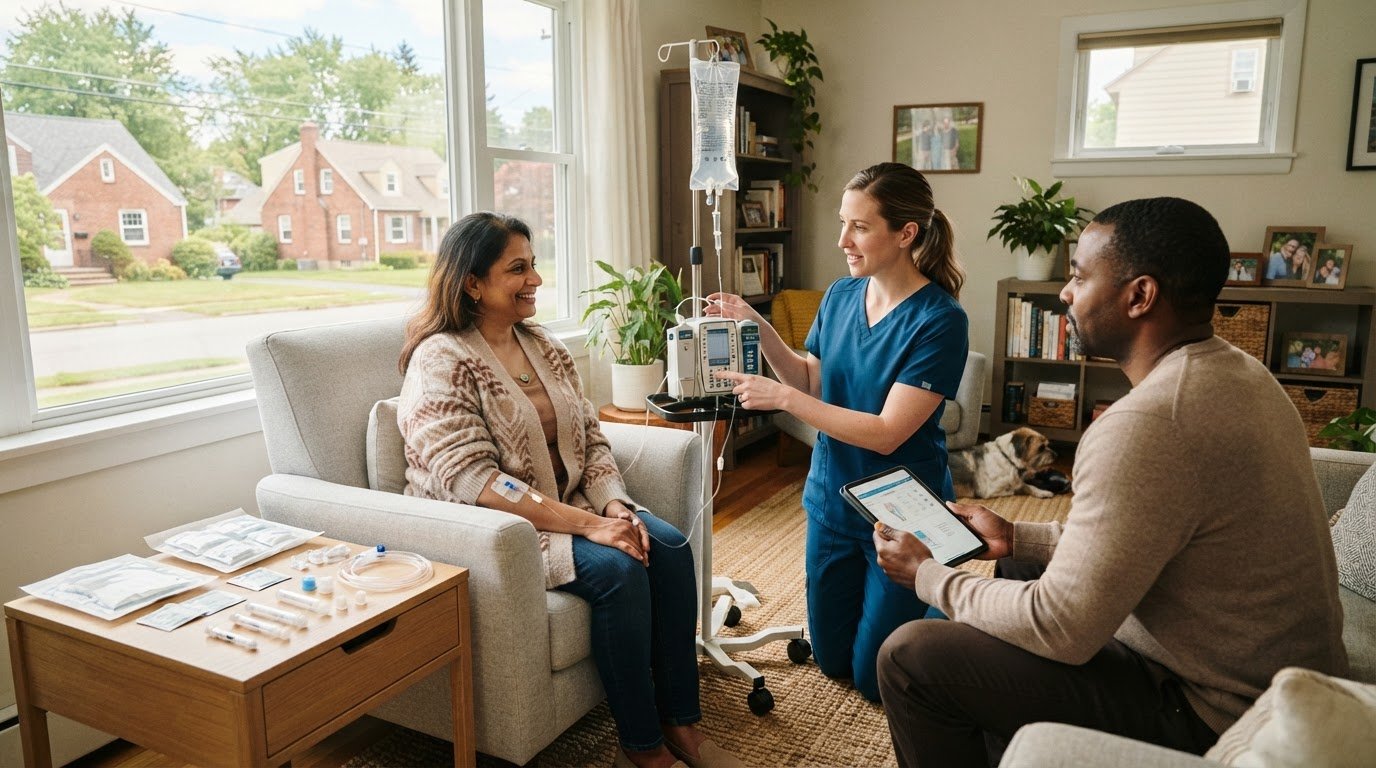
What makes the transition to home TPN easier to navigate? Often, it’s knowing who is responsible for each part of care. TPN management in Albany NY may involve coordinating a prescription, nutrition needs, supplies, appointments, and communication between the prescribing clinician and infusion-care team. Sorting out those responsibilities can feel daunting, especially when you’re unsure whom to contact with routine questions.
Clear expectations can make the process easier to understand. This article explains what coordinated TPN management may involve and gives you practical questions to ask a prospective provider about prescriptions, delivery, education, and follow-up. You’ll also learn what to discuss with your prescribing clinician and how to explore home infusion support in Albany without assuming a service is available for every address or patient.
Vital Care of Syracuse offers parenteral nutrition and lists Albany among its service-area cities, though you should confirm current availability for your specific address. Use the guidance below to prepare for that conversation and identify a supported next step with your care team.
Key Takeaways
- TPN delivers nutrition intravenously when oral or tube feeding isn’t suitable; the prescribing clinician determines the individualized treatment plan.
- For TPN management in Albany NY, clarify who handles routine questions and who can address changes to the prescribed plan.
- Compare prospective providers by asking about coverage at your address, patient education, care coordination, and delivery arrangements for your care.
- Before considering a transition home, discuss readiness with the prescribing clinician, confirm provider availability for your address, and review responsibilities and instructions.
- Vital Care of Syracuse lists TPN and Albany among its offerings and service-area cities; ask about current availability, eligibility, and services for your specific address.
What TPN management in Albany, NY involves
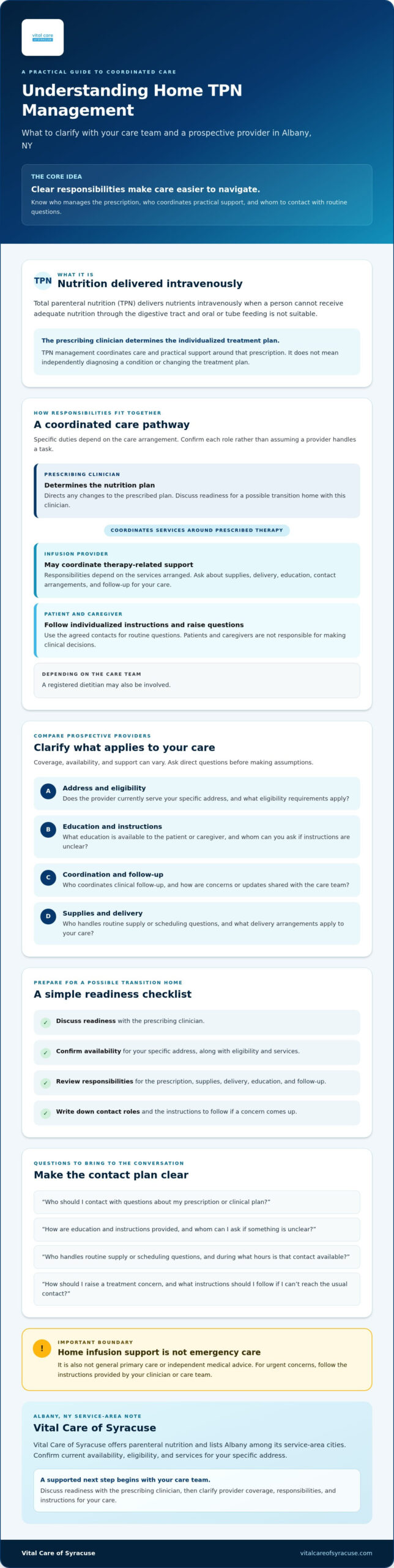
Total parenteral nutrition (TPN) delivers nutrients intravenously when a person can’t receive adequate nutrition through the digestive tract and oral or tube feeding isn’t suitable. The approach depends on the individual’s medical needs and the prescribing clinician’s plan. The Parenteral nutrition overview offers background on this form of nutrition support.
TPN management means coordinating care and practical support around an individualized prescription. It does not mean independently diagnosing a condition or prescribing or changing the treatment plan. For TPN management in Albany NY, knowing who handles each task can help patients and caregivers ask focused questions and feel more prepared.
For a general demonstration of TPN administration, watch this video from University of Rochester Medicine. It’s educational and doesn’t replace instructions from your own care team.
What TPN management may include
Depending on the provider, prescription, and patient’s needs, coordination may include confirming how supplies are arranged, asking about delivery logistics, and learning what education is available for the patient or caregiver. Monitoring, training, and contact arrangements can vary. Ask what applies to your care, whom to contact with routine questions, and what instructions to follow if a concern comes up.
Home infusion support is not emergency medical care, general primary care, or a source of independent medical advice. For urgent concerns, follow the instructions provided by your clinician or care team.
Who may be involved in a TPN care plan?
The prescribing clinician determines the nutrition plan and directs any changes to it. An infusion provider may coordinate services related to the prescribed therapy, with specific responsibilities depending on the arrangement. A registered dietitian may also be involved, depending on the patient’s care team. Patients and caregivers can follow their individualized instructions and raise questions through the agreed contacts.
Before home therapy begins, ask who to contact about the prescription, supplies, delivery, education, and routine concerns. Clarifying these roles early helps prevent uncertainty without making the patient or caregiver responsible for clinical decisions.
How the TPN care team coordinates treatment and communication
Home TPN can involve several people, so a clear communication plan helps patients and caregivers direct routine questions to the right contact. The prescribing clinician oversees the medical plan, while the infusion provider’s responsibilities depend on the services arranged for the patient. Before starting, ask how the roles connect and how the teams share concerns or updates.
For patient-focused background on home care, the National Library of Medicine’s Total parenteral nutrition (TPN) resource can help you prepare questions for your clinicians. Its general guidance doesn’t replace the individualized instructions from your care team.
Questions to clarify with the prescriber and infusion provider
Ask each team member to explain their responsibilities in practical terms. Confirm who manages the prescription, who arranges clinical follow-up, and whom to contact about a treatment concern. Ask how you or your caregiver will learn to use the equipment and follow the instructions for your care. Don’t assume a particular provider handles a task without checking.
- Who should I contact with questions about my prescription or clinical plan?
- How are education and instructions provided, and whom can I ask if something is unclear?
- Who handles routine supply or scheduling questions, and during what hours is that contact available?
- How should I raise a treatment concern, and what instructions should I follow if I can’t reach the usual contact?
These questions establish a practical contact pathway without assuming every provider offers the same support or availability. Record the names or roles, preferred contact methods, and instructions your care team gives you so you and your caregiver can refer to the same plan.
Monitoring, documentation, and care-plan changes
The clinical team determines monitoring needs and timing for each patient. Ask whether laboratory orders and follow-up are coordinated by the prescriber, the infusion provider, or both. Find out how results are communicated to the prescriber and who will explain them to you. Processes vary, so confirm the details rather than assuming results are automatically shared or reviewed by a particular team member.
Documented responsibilities and clear contact pathways help the patient, caregiver, prescriber, and infusion provider coordinate supplies, questions, results, and follow-up, while clarifying who should respond. If you have a question about a result or feel your care needs have changed, contact the clinician identified in your plan. Changes to the prescribed nutrition plan must come from the appropriate clinician, not from the patient, caregiver, or provider acting independently.
As you assess TPN management in Albany NY, you can also ask Vital Care of Syracuse about TPN coordination, including which clinical, education, and communication arrangements apply to your care.
How to compare TPN management providers serving Albany
Choosing support involves more than checking whether a provider lists TPN. Compare practical details that affect your care, and separate what’s confirmed in available information from what needs a direct conversation or review of your prescription. A provider’s general service-area listing doesn’t confirm current availability for every address or patient.
For broader educational context, Vital Care of Syracuse’s Albany-area home infusion and GI care guide discusses home infusion in relation to GI care, but focuses on Rochester. It doesn’t confirm TPN availability or services in Albany. The American College of Gastroenterology also discusses complications associated with parenteral nutrition, which is one reason to clarify clinical contacts and follow-up with your care team.
What to ask before selecting a TPN provider
Use a comparison table to keep answers organized. Vital Care of Syracuse lists TPN and Albany among its service-area cities, and describes home-based and suite-based infusion. Confirm the other details below for your specific care rather than assuming they’re included in a general listing.
| Comparison area | What is confirmed | What to ask |
|---|---|---|
| Service area | Vital Care of Syracuse lists Albany among its service-area cities. | Do you currently support TPN at my specific Albany-area address? |
| Care-team contacts | Responsibilities may vary by provider and care plan. | Who coordinates with my prescribing clinician, and whom do I contact with routine questions? |
| Education | Education arrangements need to be confirmed. | What instruction is available for me or my caregiver, and how does it relate to my individual plan? |
| Coordination | Specific coordination processes aren’t established by a service-area listing. | How are treatment concerns and follow-up communicated with my clinician and other care professionals? |
| Delivery arrangements | Vital Care describes home-based and suite-based infusion. | Which arrangements, supplies, and delivery services apply to my prescription and location? |
How to evaluate fit without assuming every service is included
Ask each prospective provider to explain responsibilities, contact pathways, and availability. Confirm which education, supply coordination, and follow-up services apply to your plan. Ask how insurance benefits and any required authorization are reviewed. Coverage and payment depend on individual circumstances, so don’t treat a general answer as a guarantee.
Share the provider’s answers with your prescribing clinician and ask whether that service model fits your care plan. For TPN management in Albany NY, verifying the address, responsibilities, and specific arrangements turns a general provider listing into information you can use to make an informed choice.
Preparing for a possible transition to home TPN in Albany
Consider a move to home TPN with the prescribing clinician, who can assess whether it fits the patient’s condition and care plan. Convenience or a provider’s general service listing alone isn’t enough to decide. A careful conversation can help you understand what support may be needed and whether a provider’s arrangements suit your situation.
Keep the process manageable: discuss readiness with the clinician, confirm provider fit for your address and prescribed therapy, clarify who handles each responsibility, and review the care team’s instructions before care begins. For TPN management in Albany NY, confirm current availability directly rather than assuming a provider serves every address in the city.
Information to gather before discussing home care
Before speaking with the clinical team or a prospective provider, collect current contact details and note your questions about the prescribed therapy. Consider who may be present for education, such as a caregiver, and tell the team what support the patient may need to understand and follow the instructions.
Ask the clinical team which records or treatment information a prospective provider will need and how to share them. You don’t need to decide on your own what is clinically necessary. Gathering this information can make conversations more focused and help the clinician and provider discuss the patient’s needs.
- Write down the prescribing clinician’s and current care team’s contact information.
- List questions about provider availability, responsibilities, and coordination.
- Identify who should participate in education and what support would be helpful.
- Ask which records or therapy details should be available for provider review.
Questions to resolve before the first home infusion
Before beginning, ask the care team to review the instructions for your situation. Confirm how equipment and supplies are arranged, what education is available, and which contact handles routine communication. Make sure you know whom to contact about a provider-related concern and when to reach the prescribing clinician. Responsibilities and support arrangements can differ, so ask for clear answers about your care plan.
Ask the clinical team how to respond if urgent symptoms or concerns arise, including which contact pathway to use and when to seek emergency help. This article cannot assess symptoms or provide emergency instructions. Follow guidance from your care team and appropriate emergency services rather than treating a general checklist as personal medical advice.
Vital Care of Syracuse lists TPN and Albany among its service offerings and service-area cities. To explore whether its home infusion support may fit your plans, ask Vital Care about TPN support in Albany, including current availability for your address and which services apply to your care. Discuss the information with your prescribing clinician before making decisions about a transition.
Explore TPN management support from Vital Care of Syracuse in Albany
Vital Care of Syracuse lists parenteral nutrition (TPN) among its services and Albany among its service-area cities. The provider describes home-based and suite-based infusion, giving you care settings to ask about as you explore options. A listing alone doesn’t confirm current TPN availability for every Albany-area address or that a particular setting is suitable for an individual patient.
For TPN management in Albany NY, confirm the details for the patient and prescribed care plan. Availability, individual eligibility, and applicable services require direct discussion and, where appropriate, review with the prescribing clinician. The clinician remains the resource for medical advice and decisions about treatment.
What to ask Vital Care about TPN services
When contacting Vital Care, share the patient’s general Albany-area location and explain that you’re asking about prescribed TPN support. These questions can help focus the conversation and identify what still needs confirmation:
- Is TPN support currently available for the patient’s specific address?
- What coordination with the prescribing clinician and other care-team members applies to this plan?
- What education is available to the patient or caregiver, and who provides it?
- How are supplies and delivery arrangements handled for this prescription and location?
- What follow-up and routine communication services apply, and whom should the patient contact with questions?
- Are home-based or suite-based arrangements possible for this situation, and how is the appropriate setting considered?
Ask for a clear explanation of what is included and what remains the responsibility of the prescriber or another care professional. Don’t assume education, supply coordination, follow-up, or contact arrangements are identical for every patient. If insurance or authorization is relevant, ask how those questions are reviewed without treating an initial conversation as confirmation of coverage.
A supported next step for patients and caregivers
Before reaching out, have the patient’s location and prescriber’s contact information ready, along with questions about coordination and service arrangements. You don’t need to settle every clinical question in advance. The goal is to learn whether the provider’s services may fit the prescribed plan and what information the care team needs to assess that fit.
If home or suite-based TPN support is under consideration, invite the prescribing clinician to review the information with you. A direct conversation with Vital Care and the clinician can clarify current availability, individual eligibility, and responsibilities without assuming acceptance or a particular outcome.
Take a clear next step toward coordinated TPN support
Choosing home TPN support starts with understanding who manages the prescription, how the care team communicates, and which education, delivery, and follow-up services apply to the individual plan. The prescribing clinician should guide decisions about readiness and treatment. Patients and caregivers can ask providers to clarify responsibilities and contact pathways.
For TPN management in Albany NY, verify current service availability for the patient’s specific address instead of relying on a general service-area listing. Vital Care of Syracuse lists TPN among its services and Albany among its service-area cities, and describes home-based and suite-based infusion. The appropriate setting and available services depend on the patient’s circumstances and should be discussed directly.
If you’re exploring options, contact Vital Care of Syracuse to ask about TPN support in Albany. Bring questions about location, coordination, education, and supplies, and include the prescribing clinician in discussions about whether the provider’s services fit the care plan.
Frequently Asked Questions
What does TPN management include?
TPN management coordinates support around a nutrition plan prescribed by a clinician. Depending on the patient’s needs and provider arrangements, this may involve coordinating supplies and delivery, education on the prescribed care instructions, and communication between the infusion provider and clinical team. Services vary, so ask who handles routine questions, follow-up, and other responsibilities. The prescribing clinician, not the provider acting independently, directs changes to the nutrition plan.
Can TPN be managed at home in Albany, NY?
Home TPN may be an option for some patients, but the prescribing clinician must assess whether it fits the individual’s condition and care plan. A provider’s general service-area listing doesn’t confirm availability for every Albany address. Ask prospective providers whether they currently support TPN at the patient’s location, what services apply, and how they coordinate with the prescriber. Discuss the answers with the clinician before deciding about a transition.
How do I choose a TPN management provider in Albany?
Compare providers by asking about availability at your address, points of contact, education, supply and delivery arrangements, coordination with the prescriber, and follow-up. Ask which responsibilities are included and which belong to other members of the care team. You can also ask how insurance and any authorization process are reviewed, but confirm coverage directly rather than assuming it. Your prescribing clinician can help assess whether a provider’s service model fits the care plan.
Who monitors a patient receiving TPN at home?
The patient’s clinical team determines the monitoring plan and who is involved. The prescribing clinician directs medical decisions, while an infusion provider may coordinate services according to its arrangement with the patient. A registered dietitian may also be part of the care team, depending on individual circumstances. Ask who orders and reviews any tests, how results reach the prescriber, and who explains them. Confirm monitoring responsibilities and processes for the specific care plan.
Is home TPN appropriate for every patient?
No. Whether home TPN is appropriate depends on the patient’s individual condition, needs, and prescribed plan. The clinician responsible for the patient’s care should assess readiness and discuss the options. Provider availability and service arrangements also need confirmation for the patient’s address and circumstances. A general description of home infusion cannot establish eligibility or suitability. Patients and caregivers can ask questions and share concerns with the prescribing clinician.
What should I ask before starting home TPN?
Ask the prescribing clinician and prospective provider who manages the prescription, education, equipment and supply arrangements, routine questions, and follow-up. Confirm how the provider coordinates with the existing care team and which instructions apply to the patient. Ask whom to contact about different concerns and what to do if an urgent issue arises. Write down contact details and instructions, and ask the clinical team for guidance specific to the patient instead of relying on general information.
Does Vital Care of Syracuse provide TPN management in Albany, NY?
Vital Care of Syracuse lists parenteral nutrition (TPN) as a service and Albany among its service-area cities. The company describes home-based and suite-based infusion, but current availability, individual eligibility, and applicable services must be confirmed for the patient’s address and care plan. Its listed cities also include Syracuse, Rochester, Utica, Buffalo, Auburn, and Binghampton. Ask Vital Care about TPN coordination and discuss provider fit with the prescribing clinician.
Leave a Reply