



Can two prescribed therapies fit into a home-care plan without being infused at the same time? If you’re searching “TPN and IVIG co-administration at home Rochester,” the distinction matters: coordinated home care does not automatically mean simultaneous infusions, a shared line, or a shared schedule. Those decisions require an individualized clinical review of the therapies, line access, timing, and monitoring needs.
It’s understandable to want one clear plan when multiple clinicians and services are involved. Your prescriber, infusion pharmacy, and home-infusion team need to align on the treatment plan and clarify who will manage each step. Together, they can assess whether home infusion is appropriate and how each prescribed therapy should be arranged.
This article explains what clinicians may consider when reviewing TPN and IVIG together, what to ask about access, scheduling, training, and coverage, and how to explore local support in Rochester. Vital Care of Syracuse lists both parenteral nutrition and immunoglobulin therapy among its services and provides home-based and suite-based infusion care, serving Rochester. A patient-specific discussion with your prescriber and a potential home-infusion provider can help clarify next steps.
Key Takeaways
- For TPN and IVIG co-administration at home Rochester, the key question is how your care team will coordinate the therapies, not whether they will automatically run simultaneously.
- Ask your prescribing clinician and infusion pharmacist to review the orders, line access, infusion sequence, compatibility, and prescribed monitoring for your individual plan.
- Compare home-infusion options by asking how clinical coordination, pharmacist access, nursing support, training, and communication would work for your referral.
- Prepare for referral discussions by gathering current therapy details and prescriber contacts, then ask what additional information the provider needs to review your case.
- Vital Care of Syracuse lists TPN and IVIG/SCIG among its offerings and Rochester among its service-area cities. Confirm current availability and referral steps directly with the provider.
What Does TPN and IVIG Co-Administration at Home in Rochester Mean?
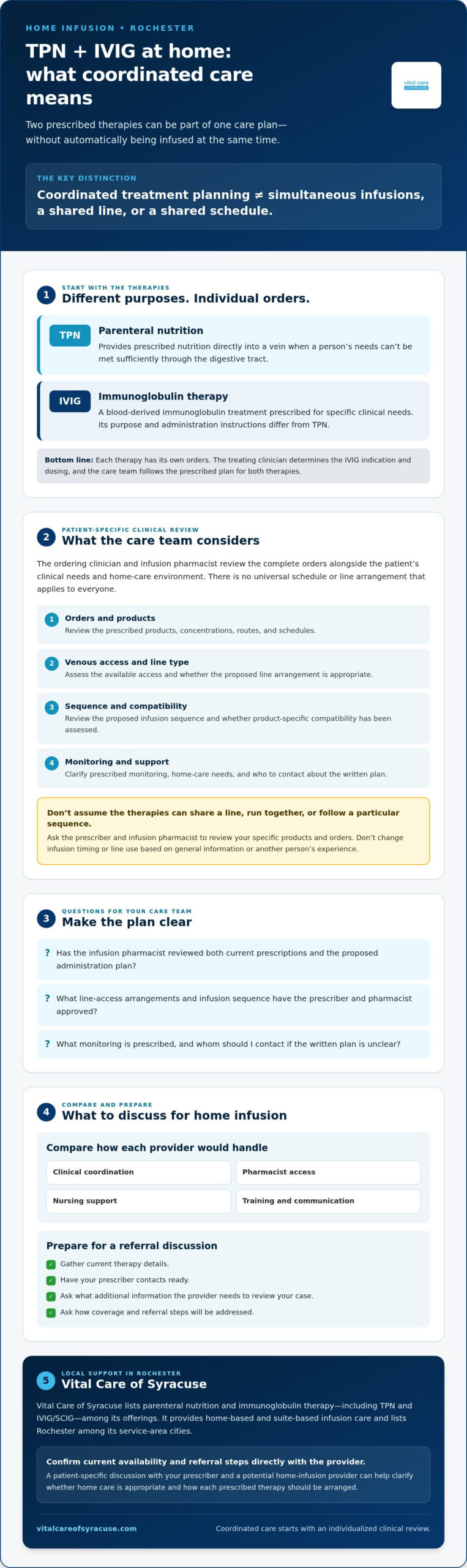
Managing nutrition support alongside prescribed immunoglobulin therapy can involve several instructions and monitoring needs. For people searching “TPN and IVIG co-administration at home Rochester,” the key point is that co-administration describes coordinated treatment planning, not necessarily infusions running at the same time.
TPN delivers prescribed nutrition directly into a vein when a person’s needs can’t be met sufficiently through the digestive tract. This overview of parenteral nutrition explains how nutrition can be provided outside the usual digestive route, including through TPN. IVIG is a blood-derived immunoglobulin treatment prescribed for specific clinical needs. Its formulation, purpose, and administration instructions differ from those of TPN.
A pump demonstration may help you recognize some equipment used for TPN, but it is not a substitute for your own care team’s instructions.
How are TPN and IVIG different therapies?
TPN provides nutrition through venous access according to an individualized prescription. IVIG provides immunoglobulins and is prescribed for particular clinical needs. Because their ingredients, purposes, and administration plans differ, each therapy has its own orders. The treating clinician determines the indication and dosing for IVIG, and the care team follows the prescribed plan for both therapies.
Does co-administration mean both infusions run together?
Not necessarily. Coordinated care may involve separate infusion times or another arrangement directed by the clinical team. Don’t assume the therapies can use the same line, run together, or follow a particular sequence without a patient-specific review.
The prescriber and infusion pharmacist assess the complete orders and available venous access, including whether the prescribed products and setup are appropriate for the individual plan. Ask that team about timing, line use, and monitoring before the home schedule is established.
Definition: Co-administration of TPN and IVIG at home means coordinating two prescribed therapies within an individualized care plan. Only the clinical team can determine a suitable plan for a specific patient.
How Do Clinicians Assess Whether Home TPN and IVIG Can Be Coordinated?
There is no universal schedule or line arrangement that applies to everyone. To assess whether home TPN and IVIG can be coordinated, the ordering clinician and infusion pharmacist review the complete orders alongside the patient’s clinical needs and home-care environment. Their review helps determine whether a workable plan can be established and what support it may require.
What happens during a medication and line-access review?
The team may review the prescribed products, concentrations, routes, and schedules, as well as the available venous access and line type. They consider the proposed infusion sequence and whether product-specific compatibility has been assessed. These details matter because a line-use or timing decision for one patient cannot be assumed to apply to another.
Before assuming a line can be shared or reused, ask the infusion pharmacist to review the specific products and orders. Useful questions include:
- Has the pharmacist reviewed both current prescriptions and the proposed administration plan?
- What line-access arrangements and infusion sequence have the prescriber and pharmacist approved?
- What monitoring is prescribed, and whom should I contact if the written plan is unclear?
The clinical team should provide instructions for your individual plan. Don’t change infusion timing or line use based on general information or another person’s experience.
What monitoring and home-care readiness may be discussed?
Home suitability depends on more than the therapies themselves. The care team considers the patient’s clinical needs, the home setting, and the provider’s assessment. Ask what nursing oversight, training, and follow-up may be appropriate for your situation, and how the plan will be explained to you or a caregiver.
You can also ask how supplies and equipment would be managed, who may be involved in care, and which contact to use for non-emergency questions. Monitoring needs and home-care arrangements depend on the patient and prescribed therapies, so ask the team to explain the plan rather than relying on a standard schedule.
For people exploring TPN and IVIG co-administration at home Rochester, a referral review is a practical way to clarify what may be arranged without assuming the therapies can run together. Vital Care of Syracuse lists both parenteral nutrition and immunoglobulin therapy among its offerings and Rochester among its service-area cities. You can review its home infusion services and ask whether the provider can review a potential referral and what requirements apply.
What Should Rochester Patients Compare Before Choosing Home Infusion?
When assessing TPN and IVIG co-administration at home Rochester, compare how a provider would coordinate your specific orders, not just whether it lists both therapies. Ask who reviews the combined medication profile, how the provider communicates with your prescribers, and what support your referral may require. The table distinguishes known information about Vital Care of Syracuse from details to confirm for your own care.
| Area to compare | Confirmed provider information | Questions to ask for your referral |
|---|---|---|
| Clinical coordination | Vital Care lists parenteral nutrition and immunoglobulin therapy among its offerings. | Who reviews both sets of orders and coordinates with my prescribing clinicians? How will changes be shared? |
| Pharmacist access | Pharmacist availability for a specific referral isn’t confirmed in the information provided. | How can my care team or I raise questions about products, line access, timing, and the prescribed plan? |
| Nursing support and training | Specific nursing arrangements and training for an individual referral need to be confirmed. | What oversight, patient or caregiver training, and follow-up would be appropriate for my treatment plan? |
| Communication and supplies | Individual processes for delivery, scheduling, and updates aren’t confirmed here. | How will schedules, supplies, and revised orders be communicated, and whom should I contact with non-emergency questions? |
| Care setting and Rochester availability | Vital Care describes home-based and suite-based infusion care and lists Rochester among its service-area cities. | Is the prescribed plan supported in Rochester currently, and which setting, if any, is appropriate for my referral? |
Which questions reveal whether a provider can coordinate both therapies?
Look for a clear explanation of how the provider will review the combined medication profile and work with each prescriber. Ask how scheduling, supply arrangements, training, and order changes will be communicated to you and your care team. Confirm current Rochester availability directly. A city listed in a service area does not by itself confirm capacity or suitability for a specific referral.
How should patients compare home and suite-based care?
Home care may reduce travel, while a suite offers a different care environment. Consider privacy, the support available at home, travel needs, and the clinical oversight required by your orders. Share your preferences with the care team, but let its clinical assessment guide which setting can meet your needs.
The appropriate setting depends on clinical assessment, treatment orders, and each patient’s circumstances. Vital Care of Syracuse describes both home-based and suite-based infusion care. Confirm directly with the provider which setting, if any, is available for an individual referral.
How Can You Prepare for a Home TPN and IVIG Referral in Rochester?
A focused referral discussion can help your prescribers and a potential home-infusion provider determine what information is needed to assess your situation. For TPN and IVIG co-administration at home Rochester, preparation cannot guarantee that care can be arranged, but it can make the review more focused and clarify next steps.
Consider this sequence:
- Discuss home infusion with your prescribers. Ask whether they support exploring a home-care plan for your prescribed therapies.
- Gather current treatment information. Have available orders and contact details for the clinicians involved in your care, if you have them.
- Request a referral review. Ask the provider how to submit the referral and which clinical documents are needed.
- Follow up on open questions. Confirm who will explain the review outcome, next steps, and any information still required.
What information should you have ready for the referral discussion?
Useful items may include contact information for your prescribers and care team, current TPN and IVIG orders, and details about your current treatment arrangements. You don’t need to share private medical information publicly. Provide clinical details through the provider’s appropriate referral process, and ask which documents are needed before sending records.
Prepare questions about line access, scheduling, training, monitoring, and who communicates order changes. You can also ask who will coordinate with each prescriber and how you’ll receive updates. These questions clarify responsibilities without assuming that a particular plan can be approved.
What should Rochester patients ask about coverage and timing?
Ask the provider and your insurer to review benefits, authorization requirements, and any coverage conditions that may apply to your referral. Coverage decisions depend on individual circumstances, so confirm them directly rather than relying on general information. Before making arrangements, ask which review steps remain and when you should expect an update. The provider and clinical team must confirm referral requirements and whether care can be arranged. Don’t assume approval or a start date.
For additional background as you prepare, you may find resources on home infusion for GI disorders in Rochester and the benefits of a local home infusion company helpful. Vital Care of Syracuse lists TPN and immunoglobulin therapy among its offerings and Rochester among its service-area cities. To discuss a potential referral and ask what information is needed for review, contact Vital Care of Syracuse.
Coordinated Infusion Care at Vital Care of Syracuse
Vital Care of Syracuse lists parenteral nutrition (TPN) and immunoglobulin therapy (IVIG/SCIG) among its infusion services, and Rochester among its service-area cities. The provider describes both home-based and suite-based care. These offerings make it a potential point of contact for patients and prescribers exploring TPN and IVIG co-administration at home Rochester, but they don’t establish that both therapies can be arranged for every referral or given together.
The next step is an individualized referral review. The clinical team needs to assess the prescribed therapies and relevant patient information before determining whether a care plan or setting is appropriate. If you inquire, ask how the review works and what information the team needs from your prescribers. Confirm current Rochester availability and referral requirements directly with the provider.
What can patients ask Vital Care before moving forward?
A few focused questions can help you understand the process and who is involved. Ask whether the team can review a Rochester referral involving both prescribed therapies, who will coordinate with your prescribers and infusion pharmacist, and how you’ll learn the outcome of the clinical assessment.
- Can the referral for TPN and IVIG/SCIG be reviewed together?
- Who communicates with my prescribing clinicians and pharmacist during the assessment?
- What referral documents or other information are needed?
- Is service currently available for my location, and what care settings might be considered?
Answers may depend on the referral and current provider requirements. An inquiry helps you learn about the process, but it does not confirm eligibility, coverage, or a specific care arrangement.
What should patients expect after making an inquiry?
Depending on the review, coordination may involve you, your prescriber, the pharmacy, and the infusion team clarifying orders, clinical information, and possible care arrangements. The provider must assess the referral before confirming whether a plan can proceed or which setting may be appropriate. Ask what follow-up is needed and who will contact you, without assuming a particular timeline.
Keep your prescribing clinicians informed as the referral moves forward. They can help ensure the provider receives current orders and address clinical questions that arise during assessment. If you’re ready to ask about a potential referral, contact Vital Care of Syracuse to discuss the review process. A conversation can clarify the next step while leaving decisions about your care with the clinical team.
Take the Next Step Toward a Coordinated Care Plan
For TPN and IVIG co-administration at home Rochester, coordination means an individualized clinical review, not an assumption that therapies can run together or share access. Your prescriber and infusion pharmacist can assess the orders, line access, timing, and monitoring needs. You can ask the provider about referral requirements, care settings, and coverage review.
Vital Care of Syracuse lists both parenteral nutrition and immunoglobulin therapy among its offerings, and Rochester among its stated service-area cities. A referral inquiry can clarify current availability and how the clinical team would review your situation, but it does not guarantee eligibility or a particular care plan.
To explore a potential Rochester home-infusion referral, contact Vital Care of Syracuse and ask how prescriber coordination and referral review work. Keep your prescribing clinicians informed as you consider next steps. With focused questions and a patient-specific review, you can move forward with greater clarity.
Frequently Asked Questions
Is it safe to receive TPN and IVIG at home at the same time?
Only your care team can determine whether both therapies can be managed safely at home under your individual treatment plan. The prescriber and infusion pharmacist need to review the orders, line access, product-specific compatibility, infusion sequence, and monitoring needs. “At the same time” doesn’t necessarily mean both infusions run simultaneously. Don’t combine products, change the prescribed schedule, or assume a line can be shared without direction from your prescriber and infusion pharmacist.
Can TPN and IVIG use the same central line?
Whether both therapies can use the same central line or lumen depends on the specific products, orders, access device, and clinical plan. Don’t assume a shared line or a particular sequence is appropriate. Ask the prescribing clinician and infusion pharmacist to assess compatibility and provide patient-specific instructions before either therapy is administered. If instructions are unclear, contact your care team for clarification rather than making changes yourself.
How are TPN and IVIG scheduled for home infusion?
The care team sets the schedule based on the prescriptions, product instructions, access, monitoring needs, and your circumstances. Don’t adjust infusion timing independently. Ask who will coordinate schedule changes, what to do if an infusion is delayed, and whom to contact with non-emergency questions. For TPN and IVIG co-administration at home Rochester, a referral review can help clarify how the prescribed plan may be coordinated.
What happens if I need both TPN and IVIG but don’t qualify for home infusion?
If home infusion isn’t appropriate or available for your referral, ask your prescriber to explain why and discuss other suitable care arrangements. Another setting may be considered if it’s available and appropriate for your clinical needs. An inquiry doesn’t guarantee eligibility, acceptance, or coverage. Your prescriber can coordinate with the infusion provider and insurer so next steps reflect your current orders and individual circumstances.
Does insurance cover home TPN and IVIG in Rochester?
Coverage varies by insurance plan, prescribed therapy, authorization requirements, and individual circumstances. Approval for one therapy doesn’t guarantee coverage for the other or for home administration. Ask both the insurer and infusion provider to verify benefits and required authorizations before making arrangements. Confirm any potential patient responsibilities directly with them, since coverage and authorization decisions can’t be determined from a general article or provider inquiry alone.
How do I start a home TPN and IVIG referral in Rochester?
Start by discussing home infusion with the clinicians who prescribe your therapies. Ask which current orders and clinical records are needed, then contact a provider serving Rochester to find out whether it can review the referral. Vital Care of Syracuse lists Rochester, Syracuse, Albany, Utica, Buffalo, Auburn, and Binghampton among its service-area cities. The clinical team must assess the referral, care setting, and current availability. Keep your prescribers involved, and don’t change treatment while waiting.
Leave a Reply