


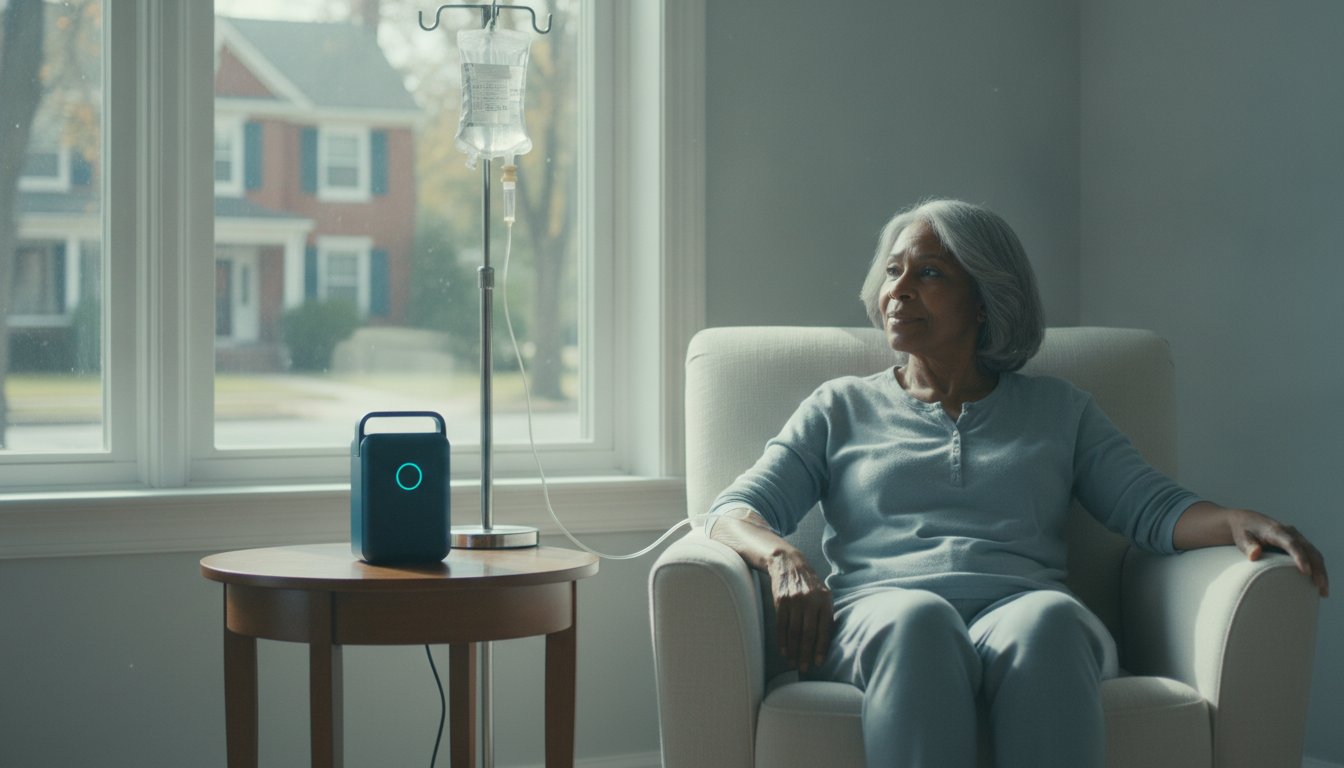
What if the most effective environment for managing advanced heart failure wasn’t a sterile hospital wing, but your own living room? For many families in Central New York, the exhausting cycle of hospital readmissions and the high costs of inpatient cardiac care create a heavy burden of anxiety. You likely already know that the comfort of home is where you feel most like yourself, yet the thought of managing complex medical equipment can feel overwhelming. Choosing inotropic therapy at home Syracuse allows you to break that cycle by bringing hospital-grade safety into your private residence.
This 2026 guide explains how advanced cardiac infusion, such as Milrinone or Dobutamine, is now more accessible and safer than ever for local patients. We’ll explore the latest Medicare payment updates for 2026 and show you how a successful transition to home care can significantly improve your quality of life while reducing hospital stays. You’ll discover how expert clinical support and personalized monitoring provide the steady, reliable hand you need to regain your independence and peace of mind. By the end of this guide, you’ll understand how to bridge the gap between complex medical requirements and your personal need for comfort.
Key Takeaways
- Understand how specialized medications like Milrinone and Dobutamine strengthen heart contractions to improve your daily vitality and blood flow.
- Discover how choosing inotropic therapy at home Syracuse provides you with 24/7 clinical support from local experts who prioritize your safety and comfort.
- Learn about the portable infusion technology that maintains hospital-grade precision while allowing you to move freely within your own home.
- Explore the seamless referral process between major Syracuse hospitals and local care providers to ensure a worry-free transition from the cardiac ward.
- Gain clarity on 2026 Medicare updates and insurance protocols to help you manage the financial aspects of your heart failure recovery with confidence.
Understanding Inotropic Therapy at Home in Syracuse
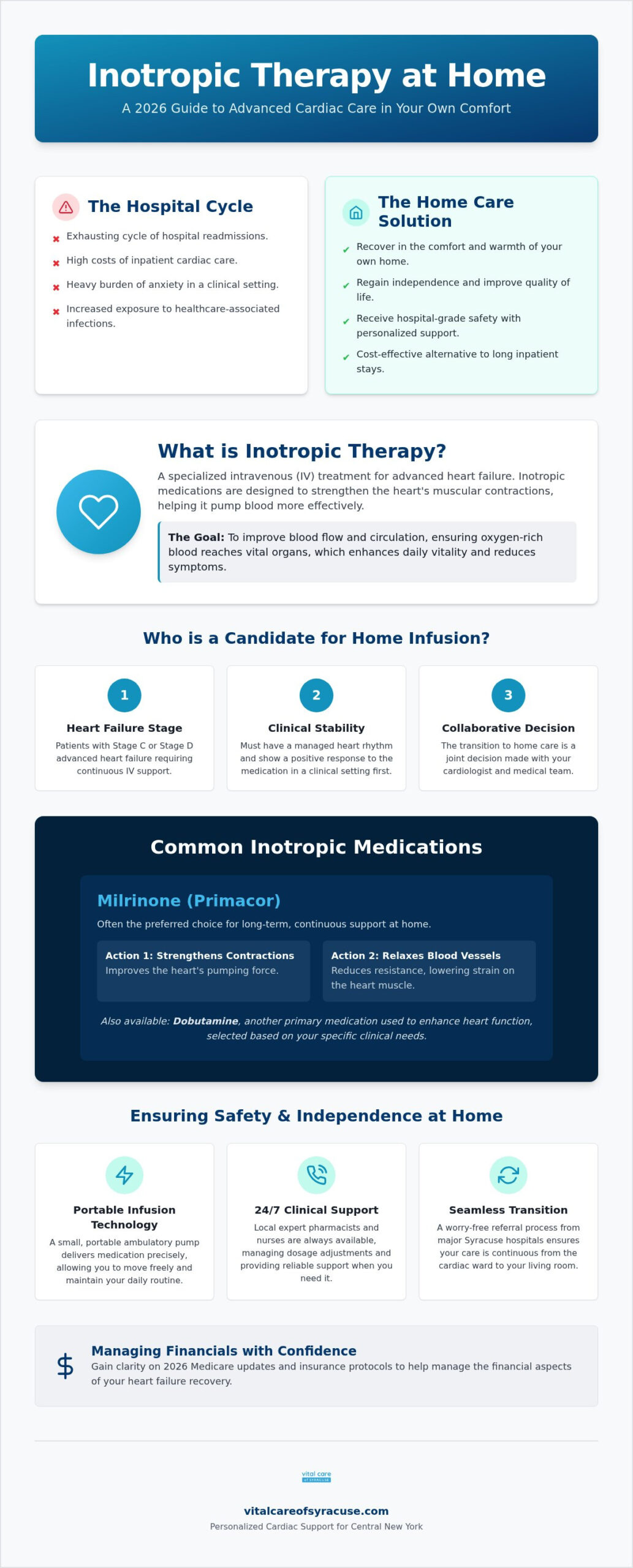
Managing advanced heart failure often feels like a series of revolving doors at the hospital. Inotropic therapy offers a way to step out of that cycle. Essentially, it’s a specialized intravenous treatment designed for those whose hearts need extra support to pump effectively. To understand the science behind this care, you might ask, What is an inotrope? These medications work by altering the force of your heart’s muscular contractions, ensuring that oxygen-rich blood reaches your vital organs and improves your overall circulation.
For many families in Central New York, choosing inotropic therapy at home Syracuse has become a preferred path because it replaces the clinical coldness of a hospital ward with the warmth of a familiar living room. Patients find that recovering in their own space provides a profound sense of emotional relief that simply can’t be replicated in a medical facility. This shift toward home-based care reflects a growing desire for independence and a more personalized approach to long-term cardiac management.
To help you visualize how these treatments are managed in a domestic setting, watch this helpful overview:
Who Qualifies for Home Cardiac Infusion?
Transitioning to home care is a collaborative decision made with your medical team. Generally, patients with Stage C or Stage D heart failure who require continuous or frequent intravenous support are the primary candidates. Your cardiologist will assess your clinical stability to ensure that your heart rhythm is managed and that you’re responding well to the medication. It’s about finding that specific balance where the clinical precision of the hospital meets the comfort of your home environment, ensuring you’re safe while you heal.
The Goal: Improving Quality of Life
The primary objective of home-based care is to help you reclaim your daily routine. Beyond the comfort of your own bed, receiving treatment at home significantly reduces your exposure to healthcare-associated infections often found in busy hospital environments. There’s also an immeasurable psychological benefit to being surrounded by family and pets during your recovery journey. While inpatient stays are naturally expensive, home care provides a cost-effective alternative that prioritizes your dignity and independence without compromising the high standard of clinical excellence you deserve.
Common Inotropic Medications: Milrinone and Dobutamine
The effectiveness of inotropic therapy at home Syracuse depends on the careful selection and precise administration of two primary medications: Milrinone and Dobutamine. While both drugs serve to enhance the heart’s ability to circulate blood, they interact with the cardiovascular system in distinct ways. These therapies are delivered through a continuous intravenous drip, managed by a small, portable ambulatory pump that allows you to maintain your mobility. To better understand the clinical foundation of these treatments, you can review this overview of What is Inotropic Therapy? and how it supports failing heart muscles.
It’s vital to remember that while these medications are powerful, their use at home is made safe through the diligent oversight of local clinical teams. Our pharmacists and nurses in East Syracuse strictly manage every dosage adjustment, ensuring that your treatment remains within the precise parameters set by your cardiologist. This level of local, expert supervision provides the security you need to focus on your recovery rather than the mechanics of your medication.
Milrinone (Primacor) for Long-Term Support
Milrinone is often the preferred choice for patients who require extended support. It’s a dual-action medication known as an inodilator; it strengthens the heart’s contractions while simultaneously relaxing the blood vessels. This relaxation, or vasodilation, reduces the overall resistance the heart must pump against, which significantly lowers the strain on your cardiac muscle. Patients who use Milrinone at home typically have chronic, advanced heart failure and may be using the therapy as a long-term management strategy.
Because the kidneys primarily clear Milrinone from the body, regular monitoring of kidney function is a standard part of our care protocol. We coordinate frequent lab work to ensure your body is processing the medication efficiently, allowing us to make proactive adjustments to your dosage. If you’re navigating these complex requirements, the compassionate experts at Vital Care of Syracuse can help simplify the process for you and your family.
Dobutamine for Acute Heart Failure Management
Dobutamine is generally utilized when a patient requires a more immediate increase in cardiac output. Unlike Milrinone, Dobutamine acts rapidly on the heart’s receptors to stimulate stronger contractions without significantly affecting blood pressure through vasodilation. It’s frequently used as a “bridge” therapy for individuals who are awaiting a heart transplant or the surgical implantation of a Left Ventricular Assist Device (LVAD). Dobutamine at home provides a critical lifeline for patients requiring immediate cardiac output support. By stabilizing your condition in a comfortable environment, it helps you maintain your strength and health while you prepare for the next steps in your cardiac journey.
Ensuring Safety: Monitoring and Technology for Home Use
Safety at home is built on a foundation of advanced technology and constant clinical vigilance. When you choose inotropic therapy at home Syracuse, you aren’t sacrificing the precision of a hospital; you’re simply changing the setting to one that promotes better rest and recovery. The center of this care is the ambulatory infusion pump. These devices are remarkably small and portable, designed to fit into a discrete shoulder bag so you can move about your home without being tethered to a stationary pole. Beyond the hardware, your safety is ensured through a central venous catheter, typically a PICC line or a Hickman line. These secure access points allow the medication to reach your heart safely and consistently, minimizing the risks associated with frequent needle sticks.
Your journey is supported by a team that remains emotionally and technically present. We provide regular nursing visits to your home to perform vital sign checks and ensure your catheter site is clean and healthy. These face-to-face interactions allow us to catch subtle changes in your condition before they become concerns, providing a steady hand of support for both you and your family.
Managing the Infusion Pump
Modern pumps are programmed by our clinical team with exact parameters to deliver your medication continuously. We understand that new technology can feel intimidating at first, but these devices are designed for simplicity and reliability. We’ll walk you through how to manage the battery and what to do if an alarm sounds. Most alarms are simple notifications, such as a low battery or a kink in the tubing, rather than medical emergencies. Our goal is to empower you and your caregivers to feel confident in the equipment, knowing that hospital-grade accuracy is working quietly in the background of your daily life.
Clinical Oversight in Central New York
Your recovery is never a solo journey. Vital Care of Syracuse provides 24/7 clinical support, meaning a knowledgeable professional is always just a phone call away if you have questions about your pump or your symptoms. Our local pharmacists in East Syracuse monitor your lab results in real-time, working in close collaboration with your primary cardiologist to adjust your care plan as your condition evolves. This local proximity allows for a level of responsiveness that national providers often struggle to match.
You can learn more about the specific benefits of a local home infusion company and how it impacts your safety. By maintaining a tight-knit loop of communication between our team, your doctors, and your family, we ensure that your therapy is as safe as it is comfortable. This collaborative relationship is the key to reducing hospital readmissions and helping you stay where you want to be: at home.
Transitioning from Hospital to Home Care in Central New York
Leaving the hospital after a cardiac event is a significant milestone, but it often comes with a mix of relief and apprehension. To ensure a smooth transition for inotropic therapy at home Syracuse, our team works directly with discharge planners at local institutions like Upstate University Hospital, St. Joseph’s Health, and Crouse Health. This coordination ensures that your clinical needs are met the moment you step through your front door. We handle the complexities of insurance verification, navigating both Medicare and private New York payers, so you can focus entirely on your recovery. Our goal is to remove the administrative burden from your family during this sensitive time.
Before you leave the hospital, our clinical staff provides comprehensive caregiver training. You’ll learn the basics of pump management and line care, ensuring you feel empowered rather than overwhelmed. When your first shipment of medication arrives on that “First Day,” it won’t feel like a medical intrusion. Instead, it’s the arrival of the tools you need to stay healthy in your own space. We’re there to walk you through every step, ensuring the steady hand of professional care is always within reach.
The Referral and Discharge Process
The transition begins well before you’re discharged. A hospital discharge planner or cardiac coordinator will send a referral to Vital Care of Syracuse, initiating a seamless handoff of your care plan. Because we’re locally owned and operated in East Syracuse, we can facilitate rapid medication delivery not just in the city, but across Rochester and Utica as well. Our local proximity means we’re already familiar with the specific protocols of Central New York’s major medical systems. If your recovery involves other needs, such as anti-infective therapy at home, we coordinate those treatments simultaneously to keep your care streamlined and efficient.
Home Setup and Supplies
Preparing your home for infusion therapy doesn’t require a total renovation. We recommend establishing a “clean zone”—a dedicated, clutter-free area where you can organize your supplies and perform daily care. Vital Care provides everything you need to maintain your inotropic therapy at home Syracuse, including:
- The ambulatory infusion pump and its discrete carrying case
- IV tubing and sterile connectors
- Replacement batteries and charging cables
- Alcohol swabs, medical tape, and dressing change kits
We manage your inventory so you don’t have to. Ongoing supplies are delivered right to your doorstep on a predictable schedule, ensuring you never run low on essentials. Our pharmacy team tracks your usage and proactively reaches out for refills. If you’re ready to move from the hospital to the comfort of your own home, contact Vital Care of Syracuse today to start the referral process with our local experts.
Personalized Cardiac Support with Vital Care of Syracuse
Choosing a partner for your cardiac recovery is a deeply personal decision that extends far beyond basic clinical requirements. While national “big box” infusion companies often operate from distant call centers, Vital Care of Syracuse provides a level of intimacy and accountability that only a local provider can offer. Being based in East Syracuse means our pharmacists and nurses are your neighbors; we understand the local healthcare landscape and the specific needs of families throughout Central New York. This proximity allows us to deliver a “Compassionate Expert” approach, where we treat the individual behind the diagnosis with the dignity and precision they deserve.
Our commitment to excellence is reflected in our dedicated efforts to reduce hospital readmissions across the Binghamton and Auburn regions. By providing stable, high-quality inotropic therapy at home Syracuse, we help patients avoid the exhausting cycle of returning to the hospital for complications that can be managed safely in a domestic setting. We act as a protective advocate in your health journey, ensuring that every adjustment to your care plan is made with your long-term comfort and stability in mind. This local focus ensures that when you need support, you aren’t waiting on a shipment from another state; you’re receiving care from a team just a short drive away.
The Vital Care Difference
The strength of our service lies in our local ownership and deep community roots. As a franchise of a national network founded in 1986, we combine the extensive resources of a large organization with the personalized touch of a local pharmacy. Our expertise extends beyond cardiac care to include other vital supports, such as home infusion for GI disorders Rochester. Regardless of the complexity of your medical requirements, our clinical staff is available 24/7 to provide troubleshooting and reassurance. This availability offers a sense of security that allows you and your family to rest easier, knowing that expert guidance is always within reach.
Taking the Next Step
Starting the conversation about home inotropic therapy with your cardiologist is the first step toward reclaiming your independence and quality of life. We encourage you to download a referral form from our website to share with your medical team during your next consultation. This simple document helps bridge the gap between your hospital care and your home recovery. Whether you prefer to reach out via our online referral portal or a direct phone call, our team is ready to coordinate with your doctors to make your transition as seamless as possible. You are not alone on this journey; your Syracuse neighbors are here to help you every step of the way, providing the stability and expertise you need to heal in the place you love most.
Reclaiming Your Independence with Home Cardiac Care
Receiving advanced heart failure treatment doesn’t have to mean staying in a hospital bed. By choosing inotropic therapy at home Syracuse, you’re opting for a path that prioritizes your comfort and dignity while maintaining the highest clinical standards. Modern infusion technology and medications are now safely managed within your own living room; this allows you to stay connected to your family and daily routines. You’ve discovered how specialized monitoring and local expertise create a safe environment for recovery outside the hospital walls.
As a locally owned and operated provider in Central New York, Vital Care of Syracuse bridges the gap between complex medical requirements and your personal well-being. We maintain direct coordination with Syracuse hospital cardiac teams to ensure your transition is seamless and secure. With 24/7 access to our clinical pharmacists and nurses, you’re never left to manage your therapy alone. Contact Vital Care of Syracuse to learn more about home cardiac care. Your heart health journey deserves a partner who is both technically proficient and emotionally present. We’re here to provide the steady, reliable hand you need to recover with confidence.
Frequently Asked Questions
Is home inotropic therapy as safe as hospital care?
Yes, receiving inotropic therapy at home Syracuse is safe for patients who meet clinical stability requirements. We provide hospital-grade ambulatory pumps and continuous clinical oversight to ensure your safety. Our team in East Syracuse is available 24/7 to address any clinical concerns, providing a level of protection that mirrors the hospital environment while allowing you to heal in the comfort of your own home.
Will my insurance cover home heart failure medications in New York?
Most major insurance plans in New York, including Medicare and Medicaid, provide coverage for home-based heart failure treatments. The 2026 Medicare payment updates have continued to support access to these essential services. Our team at Vital Care of Syracuse handles the entire insurance verification process for you. We work directly with your payer to confirm benefits and manage the administrative paperwork, so you can focus on your health.
What happens if the infusion pump has an alarm or error?
If your infusion pump sounds an alarm, you have immediate access to our clinical support team at any hour. Most alarms are simple notifications regarding battery life or a small kink in the tubing that you can easily resolve. We provide comprehensive training before you leave the hospital so you’ll feel confident managing the device. If an error persists, our local Syracuse pharmacists and nurses are available to guide you through the troubleshooting process.
Can I still go for walks or be active while on an inotropic drip?
Maintaining a level of activity is often encouraged, and our portable infusion pumps are designed to support your mobility. These lightweight devices fit into a discrete bag, allowing you to walk around your home or enjoy light outdoor activities in Central New York. Choosing inotropic therapy at home Syracuse means your equipment is a supportive tool rather than a restriction. Your specific activity levels should always be discussed with your primary cardiologist.
How often will a nurse visit my home in Syracuse or Rochester?
A specialized infusion nurse typically visits your home once a week to change your dressing and perform necessary lab draws. These visits allow us to monitor your vital signs and ensure your PICC or Hickman line remains healthy. If your clinical situation requires more frequent checks during the initial transition from the hospital, we’ll adjust the schedule accordingly. Our local presence in East Syracuse ensures we can reach patients throughout Rochester and Utica efficiently.
Can a caregiver manage the therapy, or do I need a private nurse 24/7?
Family members or designated caregivers can successfully manage this therapy after receiving our thorough training. You don’t need a private nurse in your home 24/7 because the ambulatory pump handles the continuous delivery of your medication automatically. We empower your support system with the knowledge they need to change medication bags and respond to pump prompts. Our clinical team remains a phone call away to provide expert guidance whenever it’s needed.
What are the most common side effects of home Milrinone or Dobutamine?
While inotropic medications are generally well-tolerated, some patients may experience headaches, nausea, or changes in their heart rhythm. Because these drugs affect your cardiovascular system, we monitor your lab values and vital signs closely to catch any irregularities early. Our pharmacists in Syracuse review these results in real-time to adjust your care plan. If you notice any new or worsening symptoms, our clinical staff is available day or night to provide an immediate assessment.
How do I switch to Vital Care if I am currently with a different provider?
Switching to Vital Care of Syracuse is a straightforward process that begins with a simple phone call to our East Syracuse office. We handle the heavy lifting by coordinating with your current provider and your cardiologist to transfer your medical records and care plan. Our team ensures there’s no interruption in your medication delivery during the transition. We’ll visit your home to set up our equipment and provide personalized training that matches our compassionate expert approach.
Leave a Reply