



What if the closest infusion provider isn’t the best fit for your care? If you’re searching for home infusion for chronic illness near me, it’s natural to want treatment close to home and confidence in safety, training, and coordination with your healthcare team. Not every prescribed therapy or patient is suited to home infusion, so discuss what may work for your situation with your prescriber and a provider.
This guide explains how to assess home infusion options, compare local providers, and prepare practical questions before choosing care. You’ll learn what provider-led home infusion may involve, what to ask about clinical support and communication, and how to confirm whether a provider serves your community. Vital Care of Syracuse, based in East Syracuse, offers home-based and suite-based infusion options. Confirm directly whether a therapy is appropriate and whether it is available in your location.
Finding home infusion for chronic illness near me
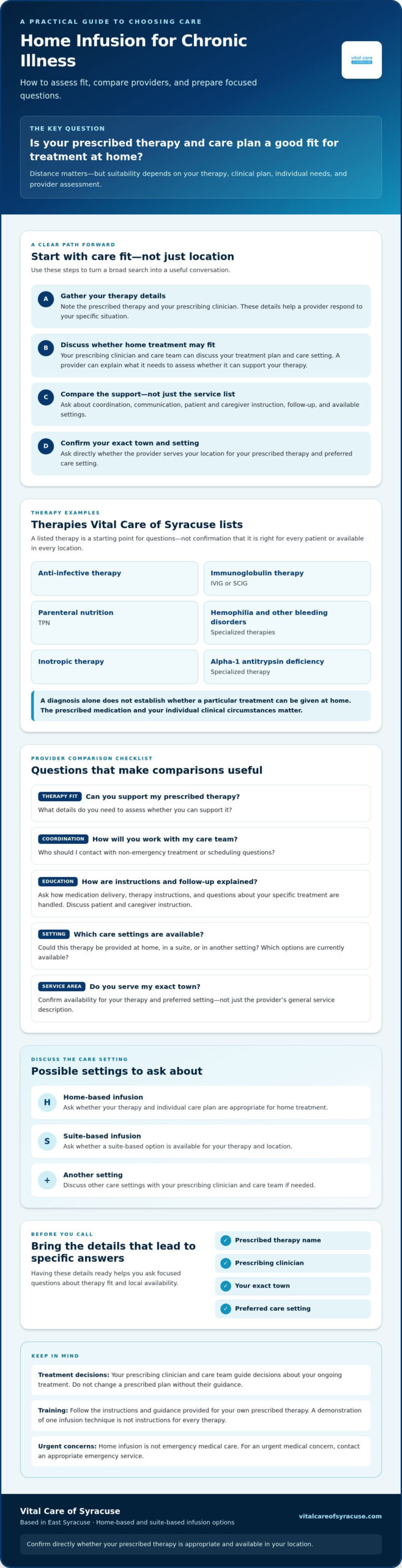
Start with the prescribed therapy, not just the provider’s distance from home. Note the therapy name, your prescribing clinician, your town, and the care setting you want to ask about. These details help you get specific answers about therapy fit and local availability.
Key Takeaways
- Home infusion suitability depends on your prescribed therapy, clinical plan, individual needs, and provider assessment.
- When comparing local providers, ask about therapy fit, care coordination, communication, available settings, and service area.
- Discuss patient and caregiver instruction for your prescribed therapy with the provider and care team.
- Before calling about home infusion for chronic illness near me, gather your therapy details and exact town so you can ask focused questions.
- Vital Care of Syracuse lists several specialty infusion therapies and home-based and suite-based options. Confirm that your therapy and location can be served.
Is Home Infusion Right for Your Chronic Illness Care?
If you’re searching for home infusion for chronic illness near me, the first question isn’t simply how close a provider is. It’s whether your prescribed therapy, clinical plan, and personal needs make treatment at home an appropriate option. Home infusion means receiving prescribed medication or nutrition therapy at home, with professional coordination that supports the plan established by your clinical team.
Infusion therapy can be delivered in different settings, including the home, as described in this overview of infusion therapy. Home treatment isn’t suitable for everyone or every medication. It also isn’t emergency medical care or a routine primary care consultation. For an urgent medical concern, contact an appropriate emergency service. Decisions about your ongoing treatment belong with your prescribing clinician and care team.
For a visual example of one infusion method, Johns Hopkins Medicine demonstrates using a gravity drip device. The video shows a specific technique, not instructions for every therapy. Follow the training and guidance provided for your own prescribed treatment.
Which chronic conditions and therapies may involve home infusion?
Vital Care of Syracuse lists anti-infective therapy, immunoglobulin therapy (IVIG or SCIG), and parenteral nutrition (TPN), as well as specialized therapies for hemophilia and other bleeding disorders, inotropic therapy, and alpha-1 antitrypsin deficiency. These therapies address different care needs, but a diagnosis alone doesn’t establish whether a particular treatment can be given at home. The prescribed medication and individual clinical circumstances matter.
Who decides whether treatment can take place at home?
Your prescribing clinician establishes the treatment plan and can discuss whether home infusion may be appropriate for you. An infusion provider can explain which therapies it lists, what information it needs to assess whether it can support your prescribed treatment, and how its coordination process works. Confirm availability directly.
Ask your clinical team to discuss care settings that may fit your plan, including home, a suite-based option, or another setting. Consider practical needs too, such as the support and instruction that would help you feel prepared. You don’t need to decide alone, and you shouldn’t change a prescribed plan without guidance from your care team.
How to compare home infusion providers near Syracuse
A useful comparison goes beyond distance or a long list of therapies. If you’re researching home infusion for chronic illness near me, check whether a provider can assess your specific prescription, explain how care is coordinated, and confirm that your town and preferred setting are within its current service area. A service listed online is a starting point for questions, not proof that it’s clinically suitable or locally available.
Use this framework when speaking with providers. Ask for specifics about your treatment rather than relying on general descriptions.
| What to compare | Questions to ask |
|---|---|
| Therapy fit | Do you handle my prescribed therapy? What details do you need to assess whether you can support it? |
| Care coordination | How do you work with my prescribing clinician, and who should I contact with non-emergency treatment or scheduling questions? |
| Education and follow-up | How are therapy instructions, medication delivery, and follow-up explained for my specific treatment? What should I expect if I have a question? |
| Setting | Could this therapy be provided at home, in a suite, or in another setting? Which options are currently available? |
| Service area | Do you serve my exact town for this therapy and setting? |
Providers may describe services differently, so ask what each answer means for your care. The Medicare home infusion therapy benefit outlines Medicare’s benefit, but it doesn’t establish an individual’s clinical suitability or confirm coverage for every therapy. Verify applicable coverage and processes directly with the relevant provider and payer.
What should you ask about clinical coordination?
Ask how the provider communicates with your prescribing clinician during care planning and how treatment instructions are shared with you or a caregiver. Confirm who handles non-emergency therapy or scheduling questions, and how medication delivery and follow-up are explained for your prescribed therapy. Clear answers can help you understand the process before care begins. Don’t assume every provider coordinates in the same way.
How do home and suite-based options differ?
Home treatment may reduce travel, while a suite-based setting means traveling to a designated location. The appropriate setting depends on your prescribed plan, personal circumstances, and provider assessment. Discuss travel, your home environment, and your preferences with your care team. Then verify which settings are currently available for your therapy and town.
Vital Care of Syracuse is based in East Syracuse and lists home-based and suite-based infusion options. If you’re comparing local providers, review Vital Care of Syracuse home infusion services and confirm directly whether your therapy, setting, and location can be accommodated.
Which safety and support questions should you ask before choosing?
Feeling prepared for home infusion depends partly on understanding how your prescribed therapy will be explained and who is involved in your care. Choosing a home setting doesn’t guarantee that treatment is safe or appropriate for every person. Discuss safety planning with your prescribing clinician and the infusion provider, based on your therapy and individual needs.
If you’re comparing options for home infusion for chronic illness near me, ask providers to describe their education and communication processes in practical terms. Find out what instructions you’ll receive, whom to contact with routine concerns, and what steps your clinician recommends if symptoms arise. These details help you understand the support plan before treatment begins.
What patient and caregiver education is provided?
Ask how instructions for your particular therapy are shared, including medication handling, storage, and administration. If you expect a caregiver to be involved, check with your care team about whether that participation is relevant to your plan and what instruction the caregiver may need. Don’t assume the same process applies to every medication.
Before care begins, ask whether instructions are available in writing and whom to contact if something is unclear. You might ask:
- How will I learn the steps for my prescribed therapy?
- What guidance will I receive about handling and storing the medication?
- How can I get an instruction clarified before proceeding if I’m unsure?
Take time to review the directions with the appropriate member of your care team. If you’re uncertain about an instruction, ask for clarification rather than guessing or relying on general information that may not apply to your treatment.
How are questions and changes communicated?
Confirm whom to contact for non-emergency questions about therapy or scheduling, and ask when that contact is available. Clarify whom to notify if your treatment plan or personal circumstances change. A provider can explain its communication process, while your prescribing clinician can guide you on clinical concerns and next steps.
Before treatment, ask your clinician how to respond to symptoms that concern you and which escalation instructions apply to your situation. Follow those instructions if a concern arises. Home infusion providers aren’t a substitute for emergency medical services. For an emergency, contact local emergency services rather than relying on an infusion provider for emergency response.
Check Local Home Infusion Availability & Prepare to Call
A provider’s location or online therapy list can help you begin your search, but neither confirms that it can support your prescribed treatment where you live. Check the provider’s fit for your therapy, preferred setting, and exact community. If you’re searching for home infusion for chronic illness near me, a short call with the right information at hand can help clarify what to verify.
What information should you have ready?
You don’t need to determine clinical suitability yourself. Be prepared to identify the prescribed therapy and the clinician overseeing your treatment. Then ask what else the provider needs to discuss its services and possible next steps. You can also prepare questions about:
- Whether the provider handles your specific prescribed therapy.
- Whether home or suite-based care may be an option to discuss with your clinical team.
- Whether your requested setting and treatment timing can be accommodated.
- Which contact details or therapy information the provider needs from you.
Keep your questions focused on your situation. The provider can explain its services and process, while your prescribing clinician remains the right person to discuss your treatment plan.
How can Central New York patients verify coverage?
Ask directly about service availability in Syracuse and your exact town, and specify the therapy and care setting. If you live in Albany, Rochester, Utica, Buffalo, Auburn, or Binghampton, ask specifically whether the provider can serve your location for that therapy and setting. Treat these as locations to verify, not as confirmed coverage areas. Availability can depend on the service and location, so request a clear answer for your circumstances rather than relying on a general regional description.
As you assess fit, local knowledge may be one factor alongside therapy support, care coordination, communication, and setting. For additional provider-selection context, consider The Benefits of a Local Home Infusion Company in Central New York.
Vital Care of Syracuse is based in East Syracuse and lists specialty home infusion services. To ask about your prescribed therapy and whether your community may be served, contact Vital Care of Syracuse and confirm current availability directly.
Explore home infusion options with Vital Care of Syracuse
Choosing an infusion provider is a personal care decision. Before moving forward, consider whether the provider handles your prescribed therapy, how it coordinates with your prescribing clinician, which care settings may be available, how questions are handled, and whether your exact location is served. If you’re searching for home infusion for chronic illness near me, confirming these details directly can help you understand your options without assuming that a listed service is automatically the right fit.
Which services can patients ask Vital Care of Syracuse about?
Vital Care of Syracuse lists anti-infective therapy, immunoglobulin therapy (IVIG or SCIG), and parenteral nutrition (TPN). Its listed specialty services also include therapy for hemophilia and other bleeding disorders, inotropic therapy, and alpha-1 antitrypsin deficiency therapy. This range may help patients and clinicians identify services to ask about, but it doesn’t mean every therapy is suitable for every patient or available in every location.
For a specific prescription, ask the provider whether it handles that therapy and what information it needs to discuss its services. Confirm whether home or suite-based infusion may be an option for your treatment, and review the care setting with your prescribing clinician. The clinical plan and provider assessment, not the diagnosis alone, guide whether a particular option may fit.
What are the next steps if the service may fit?
When contacting a provider, be ready to name the prescribed therapy, your town, and the setting you’d like to ask about. You can also ask how the provider coordinates with your clinician, who can answer non-emergency questions, and what additional information may be needed to explain possible next steps. Confirm current availability directly, since a provider’s location or service list doesn’t establish coverage for your specific community.
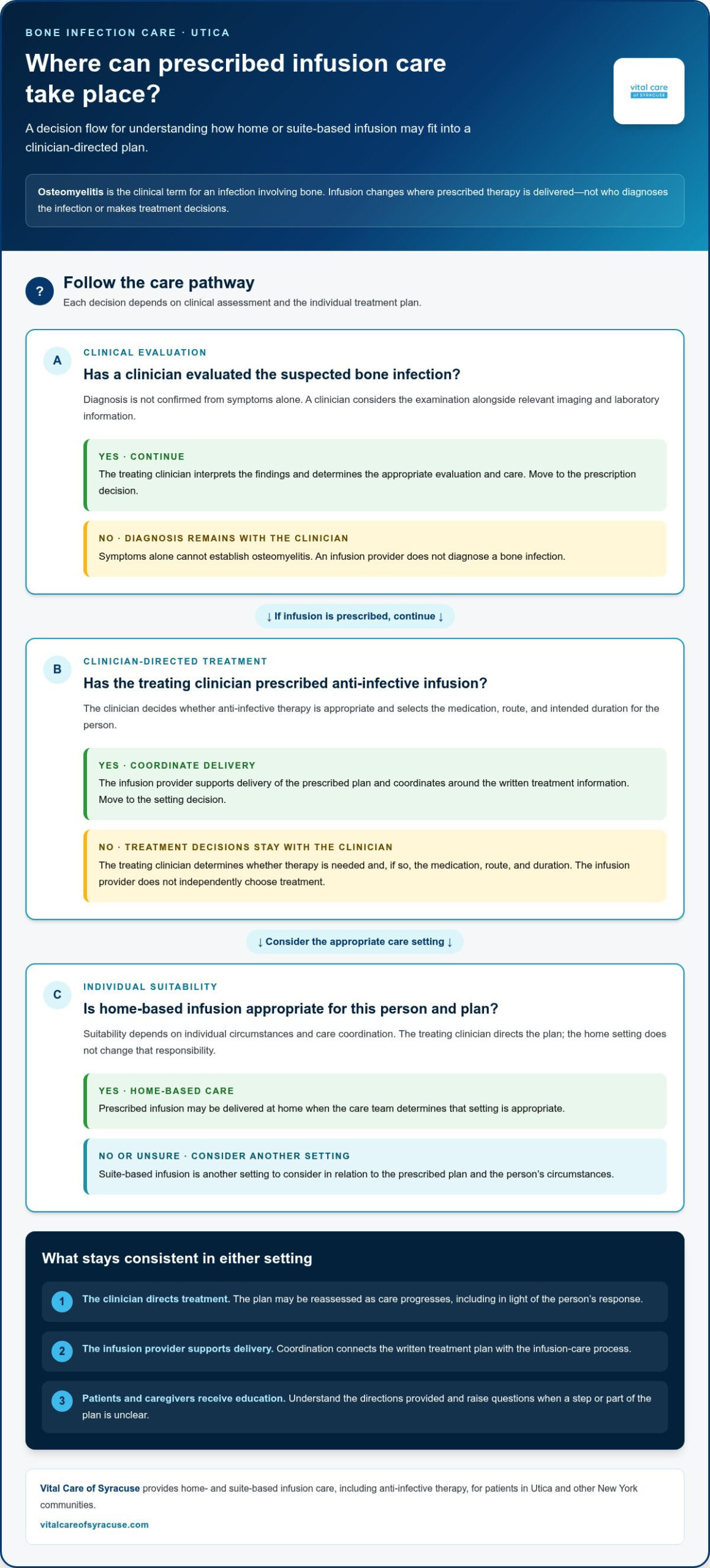
If your clinician has prescribed anti-infective treatment, ask specifically whether the provider can support that therapy and location. Keep treatment decisions with your clinician, and don’t change your care plan based on a general service description.
Vital Care of Syracuse is based in East Syracuse and offers home-based and suite-based infusion options, subject to confirmation for the individual therapy and location. You can contact Vital Care of Syracuse to ask about its listed services and verify local availability. A direct conversation can help clarify whether the provider may be an option to discuss further with your care team, without promising eligibility or a particular outcome.
Take a Confident Next Step Toward Local Infusion Care
Finding home infusion for chronic illness near me starts with confirming that a provider can support your prescribed therapy and location. Ask how care is coordinated, what settings may be available, and how questions are handled. Your prescribing clinician remains your partner in deciding whether a particular treatment setting fits your care plan.
Vital Care of Syracuse is a locally owned and operated provider based in East Syracuse. Its listed specialty therapies include anti-infective therapy, IVIG and SCIG, and TPN, among others. Home-based and suite-based infusion options are described, but your therapy’s suitability and local availability should be confirmed directly.
Have your therapy information, clinician’s details, and exact town ready when you reach out. Contact Vital Care of Syracuse to discuss your home infusion questions and ask what options may be relevant to your situation. A clear conversation can help you and your care team consider next steps with greater confidence.
Frequently Asked Questions
Is home infusion available for people with chronic illnesses?
Home infusion may be an option for some people with chronic illnesses, depending on the prescribed therapy and clinical circumstances. A prescribing clinician can discuss whether it may fit your treatment plan, while a provider can confirm whether it handles that therapy and serves your location. If you’re looking for home infusion for chronic illness near me, verify the details for your specific prescription rather than assuming home treatment is appropriate based on diagnosis alone.
How do I find a home infusion provider near Syracuse, New York?
Start by asking your prescribing clinician about potential providers, then contact them to check whether they handle your prescribed therapy and serve your exact town. Compare how each explains coordination, patient instruction, communication, and care settings. A Syracuse-area provider’s address or broad service list doesn’t prove it can support your treatment locally. Ask what therapy information is needed to discuss fit and what additional details you should confirm with your care team.
What conditions can be treated with home infusion?
Home infusion may be used for different prescribed therapies, but a condition alone doesn’t determine suitability. Vital Care of Syracuse lists anti-infective therapy, IVIG and SCIG, parenteral nutrition (TPN), hemophilia and bleeding disorder therapy, inotropic therapy, and alpha-1 antitrypsin deficiency therapy. These are services to ask about, not a guarantee that a specific medication or patient qualifies. Discuss your treatment with your clinician and confirm the provider’s current services directly.
Is home infusion safe for complex or long-term conditions?
Safety depends on the prescribed therapy, clinical plan, patient needs, and support arranged by the care team. Home treatment shouldn’t be assumed safe simply because it’s available. Ask what patient or caregiver instruction is provided, how medication handling and administration are explained, and whom to contact with non-emergency questions. Follow your clinician’s guidance about symptoms or urgent situations. Home infusion providers aren’t a substitute for emergency medical services.
Can I choose home infusion instead of an infusion suite or hospital?
Discuss the care setting with your prescribing clinician rather than changing settings on your own. Home, suite-based, or hospital care may each be considered according to your treatment plan, individual needs, and provider assessment. Ask whether your prescribed therapy can be supported in the setting you prefer and whether that option is currently available in your community. Travel, your home environment, and personal preferences may also be useful topics for your care team.
What should I ask a home infusion provider before starting care?
Ask whether the provider handles your specific prescribed therapy and what information it needs to discuss next steps. Find out how it coordinates with your prescribing clinician, what instructions you or a caregiver may receive, and whom to contact with non-emergency therapy or scheduling questions. Confirm whether home or suite-based care may be available for your treatment and exact town. Your clinician can clarify treatment decisions and guidance for urgent concerns.
Does Vital Care of Syracuse serve patients outside Syracuse?
Vital Care of Syracuse is based in East Syracuse, but confirm current availability for your exact community and prescribed therapy. Ask directly about Syracuse, Albany, Rochester, Utica, Buffalo, Auburn, and Binghampton without assuming every location is served. Also verify whether the setting you’re asking about is available locally. The provider can explain its service area, while your clinician can guide decisions about your care plan.
Leave a Reply