


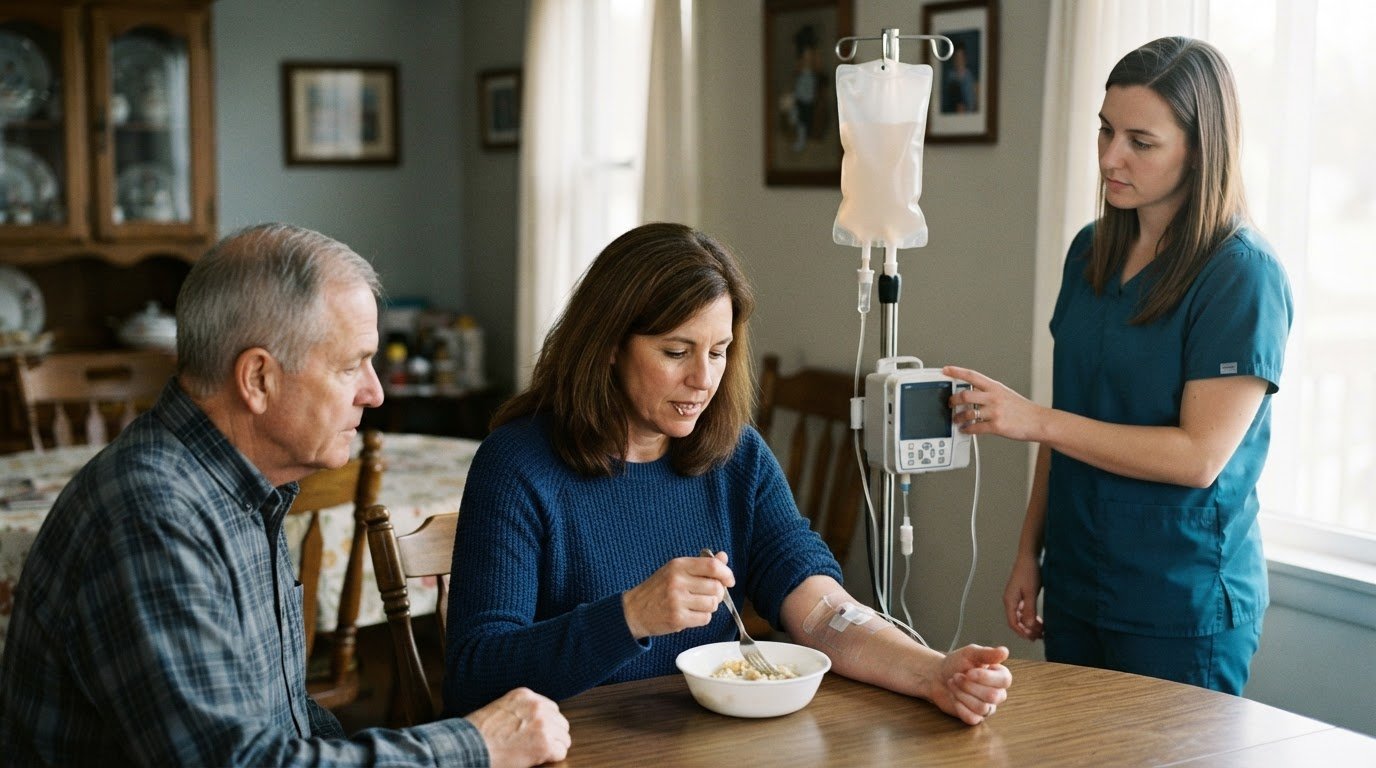
Coming off TPN is not as simple as skipping an infusion. The TPN weaning process at home in Binghamton should be planned and monitored by the care team, which evaluates fluid balance and whether a transition to tube or oral feeding is appropriate. The pace depends on the patient’s response and what they can safely tolerate, so there is no single schedule for everyone.
It is understandable to want a clear path toward eating more by mouth or spending less time on TPN while avoiding setbacks. This guide from Vital Care of Syracuse explains how a care team may approach a gradual reduction, what monitoring may be involved, and which symptoms need prompt medical attention. You’ll also learn how home infusion support can help patients and caregivers understand the treatment plan as care needs change.
Key Takeaways
- Understand how clinical training supports safe home TPN administration for patients and caregivers.
- Learn what care teams consider when gradually reducing or stopping parenteral nutrition.
- Recognize symptoms that warrant a call to a healthcare provider during home TPN.
- See how lab testing and blood glucose monitoring help track a patient’s response during weaning.
Home administration and caregiver training
Home infusion companies that provide parenteral nutrition support patients in Binghamton, NY. Their clinical teams teach patients and caregivers to follow the prescribed plan and recognize when to seek help.
- Teach the full routine. A trained healthcare provider demonstrates how to prepare, administer, and monitor parenteral nutrition. Training includes the pump, catheter connections, supplies, and the written infusion schedule. Patients and caregivers learn their roles before managing care at home.
- Review storage and timing. Home TPN is stored in a refrigerator at 35° F (1.6° C). It is taken out 2 hours before use to reach room temperature. The prescribed infusion commonly runs overnight for 12 to 18 hours, leaving patients free of the pump during the day.
- Practice clean preparation. Before preparing or disconnecting TPN, the patient or caregiver washes hands with soap and warm water for at least 20 seconds. The clinician demonstrates the sequence and observes practice, so each person understands how to reduce contamination risk.
- Demonstrate connection care. Before connecting TPN, the CVC connection is scrubbed with an alcohol wipe for 15 seconds. The CVC is flushed with 10 mL of 0.9% sodium chloride (NaCl) when connecting or disconnecting. The clinician explains each step using the patient’s prescribed supplies.
- Explain medication preparation. If vitamins are prescribed, the medicine port on the TPN bag is scrubbed with an alcohol wipe for 15 seconds. Each vitamin vial’s rubber stopper is cleaned with a new alcohol wipe for 15 seconds. The care team demonstrates the process before the patient or caregiver performs it.
- Confirm understanding. The clinician reviews the infusion schedule, connection routine, and monitoring plan with the patient and caregiver. They clarify how to follow the prescribed instructions and whom to call with concerns. This preparation helps make home administration more organized and consistent.
Reducing or stopping parenteral nutrition
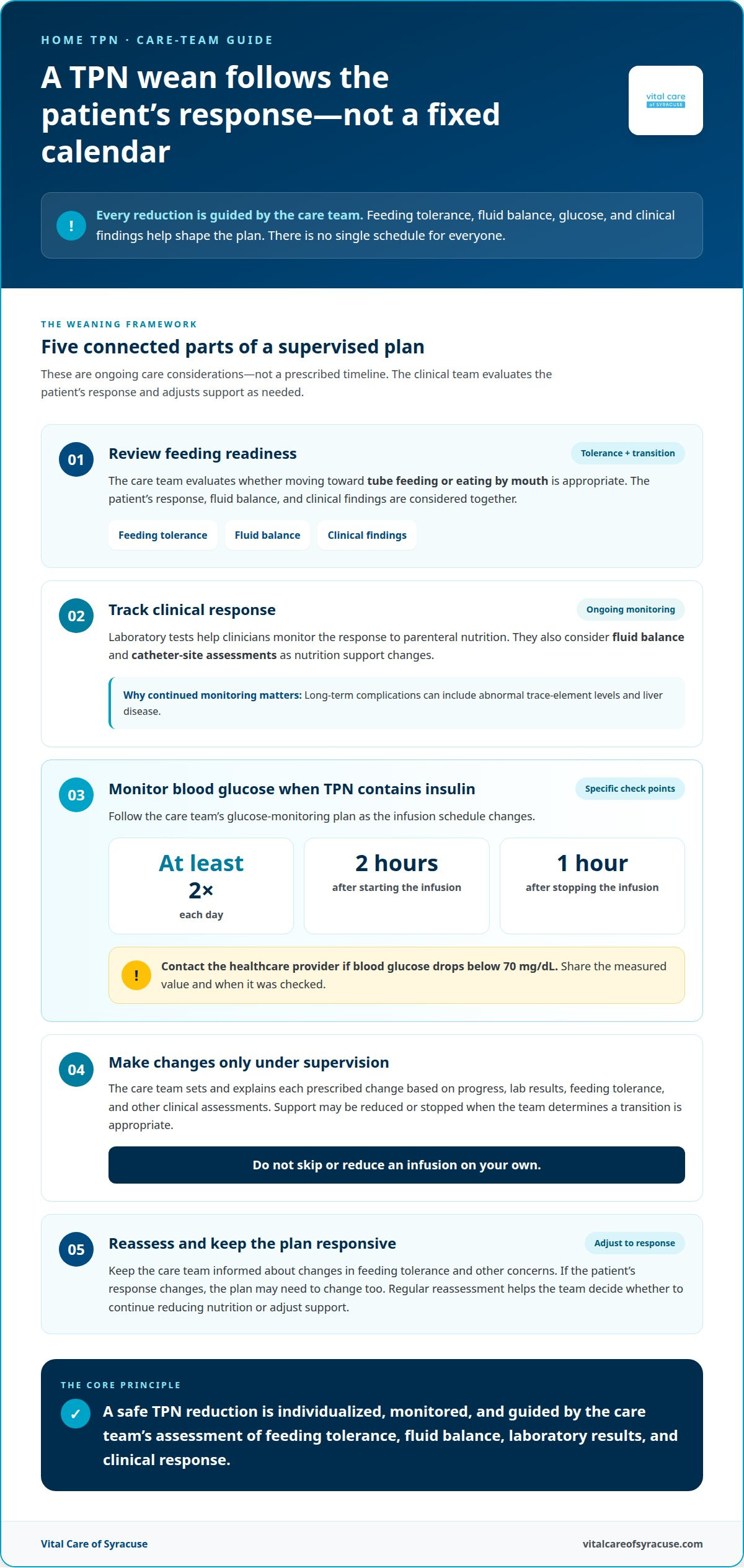
Have the care team guide every reduction based on feeding tolerance, fluid balance, and clinical monitoring. Blood glucose checks also matter when TPN contains insulin.
-
How clinicians monitor labs during TPN weaning
Share the patient’s current feeding plan and any recent changes with the care team. Clinicians use laboratory tests to monitor the response to parenteral nutrition, alongside fluid balance and catheter-site assessments. These findings help the team evaluate the patient’s response as nutrition support changes. Long-term complications can include abnormal trace-element levels and liver disease, so ongoing clinical monitoring remains important.
-
How clinicians manage blood glucose during TPN weaning
Follow the care team’s glucose-monitoring plan if TPN contains insulin. The monitoring points include checking blood glucose at least 2 times each day, including 2 hours after starting the infusion. Check again 1 hour after stopping the infusion. Contact the healthcare provider if blood glucose drops below 70 mg/dL. These checks help the care team assess glucose changes as the infusion schedule is adjusted.
- Review readiness for a feeding transition. The care team evaluates whether the patient can move toward tube feeding or eating by mouth. They consider the patient’s response, fluid balance, and clinical findings together. Parenteral nutrition may be reduced or stopped when the care team determines that a transition is appropriate.
- Use a supervised reduction plan. Ask the care team to explain each prescribed change and how it relates to the patient’s progress. There is no single reduction schedule that works for everyone. The team adjusts the plan based on lab results, feeding tolerance, and other clinical assessments. Don’t skip or reduce an infusion on your own.
- Keep the plan responsive. Weaning may involve reducing support or stopping it entirely. Keep sharing changes in feeding tolerance and other concerns with the care team. If the patient’s response changes, the plan may need to change too. Regular reassessment helps the team decide whether to continue reducing nutrition or adjust support.
Symptoms and problems that require a call to a healthcare provider
During home TPN, act promptly if a listed warning threshold or complication occurs. Share the concern with the healthcare provider managing the patient’s care.
- Call about a fever of 100.4° F (38° C) or higher. Record the temperature and when it was measured. Tell the healthcare provider the reading and whether the patient is receiving TPN. Fever matters because catheter infection is a common and serious complication of parenteral nutrition.
- Report concerns involving the catheter. Catheter infection can become serious, so contact the healthcare provider about a suspected catheter problem. Include when the concern began and any changes noticed at the catheter site. The care team can assess the situation and advise on the next step.
- Call if blood glucose falls below 70 mg/dL. Share the measured value and when it was checked, especially during an infusion change or weaning. The threshold is a clear reason to contact the healthcare provider. Don’t change the TPN or insulin plan independently while responding to the result.
- Report possible blood-clot concerns. Blood clots are a potential complication of parenteral nutrition. Contact the healthcare provider if a clot is suspected, and describe the concern clearly. Avoid making changes to the catheter or infusion based on assumptions about the cause.
- Discuss fluid or mineral imbalance concerns. Parenteral nutrition may cause fluid and mineral imbalances. Tell the care team about concerns that arise during treatment or a reduction in support. The provider can consider them alongside the patient’s clinical monitoring and laboratory results.
- Share blood-sugar problems during a change in support. Parenteral nutrition may affect blood sugar metabolism. Report concerning glucose results or changes to the healthcare provider, including the timing of the reading in relation to the infusion. This information helps the team assess the patient’s response during TPN weaning.
- Keep the care team informed during every transition. Note the concern, its timing, and any relevant temperature or glucose reading before calling. A clear account helps the provider understand what changed and how it relates to the infusion or catheter. Follow the provider’s direction for next steps.
What monitoring and lab tests are needed during home TPN weaning?
Follow the care team’s monitoring plan to track the patient’s response as parenteral nutrition changes. Laboratory results, glucose readings, and clinical assessments help guide decisions.
- Review laboratory results with the care team. Clinicians use laboratory testing to monitor a patient’s response to parenteral nutrition. During weaning, they interpret results alongside changes to feeding and the patient’s overall clinical status. The results help the team assess whether the current nutrition plan remains appropriate or needs adjustment.
- Track fluid balance during each change. Care teams periodically evaluate fluid balance as they consider reducing or stopping parenteral nutrition. Report relevant changes or concerns to the team, so they can consider them with laboratory findings. Fluid balance is one part of assessing whether a transition to tube or oral feeding is appropriate.
- Include catheter-site assessments. The care team periodically evaluates the catheter site during treatment. Share concerns about the site and note when they began. Catheter-related concerns matter because infection is a serious complication of parenteral nutrition.
- Follow glucose monitoring when TPN contains insulin. Check blood glucose at least 2 times each day, including 2 hours after starting the infusion. Check again 1 hour after stopping it. Contact the healthcare provider if glucose drops below 70 mg/dL. Keep readings and timing available for the care team’s review.
- Discuss longer-term risks in context. Long-term parenteral nutrition complications may include abnormal trace-element levels and liver disease. Laboratory testing helps clinicians monitor a patient’s response, while the care team considers the broader clinical picture. Ask how results relate to the current reduction plan and what changes they may prompt.
- Keep monitoring connected to each decision. Before a change, the care team considers laboratory results, fluid balance, catheter-site findings, and feeding tolerance together. This helps guide decisions about continuing, adjusting, or pausing the reduction. For support with home TPN care, connect with the infusion team.
Vital Care of Syracuse: Home infusion
Vital Care of Syracuse provides home infusion, including parenteral nutrition (TPN), for patients receiving nutrition support at home. If the care team is considering reducing or stopping TPN, home infusion support can be part of the broader treatment plan. The treating clinicians determine whether and how nutrition should change, based on the patient’s response, laboratory results, and feeding tolerance. Patients and caregivers can discuss prescribed home TPN needs with Vital Care of Syracuse and learn how its home infusion services fit into their care. For professional support with prescribed TPN at home, contact Vital Care of Syracuse rather than changing an infusion independently.
Contact Vital Care of Syracuse to discuss home infusion and TPN.
Plan the next conversation with confidence
For families considering the TPN weaning process at home in Binghamton, keep the conversation focused on the patient’s goals and changing needs. A thoughtful discussion can clarify what progress may look like, how concerns will be communicated, and what support could make care manageable at home. Patients and caregivers can also explain practical concerns, such as how treatment fits into daily routines, so those needs inform care planning.
Home treatment decisions can feel easier to approach when the care team understands what matters most to the patient. Bring forward questions about the transition and ask for a clear explanation of the plan. Vital Care of Syracuse can be part of the conversation about home infusion support for prescribed TPN. Contact Vital Care of Syracuse to discuss home infusion support and take the next step with greater clarity.
Frequently Asked Questions
How is TPN gradually weaned at home?
TPN is reduced according to a plan shaped by the patient’s response and ability to tolerate other nutrition. The care team may adjust the amount or schedule as it evaluates progress, rather than follow a fixed timetable. During the TPN weaning process at home in Binghamton, make sure every change follows the prescribed plan. Don’t skip infusions or change the schedule on your own.
Who decides when a patient is ready to reduce or stop TPN?
The patient’s care team determines readiness by reviewing clinical status, fluid balance, laboratory findings, and tolerance of tube or oral feeding. A scan or improved appetite alone does not establish that nutrition support can stop. The team considers these factors together and adjusts the plan as the patient’s needs change. Patients and caregivers can share concerns and feeding changes to inform those discussions.
What symptoms or complications should be watched for while reducing TPN?
Watch for concerns involving the catheter, possible infection, blood glucose changes, or signs of fluid and mineral imbalance. Parenteral nutrition can also be associated with blood clots and blood-sugar metabolism problems. Report new concerns to the healthcare provider managing treatment, and explain when they began and how they relate to infusion changes. Don’t try to change the TPN plan without clinical direction.
What home nursing and caregiver training are required for TPN weaning?
Training should prepare the patient and caregiver to follow the prescribed infusion plan, manage the equipment and catheter routine, and understand monitoring instructions. A trained healthcare provider teaches preparation, administration, and monitoring; the care team can clarify who handles each task at home. Before the schedule changes, make sure everyone involved understands the updated instructions and how to communicate concerns to the team.
What emergency signs during home TPN weaning require calling a doctor or 911?
Call the healthcare provider promptly for a fever of 100.4° F (38° C) or higher, or blood glucose below 70 mg/dL. For a situation that appears immediately life-threatening, call 911 rather than waiting for a routine response. If you’re unsure which level of help is needed, describe the symptoms and readings to the treating team. Keep the care team’s instructions accessible at home.
Leave a Reply