



Imagine the relief of finally walking through your own front door in Elmwood or North Delaware, only to feel a sudden wave of anxiety as you look at the complex infusion pump and sterile supplies waiting for you. Finding the right parenteral nutrition management Buffalo residents can trust is the first step toward turning that anxiety into a confident recovery. It’s a journey that requires precision and clinical excellence, but you don’t have to walk it alone.
We understand that the fear of catheter-related infections or the stress of coordinating with your local doctors can feel overwhelming. It’s perfectly natural to worry about missing a critical nutrient adjustment when your health is on the line. This guide will show you how expert oversight and personalized support make it possible to receive life-sustaining nutrition safely in the comfort of your own home. We’ll explore the latest safety standards for 2026, including how to master your infusion equipment and ensure your care team stays perfectly synchronized with your Buffalo-based physicians for a seamless recovery.
Key Takeaways
- Learn how specialized intravenous feeding supports recovery for complex conditions, allowing you to transition safely from the hospital to your own home.
- Explore the clinical components of parenteral nutrition management Buffalo, including the vital role of dietitians and consistent lab monitoring for formula precision.
- Master the logistics of home care with practical guidance on maintaining a sterile environment and managing your infusion equipment with confidence.
- Discover the distinct advantages of local Western New York support, from faster response times to personalized training that national providers often lack.
- Understand how a dedicated regional partner coordinates directly with your local doctors to ensure your nutritional plan remains accurate and effective.
Understanding Parenteral Nutrition (TPN) and Its Role in Recovery
When the digestive system can no longer absorb the nutrients your body needs to survive, Parenteral nutrition becomes a vital lifeline. Often referred to as Total Parenteral Nutrition or TPN, this therapy delivers a precise blend of proteins, carbohydrates, fats, vitamins, and minerals directly into your bloodstream through a specialized catheter. It’s more than just a medical procedure; it’s a bridge to recovery for those who cannot rely on traditional eating or tube feeding. For many families, finding reliable parenteral nutrition management Buffalo services is the key to moving past the sterile walls of a hospital and back into the familiar rhythm of daily life.
This approach is considered the clinical gold standard for managing gastrointestinal failure. When the GI tract is compromised by injury, surgery, or chronic illness, it simply can’t process solid food or liquids effectively. TPN bypasses the digestive system entirely, ensuring your body receives 100% of its nutritional requirements without the stress of digestion. The ultimate goal of this therapy isn’t just survival; it’s about achieving clinical stability so you can reclaim your independence at home.
To better understand the fundamentals of this life-sustaining therapy, watch this helpful video:
Who is a Candidate for Home Parenteral Nutrition?
Not every patient requiring intravenous feeding is a candidate for home care, but for those with chronic conditions, it’s often the best path forward. Clinical candidates typically include individuals managing chronic GI disorders like severe pancreatitis or short bowel syndrome. Malabsorption also plays a significant role; if your body cannot extract nutrients due to Crohn’s disease or complications from surgery, TPN provides the necessary support. To be cleared for home care in Western New York, patients must be medically stable and have a safe, clean environment where they can manage their supplies. Our team works closely with hospital discharge planners to ensure you meet these safety criteria before the transition begins.
The Shift from Hospital to Home-Based Care
The transition from a high-acuity hospital unit to your own bedroom is a significant milestone. While hospitals provide necessary stabilization, the constant noise and lack of privacy can hinder the emotional side of healing. Home infusion therapy changes this dynamic by bringing hospital-grade care into your private living space. By choosing local parenteral nutrition management Buffalo, you gain the benefit of a professional care team that understands the regional healthcare landscape. This local connection ensures that your supplies arrive on time and your clinical questions are answered by experts who are truly part of your community, making the transition feel like a step toward health rather than a logistics burden.
The Components of Effective Parenteral Nutrition Management in Buffalo
Effective care begins with the understanding that every patient’s nutritional requirement is as unique as their own signature. Unlike standard intravenous fluids, the solutions used in Total Parenteral Nutrition are complex, multi-layered prescriptions designed to meet the exact metabolic demands of your body. Achieving this level of precision requires a dedicated team of clinical experts who specialize in parenteral nutrition management Buffalo residents can rely on for long-term stability. This isn’t just about delivering calories; it’s about maintaining a delicate internal balance through rigorous pharmacy standards and constant clinical vigilance.
The process is anchored by a clinical dietitian who acts as the primary architect of your nutritional plan. They don’t just set a formula and walk away. Instead, they provide ongoing assessment, looking at everything from your energy levels to how your body is responding to specific fat emulsions. This level of personalized attention ensures that your therapy evolves as your health improves, providing a steady hand through the complexities of home-based recovery.
Customized Nutrient Formulations
Every TPN bag is a sophisticated blend of macronutrients, including carbohydrates for energy, proteins for tissue repair, and lipids for essential fatty acids. For patients with specific medical challenges, such as those with renal requirements or diabetes, these formulations are adjusted with extreme care to prevent complications like blood sugar spikes or fluid overload. Compounding is the sterile pharmacy process of mixing these TPN components in a highly controlled environment to ensure every bag is free from contaminants. This pharmaceutical precision is what allows you to receive complex medical nutrition without the risks associated with a non-sterile setting. If you’re feeling unsure about how these formulas are managed, reaching out to the experts at Vital Care of Syracuse can provide the clarity and reassurance you need.
Clinical Monitoring and Lab Management
Safety in home TPN therapy is maintained through a disciplined schedule of clinical monitoring. In the early stages of home care, lab draws typically occur once or twice a week to track electrolyte levels, liver function, and kidney health. These blood tests are the “GPS” for your care team, signaling exactly when a formula needs to be tweaked to prevent an imbalance before it becomes a problem. Local Buffalo nursing support plays a vital role here, as they can visit your home to collect these samples, saving you a taxing trip to a laboratory. Once the results are in, a seamless communication loop begins between your pharmacist, dietitian, and local physician. This collaborative approach ensures that your parenteral nutrition management Buffalo plan remains responsive to your body’s changing needs, providing you with the confidence that your health is being monitored with the highest level of professional excellence.

Navigating the Logistics of Home TPN in Western New York
Moving from the clinical theory of nutrition to the physical reality of managing boxes, pumps, and tubing can feel like a daunting transition. However, successful parenteral nutrition management Buffalo depends on creating a predictable, organized routine that fits into your life rather than taking it over. While the equipment may seem intimidating at first, it’s designed with user safety in mind, and our team ensures you’re fully prepared before your first home infusion begins. We often hear the concern that home care is too complicated to handle alone, but with the right training, these tasks quickly become a manageable part of your daily rhythm.
The primary components of your home setup include a portable infusion pump, an IV pole, and sterile administration sets. For Buffalo residents, we coordinate a reliable delivery schedule that brings these life-sustaining supplies directly to your doorstep, whether you’re in Amherst or South Buffalo. We recommend establishing a dedicated “home pharmacy” station; a clean, quiet area of your house where you can organize your weekly inventory and prepare your infusions without distractions. A well-organized station should include:
- Alcohol prep pads and hand sanitizer for consistent hygiene.
- Sterile gloves and masks to maintain a clean field during setup.
- Pre-filled saline and heparin flushes to keep the catheter clear.
- A sharps container for the safe disposal of used needles or vials.
- A dedicated refrigerator space to store your TPN bags at the correct temperature.
Managing Equipment and Sterile Supplies
Each daily TPN cycle involves more than just hanging a bag. You’ll learn to program the infusion pump, which acts as the brain of the system, carefully controlling the rate at which nutrients enter your bloodstream. Organizing these supplies in a small home space or apartment requires a bit of strategy, such as using clear, labeled bins to track your inventory. By keeping a simple log of your remaining tubing and flushes, you can ensure that your parenteral nutrition management Buffalo team stays ahead of your needs, preventing any last-minute stress regarding your supply levels.
Preventing Complications at Home
The most critical aspect of home care is the prevention of Central Line-Associated Bloodstream Infections, or CLABSI. Following established Home parenteral nutrition guidelines is essential for maintaining the integrity of your catheter site. This starts with rigorous hand hygiene and a “scrub the hub” technique every time you access your line. Beyond infection control, it’s important to monitor how your body feels. Recognizing early signs of metabolic changes, such as sudden swelling, increased thirst, or unusual fatigue, allows your care team to make proactive adjustments to your formula, keeping your recovery on a steady and safe trajectory.
Why Local Management Matters for Buffalo Patients
Choosing a provider for parenteral nutrition management Buffalo is about more than just finding a pharmacy; it’s about securing a dedicated partner in your health journey. While national chains may offer broad services, they often lack the localized infrastructure needed to provide in-person training in your own living room or respond to an urgent clinical question with a familiar face. In Western New York, the geographic reality of patient care matters. You deserve a team that understands the local hospital systems and the specific challenges of navigating our region, ensuring that your life-sustaining nutrition is never more than a short distance away.
Buffalo’s climate is a significant factor that national providers often overlook. When lake-effect snow hits the Southtowns or a winter storm creates travel bans across Erie County, a national shipping delay can quickly become a medical emergency for someone dependent on daily TPN. Local providers possess the logistical agility to monitor the forecast and ensure your supplies are delivered before the weather turns. This local knowledge provides an essential layer of safety, keeping your care steady and uninterrupted regardless of what the Buffalo winter brings.
The Importance of a Rapid Response Team
True peace of mind comes from knowing that a “compassionate expert” is available to support you 24 hours a day. If an infusion pump alarms at midnight or a sterile supply is accidentally contaminated, you shouldn’t have to wait for a package to ship from a distant warehouse. Local management means that equipment issues are handled through local inventory, allowing for immediate resolutions that keep your therapy on track. This physical presence reduces the anxiety that often accompanies home-based medical care, replacing it with the quiet confidence that help is always nearby.
Coordinating with Western NY GI Specialists
Your successful recovery depends on a unified team where everyone is speaking the same language. We maintain direct, active lines of communication with Buffalo-based GI specialists and major medical centers such as Buffalo General or Mercy Hospital. This collaborative approach ensures that your transition from a hospital bed to your own home is handled with clinical precision and that your doctor is always informed of your progress. For those managing care across the region, our Comprehensive Guide to Home Infusion for GI Disorders in Rochester offers additional insights into how we bridge the gap between regional specialists and home-based recovery. If you’re ready to experience the difference of local, expert-led care, reach out to our clinical team today to discuss your personalized TPN plan.
Partnering with Vital Care of Syracuse for Buffalo TPN Services
Vital Care of Syracuse stands as a regional leader in specialized home therapies, bridging the gap between complex clinical requirements and the quiet comfort of your home. As a locally owned and operated franchise, we prioritize the relationships we build with our neighbors across the Syracuse-Buffalo corridor. We believe that parenteral nutrition management Buffalo residents receive should be as personalized as it is precise. Our team isn’t just a service provider; we act as a dedicated extension of your healthcare circle, ensuring that every bag of TPN and every piece of equipment meets the highest standards of safety and excellence.
Our deep roots in the region allow us to offer a level of responsiveness that national providers simply cannot match. We understand the local healthcare landscape, from the specialized units at Strong Memorial to the GI clinics throughout Erie County. This regional expertise ensures that your care is never interrupted by a lack of local knowledge or logistical delays. By choosing a partner that is physically present in your community, you’re choosing a team that is genuinely invested in your successful recovery and long-term health.
Our Compassionate Approach to Infusion Therapy
Our philosophy centers on being a protective advocate for every individual under our care. We recognize that TPN is more than a medical necessity; it’s a significant lifestyle adjustment that requires emotional support alongside clinical expertise. By focusing on the local home infusion company benefits, we ensure that our response times are swift and our training is conducted in person, right where you feel most secure. This hands-on approach minimizes the anxiety of managing complex infusions and allows you to focus on your recovery rather than the mechanics of your care.
Getting Started with Home Parenteral Nutrition
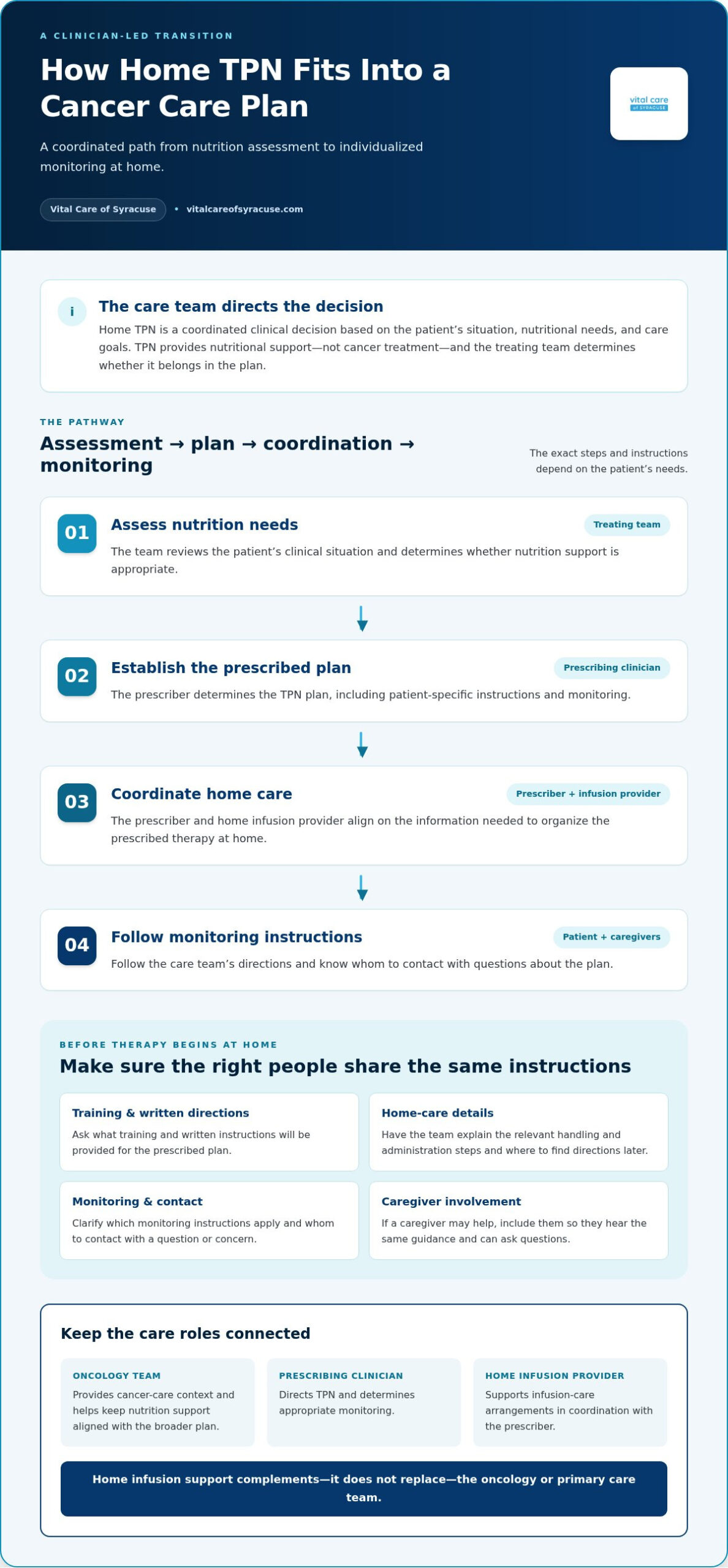
Beginning your journey with home parenteral nutrition is a structured and supportive process designed to instill confidence from day one. We follow a clear 3-step path to ensure a seamless transition from the hospital to your front door:
- Referral: Your physician or hospital discharge planner contacts our team to coordinate your specific nutritional requirements and insurance coverage.
- Training: A clinical expert meets with you to provide comprehensive, one-on-one instruction on your infusion pump, sterile techniques, and catheter care.
- Delivery: Your customized TPN formulations and essential supplies are delivered directly to your home on a predictable schedule that respects your time.
If you’re preparing for a transition to home care, speak with your doctor about how our specialized parenteral nutrition management Buffalo team can support your independence. Your path to a safe, comfortable recovery at home starts with a partner who understands your needs and respects your journey. Contact Vital Care of Syracuse today to learn more about our home TPN services and how we can help you reclaim your daily routine with confidence.
Reclaiming Your Independence with Professional Home Care
Transitioning to home-based therapy is a profound step toward healing, allowing you to trade the hospital environment for the comfort of your own living room. We’ve explored how a dedicated clinical team manages the complexities of your nutritional formula while providing the hands-on training you need to master your equipment safely. By prioritizing sterile techniques and local coordination, you can minimize risks and focus entirely on your recovery. The logistical challenges of home TPN become much lighter when you have a team that understands the specific needs of Western New York patients.
Achieving clinical stability through professional parenteral nutrition management Buffalo is a significant milestone on your health journey. As a locally owned and operated pharmacy serving Western and Central New York, Vital Care of Syracuse provides the specialized clinical expertise and 24/7 access to pharmacists and dietitians you need for total peace of mind. Our team acts as your protective advocate, ensuring every step of your home infusion is handled with precision and care. Contact Vital Care of Syracuse to discuss your home TPN management options in Buffalo and take the next step toward a safe, supported recovery. You don’t have to navigate this path alone; we’re here to provide the steady hand you deserve.
Frequently Asked Questions
What is the difference between enteral and parenteral nutrition?
Enteral nutrition is delivered via a feeding tube into the stomach or small intestine, while parenteral nutrition bypasses the digestive system entirely by delivering nutrients directly into the bloodstream through a central venous catheter. While enteral feeding is preferred when the gut is functional, parenteral nutrition is the life-sustaining alternative for those with severe malabsorption or intestinal failure. Both methods provide essential calories, but they require different clinical management and equipment.
Can I still eat food while on TPN?
You may be able to eat food while receiving TPN, but this depends entirely on your specific medical condition and your physician’s recommendations. Some patients are permitted “pleasure feeds” for comfort, even if they cannot absorb enough nutrients orally to sustain themselves. Your clinical dietitian will monitor your intake to ensure that your parenteral nutrition management Buffalo plan remains perfectly balanced with any oral consumption you are able to tolerate.
How many hours a day does a TPN infusion take?
Most home TPN infusions are administered over a period of 10 to 14 hours, a process often referred to as “cyclic” infusion. This schedule is frequently set for overnight hours, allowing you more freedom and mobility during the day. The exact duration is determined by your metabolic needs and how well your body tolerates the rate of the infusion, and your care team will adjust this schedule as your recovery progresses.
Is home TPN covered by insurance in New York State?
Home TPN is typically covered by insurance providers in New York State, including Medicare Part B and New York State Medicaid, when it is deemed medically necessary for a permanent condition. Coverage often falls under the “prosthetic device” benefit, which requires specific clinical documentation from your doctor. Our team works directly with your insurance provider to verify benefits and manage the necessary authorizations required to begin your home care.
What happens if my TPN pump alarms at night?
If your infusion pump alarms during the night, the first step is to check the display screen for a specific error code, such as an occlusion or air-in-line alert. Most issues can be resolved quickly by following the troubleshooting steps provided during your initial training. For any unresolved alarms or technical concerns, you have 24/7 access to our clinical pharmacists who can guide you through the process over the phone.
How do I know if my TPN line is infected?
Signs of a potential catheter infection include redness, warmth, swelling, or drainage at the insertion site, as well as systemic symptoms like fever or chills. It is vital to monitor these signs daily during your dressing changes and to maintain strict sterile techniques. If you notice any of these changes, contact your nursing team or physician immediately to prevent the infection from progressing or becoming more serious.
Can I travel while receiving home parenteral nutrition?
Traveling while on TPN is entirely possible with advance planning and the use of portable infusion pumps that fit into a backpack. We can help you coordinate supply deliveries to your destination or provide travel-sized kits to make the journey more manageable. It is helpful to notify your care team several weeks before your trip so we can ensure you have the necessary documentation and supplies for a safe journey.
Who coordinates my TPN lab results with my Buffalo doctor?
Your home infusion pharmacist and clinical dietitian take the lead in coordinating your lab results with your Buffalo-based physician. After your blood work is collected by a local nurse, our team reviews the data and recommends formula adjustments directly to your doctor. This seamless communication ensures that your parenteral nutrition management Buffalo plan stays aligned with your current health status and recovery goals without you needing to manage the logistics.
Leave a Reply