


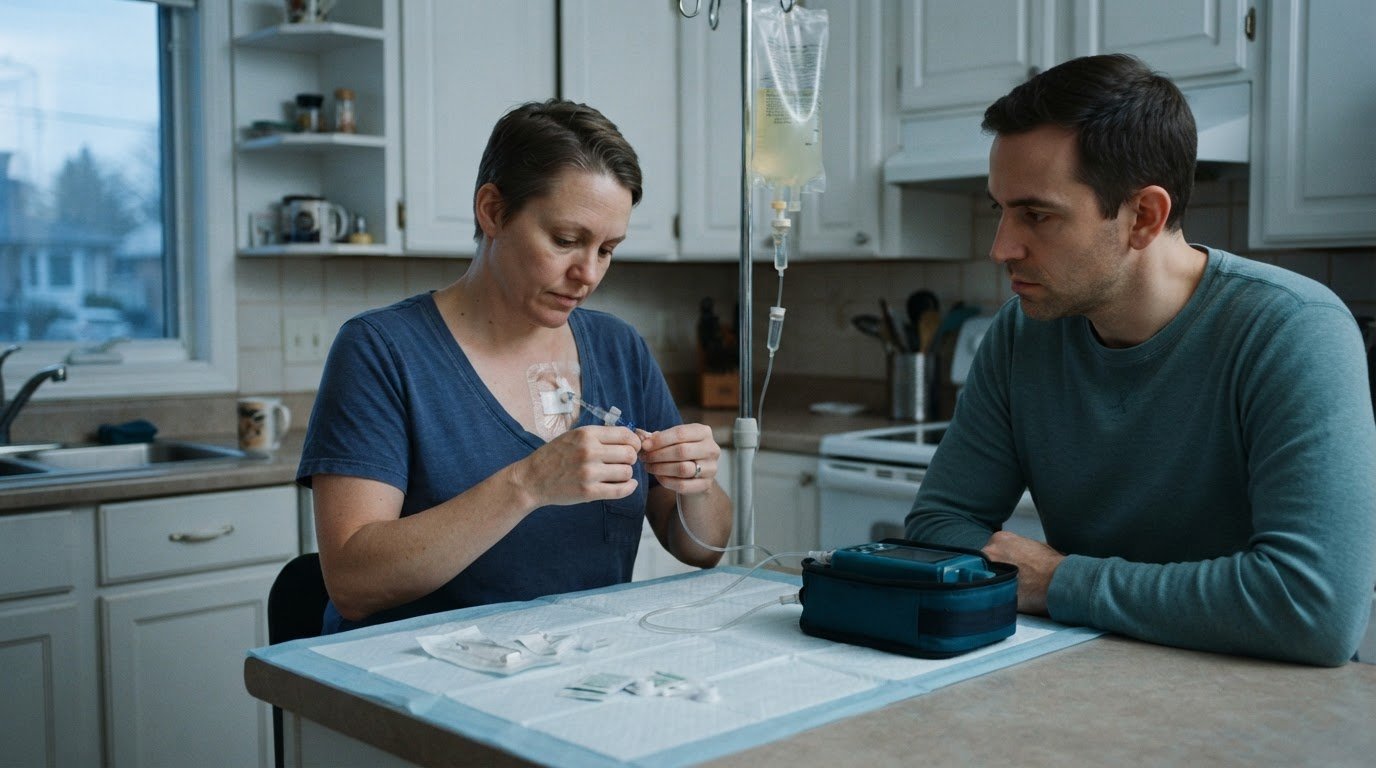
A cycled TPN infusion can create time away from the pump for work, appointments, or social plans. For people managing TPN cycling at home in Buffalo, infusion duration can range from 8 to 22 hours per day, depending on the prescribed regimen. The cycle length and daily routine need to work together safely.
It’s understandable to want clear guidance before making changes to a home infusion routine. This article explains how cycling can affect daily life, what influences cycle length, and how to connect and disconnect equipment and care for a catheter safely.
You’ll also learn why infusion timing is individualized and what practical details can make the routine manageable. Follow the instructions prescribed for your setup, because infusion steps and timing depend on your care plan.
Key Takeaways
- Cycled TPN can create time away from the pump for everyday activities, while the infusion schedule still needs to fit your prescribed care plan.
- Consistent hand hygiene and careful catheter handling are central to reducing infection risk during home infusions.
- Cycle length varies with the prescribed regimen and individual clinical needs, so changing infusion timing affects more than convenience.
- Learn what to expect when connecting and disconnecting equipment, and how home infusion support can help make TPN care more manageable.
Quality-of-life benefits of cycled parenteral nutrition
Cycled parenteral nutrition runs during a planned daily window rather than continuously. This can create time away from the pump for work, appointments, or social activities. The nutrition must still follow its prescribed schedule. For people considering TPN cycling at home in Buffalo, the practical benefit is time away from equipment, not changing an infusion independently.
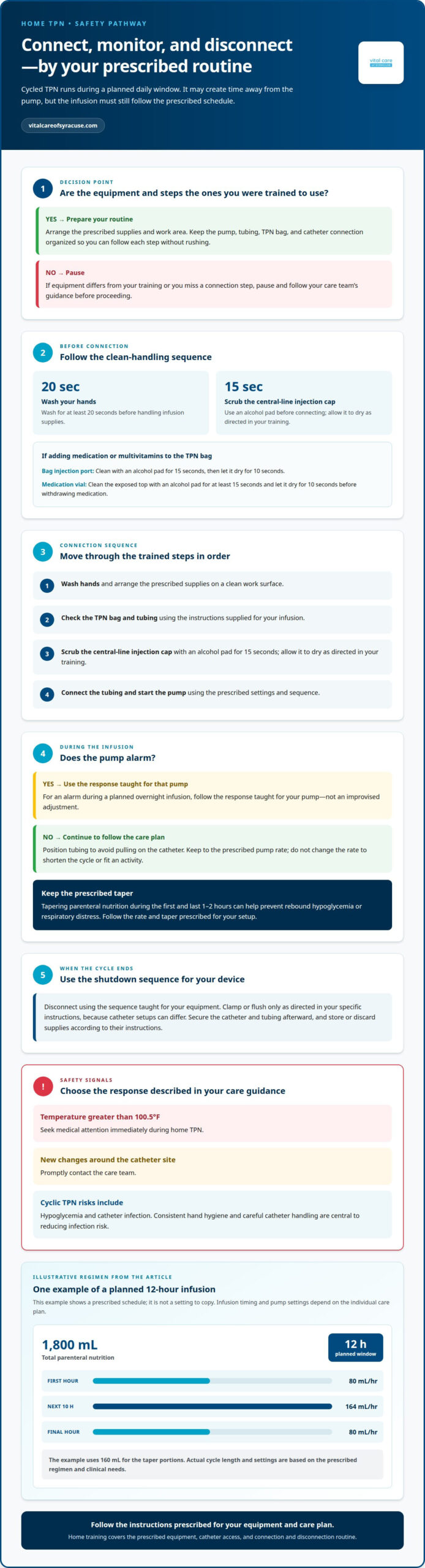
One example uses 1800 mL of parenteral nutrition over 12 hours. It starts at 80 mL per hour for the first hour, then runs at 164 mL/hr for 10 hours. The final hour returns to 80 mL per hour. In this example, 160 mL is used for the taper portions. The schedule shows how an infusion can fit within planned hours, leaving time away from the pump.
Cycling may be considered once a patient reaches their goal parenteral nutrition regimen with stable blood glucose and serum electrolytes. These measures help determine whether the planned regimen is suitable for cycling.
When cyclic TPN is started or changed, monitoring includes blood glucose and serum electrolytes. Results help assess tolerance of the schedule, while the monitoring plan is based on the prescribed regimen and clinical needs.
Home training should cover the prescribed infusion equipment, catheter access, and connection and disconnection routine. Practical instruction helps make each step familiar before home use, including how to handle TPN supplies and catheter care.
In Buffalo, hospital care teams and home-infusion services are involved in arranging home TPN. The care team coordinates the transition and infusion support needed for the prescribed regimen.
New York Medicaid and private insurance coverage for home TPN and infusion nursing follows the applicable plan terms. The benefit details determine what the plan covers for an individual’s care.
An infusion window can make daily planning feel less centered on equipment. When the prescribed schedule leaves time away from the pump, patients may be able to use that period for work, appointments, or social plans. This flexibility does not make the infusion optional or mean its prescribed timing should be changed. Consider how pump-free time fits your priorities.
Catheter care and infection prevention
Hand hygiene is a key part of preparing home TPN. Wash your hands for at least 20 seconds before handling infusion supplies. Follow the steps taught for your specific catheter and equipment, keeping the work area and supplies organized so the connection process is not rushed.
Disinfect the TPN bag injection port before adding medication or multivitamins. Clean it with an alcohol pad for 15 seconds, then let it dry for 10 seconds. If medication is added, clean the vial’s exposed top with an alcohol pad for at least 15 seconds and allow it to dry for 10 seconds before withdrawing it. Keeping these steps distinct helps avoid contaminating clean surfaces.
Use the catheter care routine provided for your equipment each time you prepare an infusion. Keep the supplies for that routine together, and follow the prescribed instructions rather than changing the sequence or adding medication independently. A consistent process makes it easier to notice if you have missed a step.
Cyclic TPN carries risks that include hypoglycemia and catheter infection. A temperature greater than 100.5 degrees is a reason to seek medical attention immediately during home TPN; new changes around the catheter site also warrant prompt attention from the care team.
Pay particular attention to how the infusion ends. Tapering parenteral nutrition during the first and last 1-2 hours can help prevent rebound hypoglycemia or respiratory distress. Keep to the prescribed rate and taper instead of adjusting the pump to fit an activity or schedule.
If an infection requires prescribed treatment delivered by infusion, anti-infective therapy may be relevant. Keep catheter care and any treatment plan guided by your clinical team, especially when symptoms or infusion instructions change.
Connecting and disconnecting the TPN setup
Cyclic TPN delivers prescribed nutrition through a central catheter during a set daily infusion window, rather than continuously. At home, the patient connects the prepared TPN bag and pump to the catheter, follows the prescribed pump settings, then disconnects when the cycle ends. The exact steps depend on the equipment and training for that setup.
Before connecting, prepare the supplies and work area according to your taught routine. Keep the pump, tubing, TPN bag, and catheter connection organized so you can follow each step without rushing. The central-line injection cap must be scrubbed with an alcohol pad for 15 seconds before connecting the infusion. Allow it to dry as directed in your training.
A careful sequence helps keep the process consistent:
- Wash your hands and arrange the prescribed supplies on a clean work surface.
- Check the TPN bag and tubing using the instructions supplied for your infusion.
- Scrub the central-line injection cap with an alcohol pad for 15 seconds.
- Connect the tubing and start the pump using the prescribed settings and sequence.
During the infusion, position the tubing to avoid pulling on the catheter. Follow the pump instructions and care plan for responding to alarms. Don’t change the rate to shorten the cycle. For example, an alarm during a planned overnight infusion calls for the response taught for that pump, not an improvised adjustment.
At the end of the cycle, use the shutdown and disconnection sequence taught for your device. Clamp or flush only as directed in your specific instructions, because catheter setups can differ. Secure the catheter and tubing afterward, and store or discard supplies according to their instructions. If you miss a connection step or the equipment differs from your training, pause and follow your care team’s guidance before proceeding.
Factors that influence cycle length
Cycled parenteral nutrition duration depends on the prescribed regimen and how the patient tolerates it. Reported cycling durations range from 8 to 22 hours per day, while home TPN infusions commonly run for 10-24 hours, depending on the prescription. These ranges describe different clinical schedules, not a target to choose without guidance.
Before cycling is considered, a patient should reach their goal parenteral nutrition regimen with stable blood glucose and serum electrolytes. These clinical measures help determine readiness. A preferred bedtime or busy daytime schedule alone does not establish that a shorter cycle is appropriate.
When transitioning from continuous TPN, clinicians assess the current regimen, glucose and electrolyte stability, and the proposed infusion window. They then prescribe the cycle and pump rates, with monitoring during the change. A randomized controlled trial found that transitioning from 24-hour continuous parenteral nutrition to a 12-hour cycle was safe for patients without diabetes or major organ dysfunction. That finding applies to the studied group, not automatically to every patient.
Infusion volume and the time available for delivery affect the required rate. A shorter window means the prescribed nutrition must run at a different rate than it would over a longer period. The rate and any taper are part of the prescription, not adjustments to make for convenience. Clinical status and lab results also help determine whether the schedule remains suitable.
If you’re balancing an overnight cycle with daytime appointments, discuss your preferred infusion window alongside the prescribed regimen. Keep the schedule consistent with the ordered pump settings, and report difficulties or changes in tolerance to your care team. Don’t shorten or extend a cycle independently.
For help coordinating prescribed TPN at home, discuss home infusion support with the care team.
Cycled parenteral nutrition can provide time away from the infusion pump for work, appointments, or social events. Plan around that time while following the prescribed schedule and pump settings.
The TPN bag may be removed from refrigeration 2 to 3 hours before the next home infusion cycle so it can reach room temperature. A 2013 estimate found that more than 25,000 individuals in the United States relied on home parenteral nutrition, underscoring the role of home infusion in care.
Vital Care of Syracuse: Home infusion
Vital Care of Syracuse provides home infusion, including parenteral nutrition (TPN), for people whose prescribed treatment is administered at home. If you’re considering home TPN or need support with an existing infusion plan, discuss how home infusion fits your treatment needs. Your TPN cycle length, pump settings, and catheter routine remain part of the prescribed care plan, so coordinate any changes with your clinical team.
Home infusion may also include anti-infective therapy or immunoglobulin (IVIG/SCIG), depending on the prescribed treatment. To discuss home TPN infusion, contact Vital Care of Syracuse.
Shape your next steps around daily life
Your infusion plan is also part of your daily routine. Consider which commitments matter most, such as work, family responsibilities, or regular appointments. Discuss those priorities with your clinical team so they can be considered alongside your prescribed care.
For TPN cycling at home in Buffalo, note what feels manageable and where the routine creates difficulty. This can focus a discussion about your current home infusion plan without changing pump settings or catheter routines on your own. Vital Care of Syracuse provides parenteral nutrition (TPN), anti-infective therapy, and immunoglobulin (IVIG/SCIG) as home infusion therapies.
Contact Vital Care of Syracuse to discuss home infusion support. With a clear plan and thoughtful support, you can approach the next step with greater confidence.
Frequently Asked Questions
How many hours per day is home TPN typically infused, and how is the schedule adjusted?
Home TPN commonly runs for 10-24 hours, depending on the prescription; cycled infusions can range from 8 to 22 hours per day. The schedule is tailored to the prescribed nutrition volume, infusion rate, and clinical needs. For example, a change in cycle length affects the rate needed to deliver the prescribed nutrition. Clinicians use the care plan and monitoring results to guide adjustments, rather than changing timing for convenience.
Which Buffalo-area hospitals and home infusion providers offer home TPN services?
Vital Care of Syracuse provides home infusion, including TPN, for patients in Buffalo and across Central New York. Hospital care teams coordinate home TPN with home-infusion services.
Leave a Reply