


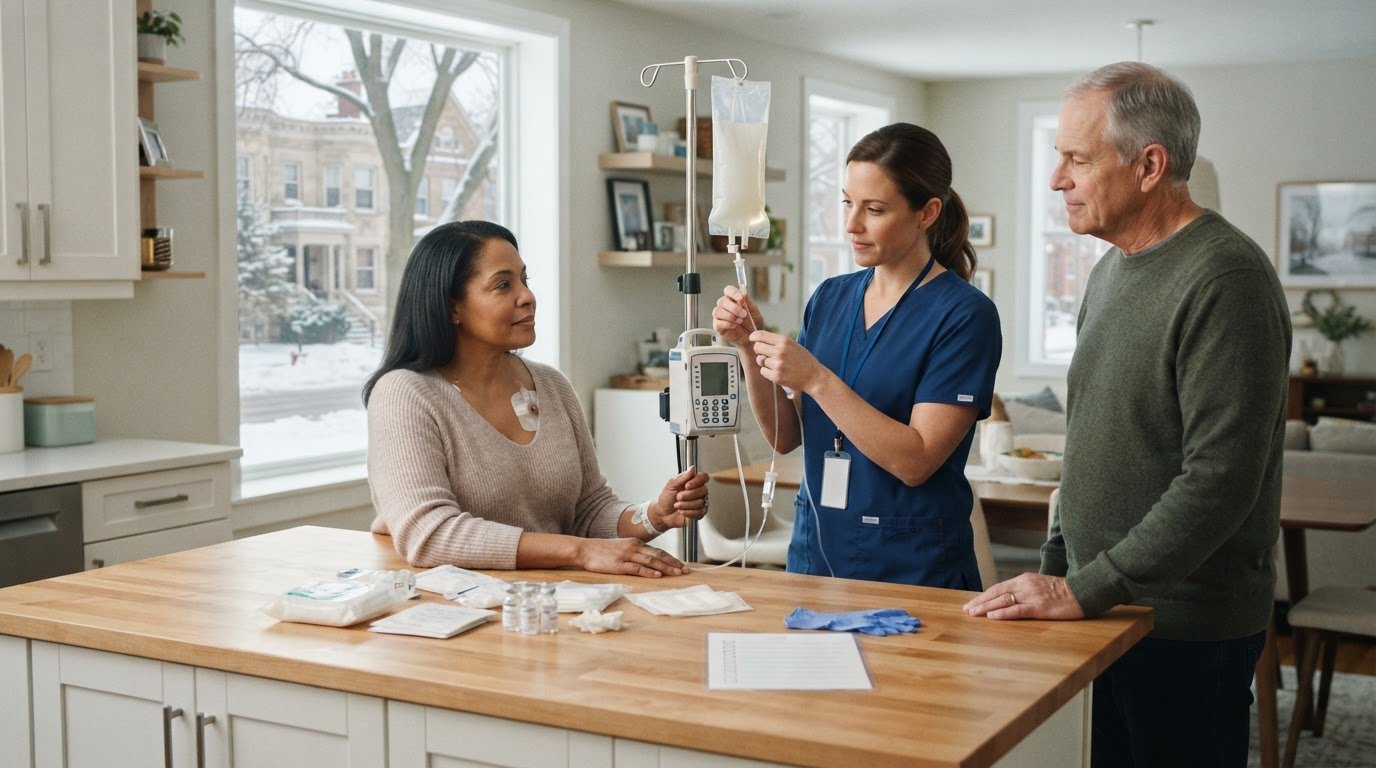
For someone with cancer, home TPN is a clinician-directed decision based on individual nutritional needs, the ability to absorb nutrients, and the goals of care. A search for “home TPN for cancer patients Buffalo” often starts with a practical question: could nutrition support be given at home, and what would that involve?
TPN is a complex therapy. It provides nutrition support, not cancer treatment, and the oncology and nutrition care teams determine whether it belongs in a patient’s plan. This guide explains what to discuss with the care team, how home and facility-based care differ, and what to organize before a transition home, including instructions, coordination, and insurance paperwork.
Vital Care of Syracuse provides home infusion, including parenteral nutrition, and serves Buffalo. Its infusion-care team works alongside the prescribing clinician and oncology team. The information below can help patients and caregivers prepare for a clear conversation about whether home TPN fits the prescribed plan.
Key Takeaways
- Learn what TPN is and why the patient’s clinical team must assess its role in cancer care.
- Understand how care can be coordinated from nutrition assessment and planning through home-care preparation and monitoring.
- Compare home and facility-based care by setting, daily routine, and coordination needs, with the patient’s clinical circumstances at the center.
- Use a practical checklist to prepare questions about instructions, home routines, caregiver roles, and coverage paperwork.
- See how home TPN for cancer patients Buffalo can involve a local infusion provider working alongside the prescribing clinician and oncology team.
Home TPN for Cancer Patients in Buffalo: Overview
Nutrition needs can change during cancer care, and patients and caregivers may have questions about which kinds of support are appropriate. A cancer diagnosis by itself does not determine whether TPN is suitable. If you’re searching for “home TPN for cancer patients Buffalo,” start by asking the treating team what nutrition concern they are assessing and what options they are considering.
Total parenteral nutrition (TPN) delivers nutrition directly into the bloodstream through a vein, rather than by mouth or through a feeding tube into the digestive tract. The clinical team selects and directs the access device and infusion method. TPN provides nutritional support; it does not treat or remove cancer.
The oncology team and clinicians involved in nutrition care consider the patient’s overall condition, nutritional needs, and ability to take in or use nutrition through the digestive system. They can explain TPN’s potential role, the practical requirements, and how the plan will be monitored in light of the patient’s goals of care. A general Parenteral Nutrition Overview can clarify terminology, but only the care team can determine what is appropriate for an individual.
How TPN differs from other forms of nutrition support
Oral nutrition comes from food and drinks swallowed and digested in the usual way. Enteral nutrition delivers formula into the digestive tract, commonly through a feeding tube. TPN delivers nutrients through venous access, bypassing the digestive tract. These routes address different clinical needs, so one is not universally better than another. The care team chooses the route and specifies the access device and infusion method based on the patient’s condition and care plan.
Why a cancer care team may discuss TPN
Cancer and its treatment can raise concerns about eating, digestion, or meeting nutrition needs, but those concerns do not automatically mean TPN is indicated. The treating team assesses the broader clinical picture and determines whether nutrition support is needed and which approach fits. Patients and caregivers can ask what prompted the discussion, which alternatives are being considered, what the plan is intended to address, and how the team will review it over time.
It also helps to clarify who will coordinate nutrition support with cancer care and whom to contact about day-to-day instructions. These questions keep the decision focused on the patient’s needs rather than assumptions about what a cancer diagnosis means. When home infusion is prescribed, Vital Care of Syracuse provides parenteral nutrition in coordination with the prescribing clinician and oncology team. The clinical team determines whether TPN is suitable and directs the patient’s care.
How Home TPN Fits Into a Cancer Patient’s Care Plan
Moving infusion care home is a coordinated clinical decision, not simply a change of location. For people considering home TPN for cancer patients Buffalo, the process starts with the treating team’s assessment and continues through planning, coordination, and individualized monitoring. The National Cancer Institute’s Parenteral Nutrition in Cancer Care reference offers background; the patient’s prescriber remains responsible for the individual treatment plan.
Home TPN relies on coordination between the prescribing clinician and the infusion-care team. Each has a distinct role, with the oncology team remaining part of the patient’s broader care.
A clinician-led path from assessment to home care
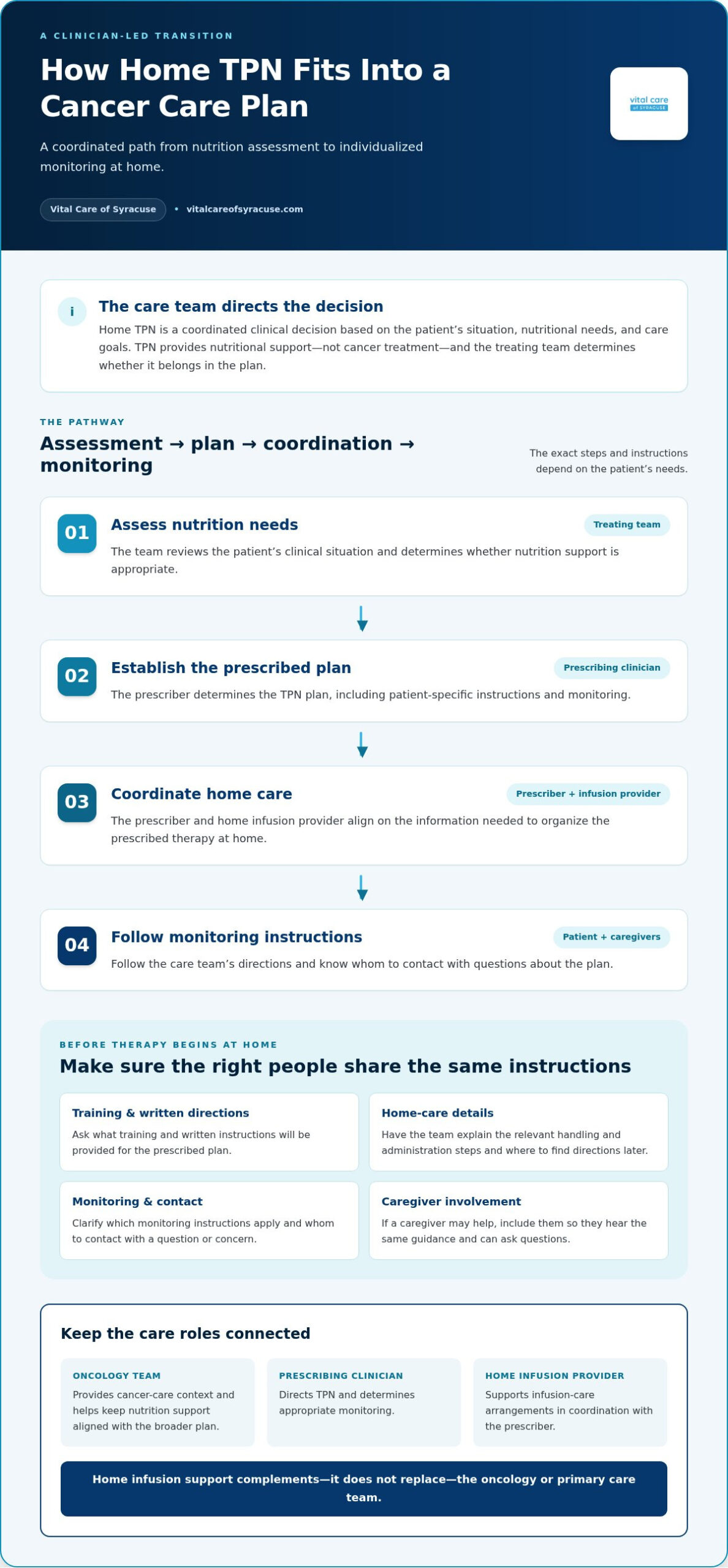
The exact steps depend on the patient’s needs. This general sequence shows how the transition is organized:
- Assess nutrition needs. The treating team reviews the patient’s clinical situation and determines whether nutrition support is appropriate.
- Establish the plan. The prescriber determines the TPN plan, including the patient-specific instructions and monitoring.
- Coordinate home care. The prescriber and home infusion provider align on the information needed to organize the prescribed therapy at home.
- Follow monitoring instructions. The patient and caregivers follow the care team’s directions and know whom to contact with questions about the plan.
Who may be involved in coordinating home TPN
The oncology team provides context about the patient’s cancer care and helps keep nutrition support aligned with the broader plan. The prescribing clinician directs TPN and determines appropriate monitoring. The home infusion provider supports the infusion-care arrangements in coordination with the prescriber. This support complements, rather than replaces, the oncology or primary care team.
Patients and caregivers can keep a shared list of questions to make conversations more useful: Who directs each part of care? Which instructions apply at home? Whom should you contact about a change or concern? What monitoring is expected, and how will the team communicate updates? Get these answers from the care team rather than relying on general online guidance.
What patients and caregivers may learn before home therapy
Before therapy begins at home, ask what training and written instructions will be provided for the prescribed plan. Have the clinical team explain the relevant handling and administration steps, applicable monitoring instructions, and where to find the directions later. If a caregiver may help, include them so they can hear the same guidance and ask questions.
Instructions must be specific to the patient’s care. Do not substitute a general checklist or online demonstration for directions from the clinical team. Ask for clarification if a step is unclear before proceeding. Understanding roles, instructions, and communication pathways can make a complex transition easier to manage. For an overview of Vital Care’s home infusion services, learn about Vital Care’s home infusion services.
Home TPN or Facility-Based Care? Questions for Cancer Patients in Buffalo
Where to receive TPN is part of the care plan, not a decision based on convenience alone. For people exploring home TPN for cancer patients Buffalo, there is no single setting that suits everyone. Home care may fit some circumstances, while facility-based care may better match others. The treating clinician determines the appropriate setting based on the patient’s clinical circumstances and care requirements.
Use the comparison below to prepare questions for the care team. It describes general differences, not a recommendation for a particular patient.
| Consideration | Home-based care | Facility-based care |
|---|---|---|
| Setting | Infusion takes place in the patient’s home, so the environment and available support are part of planning. | Infusion takes place in a clinical setting, with the facility’s care arrangements shaping the experience. |
| Daily routine | Care is incorporated into the home routine according to the prescribed plan and instructions. | The patient’s routine includes receiving care at the facility, with timing and arrangements directed by the care team. |
| Coordination needs | The patient, caregiver, prescriber, and infusion-care team may need to coordinate responsibilities and home instructions. | Care is organized around the facility setting, with the treating team guiding how services are coordinated. |
| Support and environment | Home layout, caregiver involvement, and access to support are topics to discuss with the clinical team. | The facility provides the setting for care. Patients can ask the team what support and follow-up are part of their plan. |
When home care may be considered
Home infusion may be considered after the clinical team has assessed the patient’s condition and the requirements of the prescribed therapy. Ask the treating clinician whether the patient’s situation supports care at home, what clinical stability means in this case, and what monitoring the plan involves. A general overview from Mayo Clinic on Parenteral Nutrition for Cancer can provide background, but it cannot determine the appropriate setting for an individual.
What to weigh when comparing care settings
Consider who will be involved in daily tasks, how the home environment fits the care plan, and how questions will be shared with the clinical team. If a caregiver may help, discuss the role and whether the person feels prepared. Home TPN is not suitable for every patient or home situation. Facility-based care can be appropriate when it better fits the patient’s needs.
Coverage and out-of-pocket costs vary. Ask the insurer or plan administrator how the prescribed care is handled, whether review or authorization is needed, and what patient responsibilities may apply. Coverage information is plan-specific and does not replace the clinician’s decision about the setting. Discussing these factors helps patients and caregivers weigh the options without assuming home care is always safer, less costly, or more convenient.
Preparing for Home TPN in Buffalo: A Patient and Caregiver Checklist
Preparing for home TPN involves more than arranging supplies. Patients and caregivers need clear, individualized instructions and a shared understanding of who is coordinating care. Use this checklist to organize conversations, not as a substitute for your clinical team’s directions. One patient’s plan may differ from another’s.
Start by clarifying the care plan, assigned roles, written instructions, contact information, and coverage paperwork.
Questions to discuss before transitioning home
Before the transition, ask the prescribing clinician and care team to explain how responsibilities are divided. Keep the answers with the written care instructions so patients and caregivers can refer to the same information.
- Plan and contacts: Who manages the TPN plan? Whom should you contact with non-emergency questions, and what should you do if you cannot reach that person?
- Monitoring: Which monitoring instructions apply to this patient, and how should concerns or changes be communicated to the care team?
- Symptoms and equipment: Which symptoms or equipment concerns should prompt a call, and whom should you contact about each? Follow the clinical team’s guidance on urgent situations.
- Caregiver role: What tasks, if any, will a caregiver be expected to perform? What training or written instructions should the patient and caregiver receive before managing those tasks?
Ask for clarification if an instruction is difficult to understand or conflicts with other guidance. Do not use a generic online checklist to make decisions about administration, handling, or symptoms.
Planning the home routine and Buffalo-area support
Discuss practical arrangements with the care team and infusion provider before home therapy begins. Together, they can address how the prescribed plan fits the home setting and what coordination it requires. For Buffalo-area patients, ask how the local infusion-care team and prescriber will communicate, and follow the arrangements they provide.
- Home routine: Discuss where care-related items should be kept and how to make the prescribed routine manageable within the household.
- Support people: Identify who can help with responsibilities assigned by the care team, and share relevant instructions with them.
- Information access: Keep current written instructions, care-team contacts, and notes about whom to call for different concerns in an accessible place.
- Coverage paperwork: Gather plan information and documents requested by the insurer or care team. Ask the plan administrator about applicable requirements and patient responsibilities, since coverage varies by plan.
Vital Care of Syracuse provides home infusion, including parenteral nutrition, and serves Buffalo. To learn about its role in coordinating infusion care, explore Vital Care’s home infusion services.
Vital Care’s Home TPN Support for Cancer Patients in Buffalo
When a clinical team prescribes TPN at home, coordinating the infusion-care component is an important part of putting the plan into practice. Vital Care of Syracuse provides home infusion services, including parenteral nutrition, and serves Buffalo. The team supports infusion care in coordination with the patient’s prescriber and oncology team; it does not diagnose or independently treat cancer.
Vital Care provides personalized care for complex clinical needs through home-based and suite-based infusion. The appropriate setting and clinical plan depend on the patient’s circumstances and the prescriber’s direction. For people looking into home TPN for cancer patients Buffalo, a local infusion provider can be part of the care team once the treating clinician has determined that home TPN is appropriate.
How a home infusion provider fits into the care team
The prescribing clinician directs the treatment plan and determines the clinical instructions and monitoring. The oncology team remains involved in the patient’s cancer care. Vital Care provides home infusion services as a partner in the infusion-care process, working alongside the care team rather than replacing it. This distinction helps patients understand who guides medical decisions and who supports the prescribed infusion service.
As you discuss the plan, clarify who provides clinical direction, how infusion-care coordination fits into that plan, and where to bring questions. Patients and caregivers can also ask how the selected home-based or suite-based approach will fit into care arrangements. These conversations keep attention on individual needs without assuming a particular schedule, equipment setup, or outcome.
A practical next step for Buffalo patients and caregivers
Start with the treating clinician. Ask whether home TPN is being considered for this patient, which clinical factors inform the decision, and how an infusion provider will coordinate with the existing care team. If home TPN is prescribed, discussing infusion-care arrangements can clarify the roles and information needed to organize care. The care team remains the source for patient-specific clinical guidance.
Vital Care provides Buffalo-area patients and caregivers with a local option for prescribed parenteral nutrition and home infusion support. Learning about the care pathway can help you prepare for a conversation about how infusion services fit alongside oncology care. Explore home infusion services with Vital Care.
Take the Next Step With a Clearer Conversation
You do not have to resolve every question about nutrition support at once. Start with the concern that matters most to you or your family and bring it to the treating clinician. A focused conversation can clarify what the care team is considering, which choices are available, and how they relate to the patient’s needs and priorities.
If you’re exploring home TPN for cancer patients Buffalo, discuss the clinical plan with the treating team first, then learn about infusion support that fits the prescribed approach. Patients and caregivers deserve clear explanations and time to understand what comes next.
Learn about Vital Care’s home infusion services and take the next step in understanding your options. Vital Care of Syracuse provides home infusion, including parenteral nutrition, for patients whose care teams prescribe it.
Frequently Asked Questions
Can cancer patients receive TPN at home?
Yes. Some cancer patients receive TPN at home when their treating clinician determines it is appropriate and the home-care plan can meet their needs. A cancer diagnosis alone does not establish that TPN or home administration is suitable. For home TPN for cancer patients Buffalo, ask which factors guide the decision, what alternatives have been considered, and how the plan will be reviewed if the patient’s condition changes.
What is home TPN for cancer patients?
Home TPN is prescribed nutrition support administered through venous access while the patient is at home. The formulation and instructions are specific to the individual, so another patient’s routine or solution is not a guide. The care team can explain what the prescribed plan contains, how it fits with other care, and which written instructions apply.
Is home TPN safe for cancer patients?
Home TPN can involve risks, so safety depends on the patient’s circumstances, following clinical instructions, and appropriate follow-up. Potential concerns can include infection related to venous access and changes in fluid or nutrient balance. Before starting, ask the care team which changes or symptoms need prompt attention, how to handle an infusion concern, and whom to contact. Follow patient-specific guidance rather than general online advice.
How long can a cancer patient stay on TPN?
There is no single duration that applies to every cancer patient. TPN may be prescribed for a limited period or longer, depending on why it is needed and the patient’s changing clinical situation. The prescribing clinician determines how long to continue it and when to reassess. Ask what goals the team will use to review the plan and what changes might lead them to adjust or stop TPN.
Does insurance cover home TPN in Buffalo?
Coverage may be available, but approval and out-of-pocket responsibility depend on the patient’s policy, clinical documentation, and applicable authorization requirements. Medicare Part B coverage has specific medical-necessity criteria, so coverage should not be assumed from a cancer diagnosis alone. For patients in Buffalo, Syracuse, Albany, Rochester, Utica, Auburn, and Binghampton, ask the insurer or plan administrator to review the prescribed service and the patient’s benefits.
What should caregivers ask before home TPN begins?
Caregivers can ask what responsibilities they will have, what instruction they should receive, and where written directions will be kept. Clarify whom to call about an unclear instruction, a supply or infusion concern, or a change in the patient’s condition. It is also useful to ask how care updates should be shared with the prescribing clinician. These answers help caregivers understand their role without taking on clinical decisions that belong to the care team.
Does TPN treat cancer?
No. TPN provides nutrition support; it does not destroy cancer cells or replace cancer-directed treatment. If TPN is discussed during cancer care, ask the oncology team and prescribing clinician what nutrition concern they are addressing and how TPN fits alongside the broader plan. This helps patients and families distinguish nutritional support from chemotherapy, radiation, surgery, or other therapies intended to treat cancer.
Leave a Reply