



SCIG is more than a different way to receive immunoglobulin. It is a prescribed treatment plan, not simply a different needle route. If your care team has mentioned SCIG, it is understandable to wonder how it differs from IVIG and what treatment at home might involve.
This guide explains SCIG, including how it is administered, what practical questions to raise with your care team, and how it compares with IVIG. You will also learn how home-based or suite-based infusion support from Vital Care of Syracuse can fit into an individualized care plan.
Treatment decisions depend on individual medical needs. Use this overview to prepare for a conversation with your care team, not to make changes to your treatment. We will walk through key details so you can discuss your options with greater confidence.
Key Takeaways
- Learn what SCIG means and how it differs from IVIG in practical terms.
- Understand common treatment-planning steps while recognizing that instructions vary by person.
- Use questions about suitability, setting, and logistics to prepare for a conversation with your care team.
- Understand why medication-specific safety guidance and follow-up matter during treatment.
- Learn how home-based or suite-based infusion support from Vital Care of Syracuse serves patients across Central New York.
What Is SCIG? Understand the Basics of Subcutaneous Immunoglobulin
SCIG (subcutaneous immunoglobulin) is immunoglobulin therapy administered beneath the skin. A clinician prescribes it when this route is appropriate for a person’s needs. Immunoglobulins are antibodies, proteins that help the immune system recognize and respond to potential threats. The therapy supplies antibodies from donated plasma as part of a clinician-directed treatment plan.
SCIG describes how the medication is given, not a treatment to choose independently or swap for another therapy. IVIG means intravenous immunoglobulin, which is administered into a vein. Both involve immunoglobulin, but the route and practical arrangements differ. For a general overview of immunoglobulin therapy, readers can explore how these administration methods fit within the broader treatment category.
A video can make the terminology and equipment more familiar. This demonstration shows one example of SCIG infusion equipment. It is not a substitute for medication-specific training or instructions from your care team.
What does subcutaneous immunoglobulin mean?
“Subcutaneous” means beneath the skin. In SCIG treatment, immunoglobulin is delivered into the tissue under the skin rather than directly into a vein. The medication, administration approach, and schedule depend on the prescribed plan. A video or general article can introduce the concept, but it cannot tell you how to administer your specific treatment.
People searching for SCIG may encounter unfamiliar terms, but the central distinction is straightforward: SCIG is the under-the-skin route for immunoglobulin therapy, while IVIG is the intravenous route. Neither abbreviation alone tells you which approach is suitable for you.
Why might a clinician prescribe immunoglobulin therapy?
A clinician may consider immunoglobulin therapy when a person’s medical needs indicate that antibody-containing treatment should be discussed. The decision depends on individual clinical circumstances, the medication being considered, and the broader care plan. This overview offers general education, not a diagnosis, eligibility checklist, or recommendation to begin, stop, or change therapy.
If SCIG comes up at an appointment, useful questions include: Why is this route being considered for me? How would the plan be tailored to my needs? What training and follow-up would be involved? Your treating clinician and care team can explain the reasoning and provide instructions specific to your treatment.
How SCIG Treatment Is Administered and Fits Into a Care Plan
Planning for SCIG is a clinical process, not a routine to copy from a general guide or video. The prescribing clinician determines whether this route fits your needs, then the care team provides instructions for the prescribed medication and care setting. Plans differ, so follow your treatment instructions rather than assuming a standard dose, schedule, or technique.
General SCIG education can help you prepare for common care-planning topics. Only the prescribing clinician and qualified care professionals can provide an individual regimen.
What happens when SCIG care is planned?
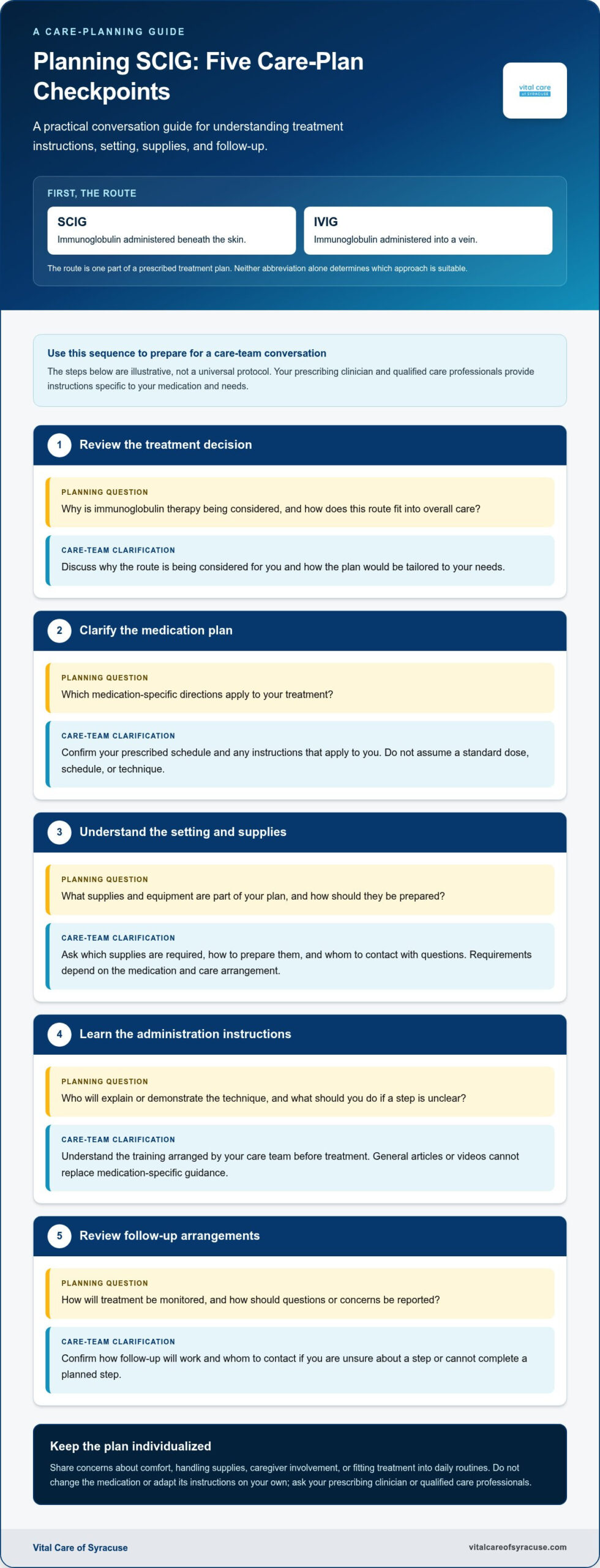
A care plan may include steps like these. This sequence is illustrative, not a universal protocol:
- Review the treatment decision. Discuss why immunoglobulin therapy is being considered and how the route fits into your overall care.
- Clarify the medication plan. The prescribing clinician establishes medication-specific directions, including your schedule and any instructions that apply to you.
- Understand the setting and supplies. Ask which supplies and equipment are part of your plan, how to prepare them, and whom to contact with questions. Requirements depend on the medication and care arrangement.
- Learn the administration instructions. Before treatment, make sure you understand the technique and any training arranged by your care team. Do not rely on general directions in place of this guidance.
- Review follow-up arrangements. Confirm how your care team will monitor treatment and how to report questions or concerns.
These steps can help organize a conversation, but they do not set a patient-specific plan. The professionals overseeing your care provide your exact instructions.
What should patients discuss before treatment begins?
Raise practical concerns early. Ask who will explain or demonstrate administration, whether a caregiver can be involved, what to do if you are unsure about a step, and how follow-up will work. Share concerns about handling supplies, comfort, or fitting treatment into daily routines. Clear answers can help you understand the plan and know where to turn for guidance.
Direct questions about preparation, administration, and what to do if you cannot complete a planned step to your prescribing clinician or qualified care professionals. Do not change the medication or adapt its instructions on your own.
Vital Care of Syracuse provides home infusion and suite-based infusion services, including immunoglobulin therapy. Read about home infusion support as you discuss care settings with your team.
SCIG and IVIG: Compare the Practical Differences Without Assuming One Is Best
SCIG and IVIG deliver immunoglobulin by different routes, which can affect how treatment fits into a person’s routine and care setting. The comparison below is educational. Use it to prepare questions, not to determine which therapy is right for you. Your treating clinician can consider your clinical history, treatment goals, and preferences when discussing the options.
How do the treatment routes differ?
SCIG is administered under the skin, while IVIG is administered into a vein. Practical arrangements depend on the prescribed medication and individual plan. SCIG is often given in smaller, more frequent administrations, while IVIG is generally given less frequently. These are broad patterns, not schedules to follow or expect in every case.
| Consideration | SCIG | IVIG |
|---|---|---|
| Route | Under the skin | Into a vein |
| Treatment logistics | May involve more frequent administrations; the setting and support depend on the plan. | Often involves less frequent infusions; the setting and arrangements depend on the plan. |
| Ask your care team | What training, supplies, and support would my plan involve? | What setting, timing, and support would my plan involve? |
More frequent SCIG administration may help maintain more even immunoglobulin levels over time, though individual experiences vary. Potential reactions also depend on the medication and person. Ask your care team what effects to watch for and how to report concerns rather than assuming either route will feel or work the same for everyone.
What questions can help guide a clinician discussion?
Shared decision-making means discussing options with your clinician, not choosing or changing therapy on your own. Consider asking:
- How do my medical history and treatment goals inform the options?
- What would each route mean for my routine and care setting?
- What training or practical support would be available?
- How would the care team monitor treatment and address concerns?
- How can my preferences be considered alongside clinical needs?
It may help to write down questions about schedule, setting, comfort, or support before an appointment. For a fuller discussion of SCIG versus IVIG, review the related comparison article on this site. Bring questions about suitability or medication-specific instructions to your prescribing clinician.
SCIG Safety and Everyday Care: Prepare for Questions, Instructions, and Follow-Up
Safe care depends on following the instructions for your prescribed medication and staying connected with the clinicians overseeing your treatment. Potential reactions and precautions can vary with the medication and a person’s health. Home administration does not remove the need for clinical guidance, monitoring, or follow-up.
Which safety topics should patients review with their care team?
Ask your prescribing clinician or qualified care professional what concerns to watch for, how to respond, and how to report them. Guidance is medication-specific, so do not use a general article to decide whether a symptom is expected or how to manage it. Follow the instructions provided for your treatment, and contact your care team if you are unsure about an administration step or have routine treatment questions.
Keep your clinicians informed about relevant health changes, allergies, and medicines you take, including nonprescription products and supplements. This context helps them give advice that reflects your circumstances. Do not change your medication, dose, schedule, or administration technique on your own. Discuss questions or proposed changes with the prescribing clinician.
For urgent or severe symptoms, follow the emergency guidance provided with your medication and seek urgent medical care. If a situation appears life-threatening, contact local emergency services. Routine questions about instructions or follow-up belong with your treatment team, but emergency concerns need prompt medical attention.
How can patients feel more prepared for ongoing care?
A few simple habits can make instructions easier to use and follow-up conversations more productive:
- Keep your current treatment instructions and care-team contact information somewhere easy to find.
- Write down questions as they arise, including concerns about preparation, supplies, or fitting treatment into daily life.
- Bring relevant updates about your health, allergies, or medicines to follow-up discussions.
- If a step is unclear, pause and contact the appropriate care professional instead of improvising.
These steps support an informed conversation, but they do not replace the plan created for you. People receiving SCIG at home still rely on their prescribing clinician and care team for treatment-specific instructions and ongoing oversight. Clear communication can help you understand what to do and whom to contact when questions arise.
Vital Care of Syracuse provides home-based and suite-based infusion services, including immunoglobulin therapy. Explore home infusion support as part of your care-planning conversation.
SCIG Home Infusion Support in Central New York: What Care Can Look Like
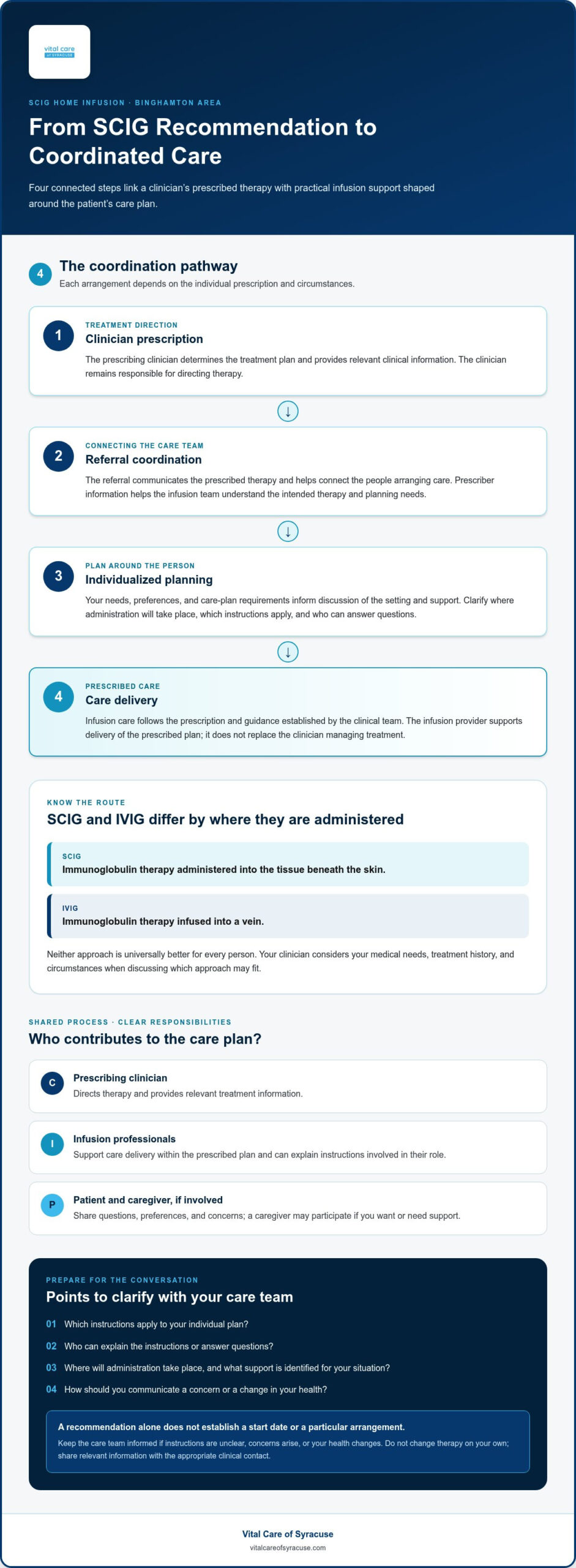
Choosing a care setting is part of the conversation around immunoglobulin therapy. Home-based or suite-based infusion can be part of a care plan when the prescribing clinician considers it appropriate. The setting does not change who guides treatment: care remains connected to the prescribing clinician and the instructions established for each person.
How can local home infusion support the care journey?
Home-based care allows treatment to take place in a familiar setting, while a suite-based option provides a dedicated location for infusion care. Which setting fits depends on the prescribed plan, clinical considerations, and the patient’s circumstances. Neither option is right for everyone, and a general description cannot determine whether either is suitable for a particular person.
Vital Care of Syracuse provides home-based and suite-based infusion services, including immunoglobulin therapy such as SCIG. Support is considered in relation to the patient’s care plan, rather than assuming everyone has the same needs or experience. Treatment-specific instructions and decisions remain with the clinician and care professionals overseeing the patient’s care.
Based in East Syracuse, Vital Care of Syracuse serves communities including Syracuse, Albany, Rochester, Utica, Buffalo, Auburn, and Binghampton. For patients across these New York communities, local home infusion support can connect the care setting with the broader treatment plan. Patients can discuss with their prescribing clinician whether home or suite-based care fits their clinical needs and what guidance is involved.
What are the next steps for learning about SCIG care?
If you are exploring SCIG, bring your questions to the clinician who prescribes or oversees your treatment. Ask how the route relates to your care goals, what setting may be appropriate, and how clinical support and follow-up fit into the plan. Your care team can explain your individual options.
Vital Care of Syracuse offers immunoglobulin therapy and home infusion services in Central New York. Learn more about Vital Care of Syracuse infusion services.
Take the Next Step With Clear, Personalized Guidance
Understanding SCIG can make conversations about immunoglobulin therapy feel less daunting. The key distinction is its route of administration, but the route alone does not determine whether it is right for you. Your prescribing clinician considers your needs and provides treatment-specific instructions, including guidance on administration, safety, and follow-up.
Comparing SCIG and IVIG can help you identify practical questions about setting, routine, and support. Use general information to prepare for that discussion, not to choose or change a treatment plan independently. If home-based or suite-based infusion is part of the conversation, care should remain connected to your clinical team and individualized plan.
Vital Care of Syracuse offers immunoglobulin therapy, including IVIG and SCIG, with home-based and suite-based infusion services. Explore home infusion and immunoglobulin care to learn more about support from Vital Care of Syracuse. With clear instructions and informed conversations with your care team, you can take your next step feeling more prepared.
Frequently Asked Questions
What is SCIG therapy?
SCIG therapy is immunoglobulin treatment administered beneath the skin. Immunoglobulin contains antibodies, proteins that help the immune system respond to potential threats. A clinician may prescribe this route as part of an individualized care plan after considering a patient’s needs. SCIG describes how the medication is given; it is not a treatment to select or adjust without guidance from the prescribing clinician and care team.
How is SCIG different from IVIG?
SCIG is given under the skin, while IVIG is infused into a vein. The different routes can mean different treatment routines and care arrangements. SCIG may involve more frequent administrations, while IVIG is generally given less often, but individual schedules vary. Neither route is best for everyone. A clinician considers medical history, treatment goals, and practical needs when discussing which approach may be appropriate.
Can SCIG be administered at home?
SCIG may be administered at home when it is part of a clinician-directed plan and the patient has received the instructions and support needed for their treatment. Home administration does not replace clinical oversight or follow-up. Vital Care of Syracuse provides home-based and suite-based infusion services, including immunoglobulin therapy, for patients in areas including Syracuse, Albany, Rochester, Utica, Buffalo, Auburn, and Binghampton.
How often is SCIG given?
The timing of SCIG varies according to the prescribed medication and individual treatment plan. It is often administered more frequently than IVIG, but there is no schedule that applies to everyone. Your prescribing clinician determines the regimen and explains how to follow it. Do not change the timing or amount on your own. Raise scheduling concerns or questions about missed or delayed treatment with your care team.
What happens if I have a reaction during or after SCIG?
Follow the medication-specific instructions from your care team if you notice a possible reaction during or after SCIG. Ask in advance which concerns to report and how to reach your treatment team for routine guidance. If symptoms are severe or seem life-threatening, seek urgent medical care or contact local emergency services. Do not try to manage a reaction by changing your medication or administration plan without clinical direction.
Is SCIG the right treatment for every patient who needs immunoglobulin?
No. SCIG is not appropriate for every patient or every treatment situation. The prescribing clinician assesses whether this route fits a person’s clinical needs, history, goals, and circumstances, and discusses relevant options with them. General information can help you prepare questions, but it cannot determine which therapy is suitable for you. Share your concerns and preferences with your clinician before starting or changing immunoglobulin treatment.
Leave a Reply