



An at-home infusion may seem like the simplest option, but clinical suitability comes before convenience when you have ITP. If IVIG is part of your treatment discussion, you may be wondering what IVIG for ITP at home Rochester care could involve, how safety is managed, and who coordinates the details. These are useful questions to raise with your clinical team.
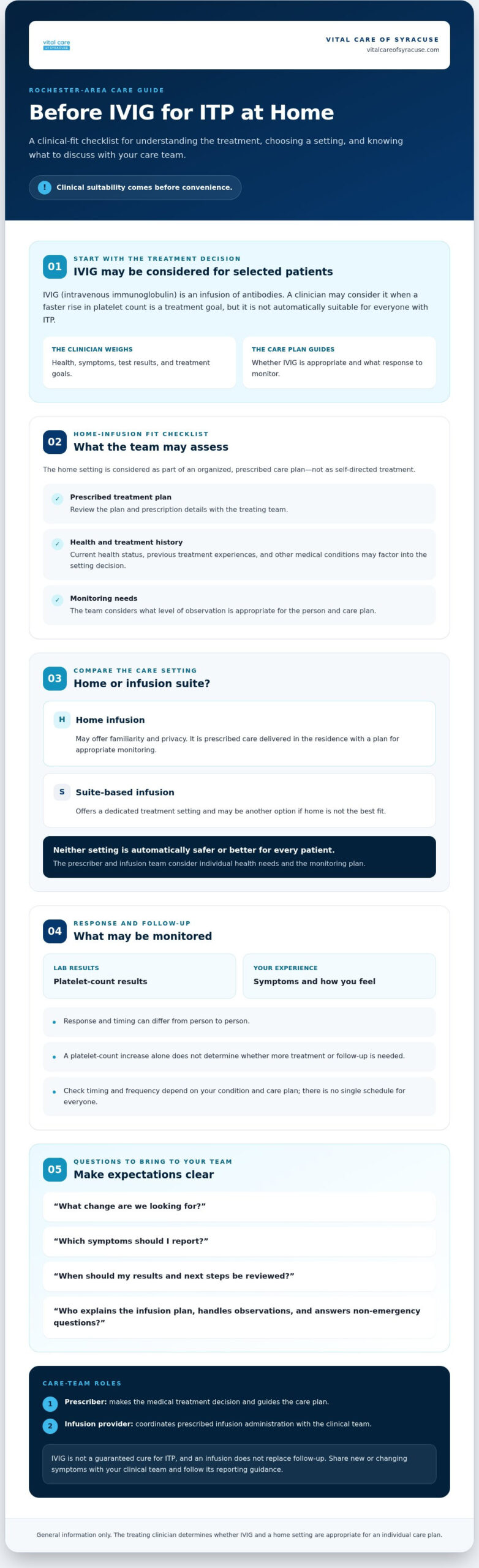
A clinician may consider IVIG when a faster rise in platelet count is a treatment goal, but it isn’t the right choice for every person or situation. This guide explains its possible role in ITP care without replacing personal medical advice. You’ll learn what an assessment for home infusion may involve, what to expect from the infusion setting, and how the prescriber, infusion provider, and insurer may coordinate. We’ll also cover symptoms to report and how home and suite-based infusion care in Rochester can fit into a plan directed by your treating team.
Key Takeaways
- Learn what ITP, IVIG, and platelets mean, and why a treating clinician determines whether IVIG belongs in an individual care plan.
- Understand that platelet response and its timing can vary, and identify useful questions to raise with the clinical team.
- Compare home and suite-based infusion settings while keeping appropriate monitoring and personal clinical needs in focus.
- Prepare for an IVIG discussion by gathering medication and allergy details, relevant health history, and current concerns.
- Explore how IVIG for ITP at home Rochester may involve coordination between the prescriber, infusion provider, and insurer.
What IVIG for ITP means, and what home treatment in Rochester can involve
A low platelet count can raise questions about which treatments may help and where they can be given. Understanding the terms is a useful first step, but only the treating clinician can determine whether IVIG is appropriate for an individual’s ITP care plan. The information here is general and isn’t a diagnosis, prescription, or promise of a particular result.
How ITP and IVIG relate
Immune thrombocytopenia, often called ITP, is an immune-mediated condition associated with a lower-than-normal number of platelets. Platelets are blood components that help form clots and control bleeding. The condition and its treatment options can vary from person to person. A general overview of immune thrombocytopenic purpura can provide background, but it can’t guide an individual treatment decision.
IVIG, or intravenous immunoglobulin, is an infusion of antibodies. Clinicians may use it in selected circumstances as part of ITP treatment, based on a person’s health, symptoms, test results, and treatment goals. It isn’t automatically suitable for everyone with ITP. The prescribing clinician can explain why it’s being considered, what response they’ll monitor, and what other care options may be relevant.
What patients mean by IVIG at home
Home infusion means prescribed treatment is administered in a patient’s residence as part of an organized care plan. It isn’t self-directed treatment. Patients don’t independently decide to start IVIG, adjust the dose, or replace clinical monitoring with at-home observation alone.
For IVIG for ITP at home Rochester, the treating team first considers whether the home setting fits the patient’s clinical needs. That assessment may include the prescribed treatment plan, health history, and level of monitoring considered appropriate. If home care isn’t the best fit, a suite-based infusion setting may be another option to discuss.
A specialty infusion provider coordinates prescribed infusion care with the clinical team, while the prescriber remains responsible for the medical treatment decision. Patients can ask who will explain the infusion plan, how observations during treatment will be handled, and whom to contact with non-emergency questions. The right setting is the one that supports the prescribed care and appropriate monitoring, not simply the most convenient location.
Vital Care of Syracuse provides home-based and suite-based infusion services, including immunoglobulin therapy, to Rochester-area patients. The care setting is considered in coordination with the treating team, with individual clinical needs guiding the plan.
How IVIG may affect ITP, and what patients should ask about response
For some people with ITP, a clinician may consider IVIG when treatment is intended to increase the platelet count. In brief, IVIG for ITP is an infusion of antibodies that may help raise platelet counts in selected patients. The overview of immune thrombocytopenic purpura provides background on the condition and treatment approaches, but your hematologist or prescribing clinician is the right source for advice about your care.
A change in a lab result is only one part of the picture. The clinical team also considers symptoms, bleeding concerns, medical history, and treatment goals. Response and timing differ among individuals, and a platelet-count increase doesn’t by itself determine whether additional treatment or follow-up is needed.
What the treating team may monitor
Your clinician may follow platelet-count results alongside your symptoms and how you feel, then use that information to assess the treatment plan. The timing and frequency of checks depend on your condition and care plan, so there isn’t one monitoring schedule that applies to everyone. Share new or changing symptoms with your clinical team and follow its guidance on when and how to report them.
Before treatment, consider asking: What change are we looking for? Which symptoms should I report? When should my results and next steps be reviewed? These questions help clarify what to expect without assuming a specific response.
Benefits, limitations, and treatment uncertainty
IVIG may offer a potential benefit in selected clinical circumstances, but the prescriber weighs that possibility against individual risks and other treatment options. It isn’t a guaranteed cure for ITP, and receiving an infusion doesn’t replace follow-up. Ask your hematologist or prescribing clinician to explain why IVIG is being considered, which possible side effects matter for you, and how the team will assess whether the plan is helping.
If an infusion is prescribed, the infusion provider can coordinate its administration with the clinical team. Patients considering IVIG for ITP at home Rochester can discuss how monitoring and communication will be handled at home, or whether a suite-based setting better fits the care plan. Explore Rochester-area infusion care as part of that conversation with your treating team.
Home IVIG or a facility: addressing Rochester patients’ safety concerns
Choosing where an IVIG infusion takes place is part of the care plan, not simply a matter of preference. Home may offer familiarity and privacy, while a suite provides a dedicated treatment setting. Neither location is automatically safer or better for every patient. The prescriber and infusion team consider the person’s health needs and monitoring plan before deciding whether home infusion is appropriate.
When the care setting needs individual assessment
The decision may take into account current health status, previous treatment experiences, other medical conditions, and prescription details. The team also considers what observation is needed during the infusion and how concerns will be addressed. These factors are evaluated together. Patients shouldn’t use a checklist to decide on their own whether home IVIG is suitable.
Home infusion can make treatment part of a familiar routine, while a suite offers a separate, prepared setting. In either location, the care team should explain what the infusion process involves and how it will follow the prescribed plan. For IVIG for ITP at home Rochester, suitability is determined through clinical assessment and coordination between the prescriber and infusion provider, not convenience alone.
What monitoring and response planning can mean
The infusion team follows the prescribed instructions and observes the patient as set out in the care plan. Before treatment, clarify what monitoring will take place, which symptoms to report, and whom to contact with non-emergency questions during or after the infusion. Keep those contact instructions accessible and follow the treating team’s guidance if symptoms change.
Some reactions may need prompt attention. Seek urgent medical evaluation for severe or rapidly worsening symptoms, such as trouble breathing, swelling of the face or throat, chest pain, fainting, confusion, a severe headache, or significant bleeding. This list isn’t exhaustive, and it doesn’t replace instructions from your clinician. For a medical emergency, call 911 rather than relying on a routine contact pathway.
Before treatment begins, ask how the prescriber and infusion team will communicate about the plan and follow-up, and what to do if a symptom appears after the team has left. Clear roles can make the experience more predictable: the prescriber directs the medical plan, and the infusion team coordinates and administers the prescribed therapy in the selected setting.
How Rochester-area patients can prepare for a home IVIG discussion
Preparing for a treatment conversation can help the clinical team understand what matters to you. Start with the prescribing clinician’s recommendation, then discuss the infusion setting and the steps needed to coordinate care. Home treatment isn’t decided by preference alone. The plan should reflect your clinical needs.
Questions to discuss with the hematology team
Bring a current medication list, known allergies, relevant medical history, and notes about symptoms or concerns. Ask the hematologist or prescribing clinician:
- Why is IVIG being considered, and what are the treatment goals?
- What monitoring and possible adverse effects should I understand?
- Which symptoms should I report, and whom should I contact with questions?
- Does home or suite-based infusion better fit my current health and treatment plan?
These questions can help you understand the reasoning behind the recommendation without assuming that IVIG or home administration is right for every patient. For related information about infusion care for bleeding disorders, see this bleeding disorder therapy guide.
Coordinating home infusion in the Rochester area
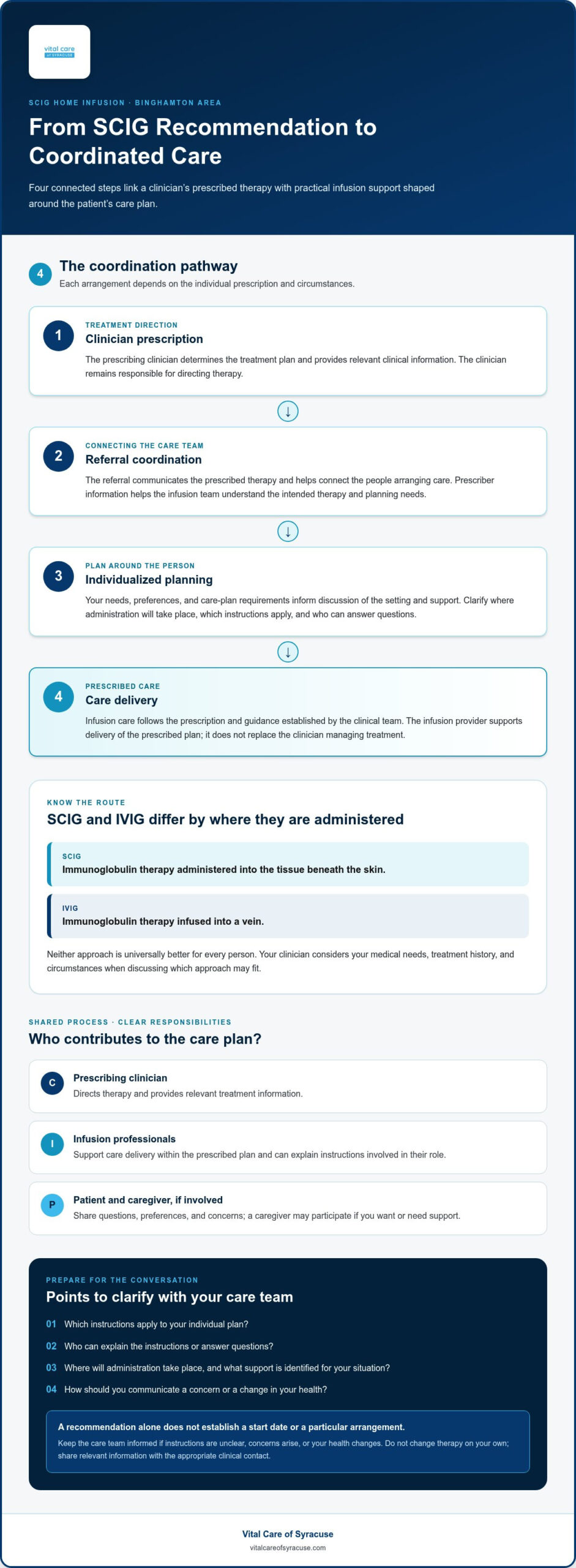
If the treating clinician prescribes IVIG, the prescriber and infusion provider coordinate the prescribed plan. That coordination may include sharing treatment instructions and relevant clinical information, arranging the selected care setting, and clarifying how the patient and clinical team will stay informed. The infusion provider supports administration and coordination; the prescribing clinician directs the medical treatment.
Authorization and scheduling depend on the individual treatment plan and payer processes. Coverage isn’t automatic, so ask the prescribing team or insurer which steps apply and what information may be needed. Rochester is among the New York locations served by Vital Care of Syracuse, along with Syracuse, Albany, Utica, Buffalo, Auburn, and Binghampton. Local infusion support can help coordinate prescribed care within the plan set by the treating clinician.
As you explore IVIG for ITP at home Rochester, keep the discussion centered on the prescription, clinical suitability, and clear coordination among your care team. Learn about Rochester-area infusion support as you plan the next conversation with your treating clinician.
Vital Care of Syracuse IVIG Support for Rochester Patients
For patients whose treating clinician prescribes immunoglobulin therapy, the infusion provider can help coordinate how the treatment is administered. Vital Care of Syracuse provides home-based and suite-based infusion services, including immunoglobulin therapy, and serves Rochester among its New York locations. The care setting is considered in light of the prescribed plan and the patient’s clinical needs.
What coordinated infusion support can involve
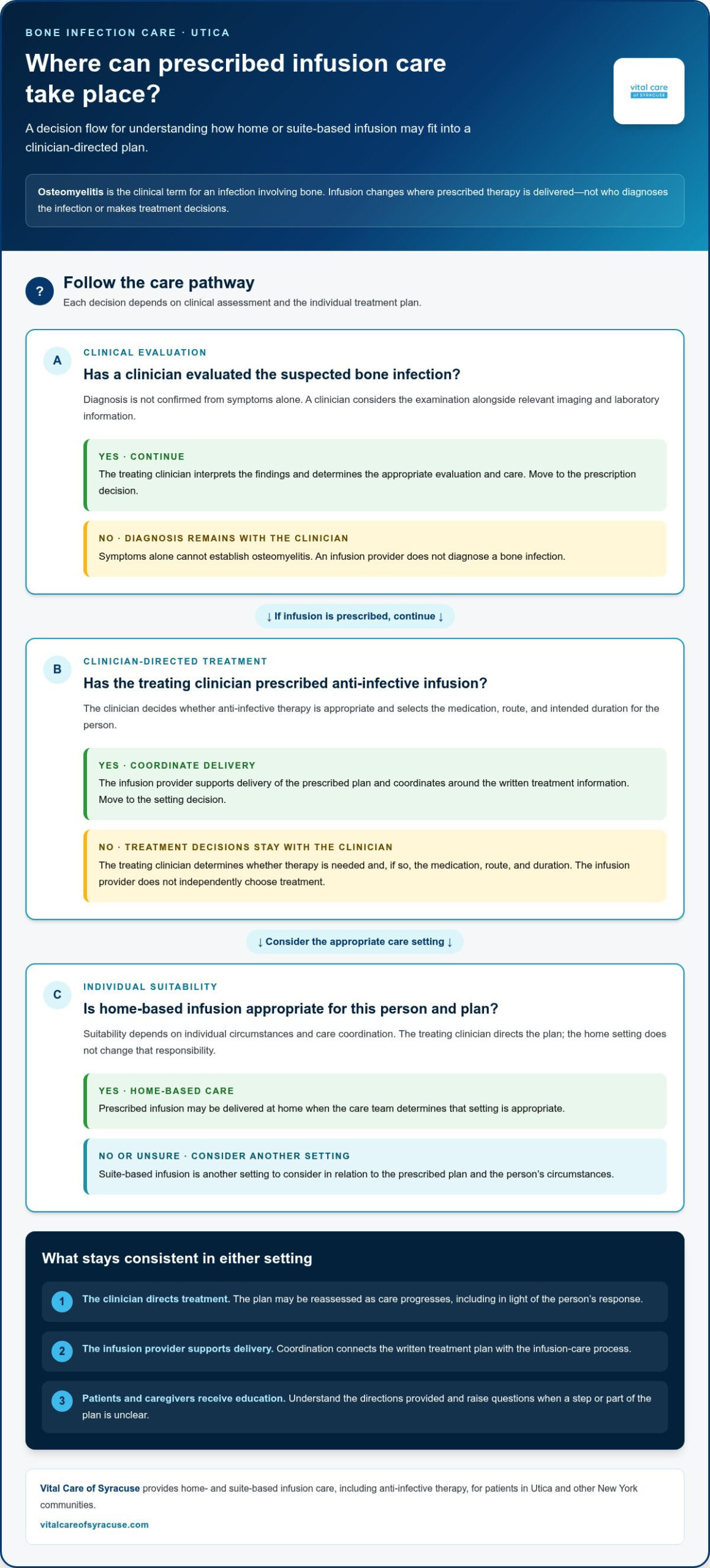
Infusion care brings together the patient, prescribing clinician, and infusion team around a treatment plan. The clinician determines whether IVIG is appropriate and provides the prescription and clinical direction. The infusion provider coordinates the prescribed therapy and communicates with the clinical team so the administration plan is understood. Clear roles help patients know whom to contact about treatment instructions, infusion arrangements, or medical decisions.
Individualized coordination also recognizes that home infusion and suite-based infusion are different care settings. The prescriber and infusion team can consider the plan and the patient’s circumstances when determining which setting is appropriate. Neither location guarantees a particular outcome, and infusion support does not replace follow-up with the clinician managing ITP.
A clear next step for patients and caregivers
If you’re considering IVIG for ITP at home Rochester, start by discussing home-infusion suitability with your treating clinician. Bring questions about the prescription, care setting, communication among the teams, and follow-up recommended by the clinician. Once a treatment plan is prescribed, the infusion provider can support coordination around it.
For Rochester-area patients and caregivers, Vital Care of Syracuse offers a local resource for prescribed infusion-care coordination through home-based and suite-based services. The next step is a conversation with your clinical team about whether home infusion fits your needs. To learn more about Vital Care’s infusion services, visit the service website.
Take the next step with your care team
IVIG may be considered for ITP in selected circumstances, but the treatment decision belongs to the prescribing clinician. A platelet-count change doesn’t tell the whole story, and response and follow-up needs can vary. Home infusion is one possible care setting, not an automatic fit for every patient. Clinical needs should guide the choice between home and suite-based care.
If you’re discussing IVIG for ITP at home Rochester, bring questions about treatment goals, monitoring, possible side effects, and coordination to your hematology team. Vital Care of Syracuse provides immunoglobulin therapy and home-based and suite-based infusion care, serving Rochester as well as Syracuse, Albany, Utica, Buffalo, Auburn, and Binghampton. Its infusion team can coordinate prescribed care with your clinical team, while the prescriber directs your treatment.
For a clearer picture of available infusion settings, learn about home and suite-based infusion services. A thoughtful conversation with your care team can help you identify the next step that best supports your individual plan.
Frequently Asked Questions
Can IVIG for ITP be given at home in Rochester?
Yes, home infusion may be an option when the prescribing clinician and infusion team determine it fits the patient’s clinical needs and treatment plan. Patients asking about IVIG for ITP at home Rochester can discuss both home and suite-based settings. Vital Care of Syracuse provides immunoglobulin therapy and serves Rochester, as well as Syracuse, Albany, Utica, Buffalo, Auburn, and Binghampton. Location alone doesn’t determine eligibility for home treatment.
How does IVIG help treat ITP?
IVIG may help raise platelet counts in selected people with ITP. It’s thought to affect immune processes involved in platelet destruction, but the reason for treatment and the expected response depend on the individual. A platelet-count change doesn’t by itself determine the next step in care. The hematologist or prescribing clinician can explain the treatment goal, how response will be assessed, and what follow-up is appropriate.
Is home IVIG for ITP safe?
Home IVIG may be appropriate for some patients, but it isn’t automatically suitable for everyone or inherently safer than treatment in a facility. The prescriber and infusion team consider health status, treatment history, and monitoring needs when deciding on the setting. Infusion reactions are possible, so ask which symptoms to report and whom to contact. Seek urgent medical evaluation for severe or rapidly worsening symptoms, including trouble breathing or significant bleeding.
What happens during a home IVIG infusion?
The infusion team follows the prescribed plan and observes the patient as directed, while the prescriber remains responsible for the medical treatment decision. Before the visit, the team can explain how the infusion will be given, what monitoring is planned, and how to raise concerns. Patients can prepare a comfortable space and keep their medication list and relevant health information available. Follow the care team’s instructions before, during, and after treatment.
How long does IVIG treatment for ITP take?
An IVIG infusion commonly takes about 2 to 6 hours, depending on the prescribed dose and the patient’s tolerance. The time may vary, so the infusion team can explain what to expect for the individual treatment plan. Allow additional time for preparation and any observation included in the care plan. Ask the treating team how long to set aside and what to do if the infusion experience or symptoms change.
Does insurance cover home IVIG for ITP?
Coverage isn’t guaranteed and depends on the insurance plan, prescribed treatment, and authorization requirements. Medicare’s Part B home infusion benefit for IVIG covers its use for primary immune deficiency diseases, not ITP. Other plan rules may differ. Ask the insurer and care team which prior authorization steps apply, what clinical information is needed, and how coverage decisions may affect the treatment setting or scheduling.
Who decides whether I can receive IVIG at home?
The prescribing clinician determines whether IVIG is appropriate and works with the infusion provider to consider the care setting and coordination plan. The decision may account for your health, treatment history, and monitoring needs. Patients and caregivers can share medications, allergies, relevant medical history, and current concerns to support that discussion. The infusion provider coordinates prescribed therapy but doesn’t replace the clinician directing ITP care.
Leave a Reply