


Your infusion schedule shouldn’t dictate your life. For many Central New Yorkers managing conditions like Crohn’s disease, rheumatoid arthritis, or ulcerative colitis, the routine of traveling to a hospital or infusion center every few weeks can quietly erode the very quality of life their therapy is designed to protect. The good news is that biosimilar infusion at home with Inflectra is not only clinically sound, it’s increasingly the standard of care for patients who want to maintain their remission without surrendering their routines.
If you’ve been wondering whether switching from a hospital setting is safe, or whether Inflectra truly performs as well as Remicade, you’re asking exactly the right questions. Concerns about efficacy, insurance coverage, and what happens if something goes wrong at home are completely valid, and they deserve honest, thorough answers rather than reassuring generalities.
This guide walks you through everything you need to know about transitioning to home infusion therapy in Central New York, from understanding how Inflectra works as an FDA-approved biosimilar to navigating insurance benefits and finding the consistent, specialized nursing support that makes the difference between an uncertain experience and a genuinely confident one.
Key Takeaways
- Inflectra is an FDA-approved biosimilar to Remicade that delivers the same therapeutic mechanism, making biosimilar infusion at home (Inflectra) a clinically sound alternative to hospital-based treatment for eligible patients managing inflammatory conditions.
- Home infusion is not a compromise on safety — specialized infusion nurses provide the same vital sign monitoring and clinical oversight you’d expect in a facility, bringing that standard of care directly to your living room.
- Transitioning from a hospital to home infusion involves a straightforward referral process through your gastroenterologist or rheumatologist, and a specialty home infusion pharmacy handles the logistics of medication delivery and coordination.
- Hospital infusion settings often carry significantly higher facility fees for the same drug, meaning patients with high deductibles may realize meaningful cost savings by shifting their site of care to home in 2026.
- Vital Care of Syracuse is a locally owned provider with specialized clinical expertise in biosimilar therapies, serving patients across a wide region that extends from Syracuse to Buffalo, Albany, Rochester, and beyond.
Understanding Biosimilar Infusion at Home: What is Inflectra?
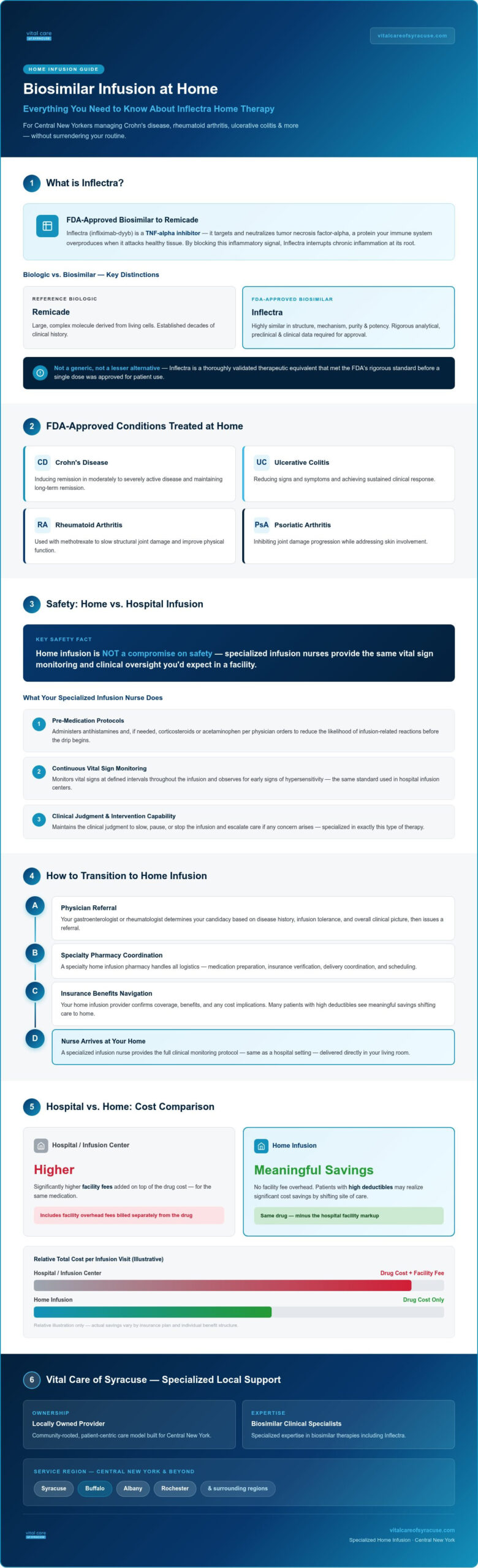
Inflectra (infliximab-dyyb) is an FDA-approved biosimilar to Remicade, one of the most widely prescribed biologic therapies for chronic inflammatory conditions. Like Remicade, it belongs to a class of medications called TNF-alpha inhibitors, which work by targeting and neutralizing tumor necrosis factor-alpha, a protein your immune system produces in excess when it mistakenly attacks healthy tissue. By blocking this inflammatory signal, Inflectra helps interrupt the cycle of chronic inflammation that drives conditions like Crohn’s disease and rheumatoid arthritis at their root.
Choosing biosimilar infusion at home with Inflectra represents a clinically grounded decision, not a compromise. Understanding precisely what that means requires a clear look at both the science behind the medication and the regulatory standards that brought it to market.
Biologics vs. Biosimilars: Clearing the Confusion
Biologics are large, complex molecules derived from living cells, which makes them fundamentally different from traditional small-molecule drugs. A biosimilar like Inflectra is developed to be highly similar to its reference biologic in molecular structure, mechanism of action, purity, and potency. The FDA’s approval pathway for biosimilars requires extensive analytical, preclinical, and clinical data demonstrating that no clinically meaningful differences exist between the biosimilar and the reference product in terms of safety, efficacy, and immunogenicity. Inflectra met that rigorous standard before a single dose was approved for patient use. It’s not a generic, and it’s not a lesser alternative; it’s a thoroughly validated therapeutic equivalent.
Conditions Treated with Home Inflectra Infusions
Inflectra carries FDA-approved indications across several serious inflammatory conditions, making it a versatile option for patients whose physicians have determined they’re appropriate candidates for home-based care. These include:
- Crohn’s Disease: Both inducing remission in moderately to severely active disease and maintaining that remission long-term
- Ulcerative Colitis: Reducing signs and symptoms and achieving sustained clinical response
- Rheumatoid Arthritis: Used in combination with methotrexate to slow structural joint damage and improve physical function
- Psoriatic Arthritis: Inhibiting joint damage progression while addressing skin involvement
For patients in stable remission across any of these conditions, the clinical rationale for transitioning to biosimilar infusion at home is well-established. Your prescribing physician determines candidacy based on your disease history, infusion tolerance, and overall clinical picture, and the infusion itself is administered by a specialized nurse who brings the same monitoring protocols you’d expect in a hospital setting directly into your home.
Safety and Tolerability: Is Home Infusion Right for You?
The most common hesitation patients express about leaving a hospital setting isn’t about the medication itself. It’s about the distance from clinical resources if something unexpected occurs. That concern is worth taking seriously, and the honest answer is that biosimilar infusion at home with Inflectra is built around the same safety protocols used in facility-based care, delivered by nurses who specialize in exactly this type of therapy.
Clinical Monitoring in Your Living Room
A specialized infusion nurse arrives prepared to manage the full clinical picture of your infusion, not simply to insert an IV and wait. Before the drip begins, pre-medication protocols are administered to reduce the likelihood of infusion-related reactions. These typically include antihistamines and, in some cases, corticosteroids or acetaminophen, depending on your physician’s orders and your personal history with the medication.
Throughout the infusion, your nurse monitors vital signs at defined intervals, observes for early signs of hypersensitivity, and maintains the clinical judgment to slow, pause, or stop the infusion if anything warrants attention. The one-on-one nurse-to-patient ratio in home infusion is genuinely significant here. In a hospital or outpatient infusion suite, a single nurse may be managing several patients simultaneously. At home, their complete clinical attention is yours for the duration of the visit.
Every home infusion kit is equipped for immediate intervention. Standard preparedness supplies include epinephrine, antihistamines, corticosteroids, and the equipment necessary to manage a reaction while emergency services are contacted if escalation becomes necessary. This isn’t a backup plan; it’s a standard component of every visit.
Addressing Common Concerns About Switching
Patients who’ve been stable on Remicade for years often ask whether switching to Inflectra disrupts that stability. The clinical picture here is reassuring. Because Inflectra shares the same mechanism of action, the same molecular target, and a highly similar structural profile to Remicade, the transition does not reset your therapeutic history. Your immune system’s response to the active molecule remains consistent, and your remission doesn’t need to be re-earned.
Tolerability during the switch phase is well-characterized in clinical literature. Patients transitioning from the reference biologic to infliximab biosimilars have not demonstrated meaningful differences in adverse event rates or loss of response compared to those who remain on the originator product. Long-term outcomes for patients receiving home-based specialty biologic therapy reflect the same durability seen in facility settings when consistent clinical oversight is maintained.
Candidacy for home infusion is determined by your prescribing physician based on your infusion history and disease stability. If you’ve been tolerating your infusions well and your condition is managed, the clinical threshold for transitioning is often lower than patients expect. A good starting point is a conversation with your care team, and if you’d like guidance on what that process looks like locally, connecting with Vital Care of Syracuse can help clarify your options before you speak with your physician.
The Practical Path: Setting Up Your Inflectra Infusion at Home
Knowing that biosimilar infusion at home with Inflectra is clinically sound is one thing. Understanding exactly how to get there is another. For many patients, the uncertainty around logistics is the actual barrier, not clinical hesitation. The process is more straightforward than most people expect, and having a clear picture of each step makes the transition feel far less daunting.
It begins with a conversation with your gastroenterologist or rheumatologist. If your disease is stable and your infusion history is uncomplicated, your physician can initiate a referral to a specialty home infusion pharmacy. That referral sets the administrative process in motion, and a provider like Vital Care of Syracuse takes over the coordination from there, managing documentation, insurance verification, and scheduling so the burden doesn’t fall on you.
The Referral Process in Central New York
Vital Care of Syracuse coordinates with prescribing physicians across a wide region, including practices in Rochester, Buffalo, Albany, Utica, and beyond. Once your physician submits a referral, a clinical coordinator contacts you directly to gather your insurance information, confirm your infusion history, and initiate prior authorization with your payer. Prior authorization for biosimilar therapies can require documentation of your diagnosis, treatment history, and clinical rationale for home-based care. Because Vital Care’s team works with these requests regularly, they know precisely what documentation accelerates approval and what gaps tend to slow it down.
Transitioning from a hospital outpatient department involves one additional layer: confirming that your prescription is transferred cleanly to the specialty pharmacy and that your physician’s orders reflect the home care setting. This is handled administratively, and your clinical team at Vital Care ensures nothing falls through the gaps between your old setting and your new one.
Preparing Your Home for an Infusion Suite Experience
For patients managing digestive health conditions specifically, the Home Infusion for GI Disorders Rochester resource covers condition-specific preparation considerations in greater detail, including dietary timing and what to communicate to your nurse before your session begins.
Your first visit will also include an orientation from your nurse covering what to expect throughout the infusion, how reactions are monitored, and who to contact with questions between visits. From that point forward, your schedule is yours again.
Comparing Costs: Hospital vs. Home Infusion in 2026
The medication in the IV bag is identical. What changes dramatically depending on where that bag is hung is the bill that follows. Hospital outpatient departments and infusion centers operate under a billing structure that layers facility fees on top of drug costs, administrative charges, and overhead allocations that have nothing to do with your care. For patients managing a chronic inflammatory condition who infuse every six to eight weeks, those facility fees accumulate into a meaningful financial burden over the course of a year.
This is what’s commonly called the “site of care” cost differential, and it’s one of the most consequential variables in specialty drug spending that patients rarely hear explained clearly. The drug itself, whether Remicade or a biosimilar like Inflectra, carries a wholesale acquisition cost that exists independently of the setting. But hospital outpatient departments bill under a separate fee schedule that allows them to charge substantially more for the same infusion than a home-based provider operating under a different reimbursement structure. For patients with high deductibles or significant cost-sharing obligations, that gap translates directly into out-of-pocket exposure.
Insurance Coverage for Biosimilars in New York
New York payers have been progressively formalizing biosimilar-first policies, meaning some commercial plans now require a trial of an approved biosimilar before authorizing the reference biologic at the preferred tier. For patients already receiving biosimilar infusion at home with Inflectra, this trend works in their favor: they’re already aligned with the coverage pathway their insurer prefers. Patients still receiving Remicade in a hospital setting may find that their plan’s 2026 formulary creates financial pressure to switch, making the conversation about transitioning both clinically and financially timely.
Specialty pharmacies play a role here that most patients don’t anticipate. When Vital Care of Syracuse coordinates your prior authorization, their team is familiar with the specific documentation requirements that major New York payers look for in biosimilar approvals. That institutional knowledge shortens the authorization timeline and reduces the likelihood of denials that require appeals.
Financial assistance programs are also worth exploring early. Several manufacturers of infliximab biosimilars offer co-pay assistance cards that reduce patient cost-sharing for commercially insured patients. Eligibility requirements vary, and these programs don’t apply to Medicare or Medicaid, but for patients with employer-sponsored insurance carrying a high deductible, they can offset a meaningful portion of annual infusion costs.
Long-term Economic Benefits of Home-Based Care
The cost comparison extends beyond the explanation of benefits. Consider what a hospital infusion actually costs a Syracuse or Albany resident when the full picture is accounted for: round-trip transportation, parking fees at a medical campus, and several hours of lost productivity or paid time off per visit. Across eight or ten infusions annually, those indirect costs are real and recurring. Home infusion eliminates them entirely.
There’s also a risk-reduction dimension that carries economic weight. Hospital environments carry exposure to healthcare-associated infections, a concern that’s particularly relevant for patients on immunomodulating therapies. Avoiding that exposure isn’t just a clinical preference; it’s a practical safeguard against the downstream costs of an illness that interrupts your treatment schedule.
For a thorough breakdown of how local, specialized providers deliver cost efficiencies that larger national chains often can’t match, the Benefits of a Local Home Infusion Company resource covers the operational and financial advantages in detail. If you’d like to understand how your specific insurance plan interacts with home-based biosimilar therapy, reach out to Vital Care of Syracuse for a benefits review before your next infusion cycle.
Specialized Support from Vital Care of Syracuse
There’s a meaningful difference between receiving care from a provider who administers biosimilar infusions and one who has built a clinical program around them. Vital Care of Syracuse represents the latter. As a locally owned specialty home infusion pharmacy, the practice brings a level of investment in patient outcomes that larger national chains rarely replicate, combining the institutional backing of a broader network with the accountability that comes from being genuinely rooted in the communities it serves.
That local ownership matters in ways that aren’t always obvious at first. When a question arises about your therapy between visits, you’re not navigating a call center. You’re reaching a team that knows your chart, your prescribing physician, and the specific clinical considerations that shape your care plan. That continuity is the foundation on which trust in any long-term infusion relationship is built.
Our Local Clinical Expertise
Vital Care’s clinical team carries specialized training in specialty biologics and biosimilar therapies, including the monitoring protocols, pre-medication considerations, and reaction management procedures specific to infliximab-based treatments. For patients managing biosimilar infusion at home with Inflectra, that depth of preparation isn’t incidental; it’s the clinical standard that makes home-based care genuinely safe rather than simply convenient.
Patients with more complex neurological or multi-system conditions can find a broader picture of how that specialized expertise applies across therapy types in the Home Infusion for Neurological Disorders Syracuse resource, which illustrates the range of clinical scenarios the team is equipped to support.
Personalized Care Across Central New York
Vital Care serves patients well beyond the Syracuse metro area. Current service coverage extends to Utica, Auburn, Binghamton, Rochester, Buffalo, and Albany, addressing a gap that many regional patients encounter when seeking specialized home infusion support outside of major urban centers. Geography shouldn’t determine access to expert care, and Vital Care’s reach is built around that principle.
Consistent nursing assignments are a deliberate part of how care is structured. Rather than rotating through different nurses each visit, patients build an ongoing relationship with a clinician who understands their infusion history, their vein access patterns, and how they typically respond to the medication. That familiarity translates into sessions that feel less like clinical encounters and more like a routine managed by someone who genuinely knows you.
For patients ready to explore biosimilar infusion at home as a genuine alternative to their current hospital or outpatient setting, the next step is straightforward. Connect with Vital Care of Syracuse to request a consultation, and the team will guide you through insurance verification, referral coordination, and scheduling so the transition is handled with the care and precision your therapy deserves.
Your Next Infusion Belongs at Home
Managing a chronic inflammatory condition is demanding enough without adding unnecessary travel, facility fees, and fragmented clinical relationships to the equation. Biosimilar infusion at home (Inflectra) offers a path that’s clinically sound, financially sensible, and genuinely more compatible with the life you’re working to protect.
The key points are worth holding onto: the transition from a hospital setting is straightforward when guided by an experienced team, the safety protocols travel with your nurse, and the cost structure of home-based care often works in your favor. What you gain isn’t just convenience; it’s consistency, continuity, and care from clinicians who specialize in exactly this therapy.
Vital Care of Syracuse is locally owned, deeply rooted in Central New York, and built around the specialized clinical expertise that complex specialty biologics require. Expert clinical pharmacists are available to support your care, and the team serves patients across a wide regional footprint.
When you’re ready to explore what this transition looks like for your specific situation, request a consultation with Vital Care of Syracuse and take the first step toward infusions that work around your life.
Frequently Asked Questions About Biosimilar Infusion at Home (Inflectra)
Is Inflectra as effective as Remicade for Crohn’s disease?
Yes. Inflectra shares the same active mechanism as Remicade, targeting TNF-alpha to reduce inflammation at its source. The FDA’s biosimilar approval pathway requires clinical evidence that no meaningful differences exist between the two products in terms of efficacy, safety, and immunogenicity. For patients with Crohn’s disease, that means the therapeutic outcomes you’d expect from Remicade are supported by Inflectra as well.
Can I switch from Remicade to Inflectra at home?
In most cases, yes, and the transition is clinically straightforward for patients who are stable and tolerating their current infusions without complications. Your prescribing physician determines candidacy, but the switch doesn’t reset your therapeutic history or require re-induction in stable patients. Vital Care of Syracuse coordinates the prescription transfer and prior authorization process, so you’re not navigating that paperwork on your own.
How long does a typical Inflectra infusion take at home?
A standard Inflectra infusion runs approximately two hours, though your total visit will be longer when you account for pre-medication administration and the post-infusion monitoring period your nurse conducts before leaving. First infusions or those following a gap in treatment may be administered more slowly as a precaution. Plan for roughly three hours total, particularly for early visits while your nurse establishes your individual response baseline.
What are the most common side effects of Inflectra infusions?
Infusion-related reactions are the most frequently reported concern, and they can include flushing, headache, mild fever, or nausea during or shortly after the infusion. Serious reactions are uncommon in patients with an established infusion history. Because your home infusion nurse monitors vital signs throughout the session and arrives prepared with intervention supplies, early signs are identified and addressed promptly, the same way they would be in a clinical facility.
Will my insurance cover Inflectra if I get it at home instead of a hospital?
Most commercial insurance plans cover biosimilar infusion at home with Inflectra, and some New York payers now actively prefer biosimilars over the reference biologic on their formularies. Coverage specifics depend on your individual plan, including how your benefits handle specialty drugs and site-of-care distinctions. Vital Care of Syracuse conducts a benefits review as part of the onboarding process, so you’ll have a clear picture of your coverage and any cost-sharing obligations before your first home infusion.
Do I need to have a caregiver present during my home infusion?
What should I do if I experience a reaction during my home infusion?
Tell your nurse immediately, even if the symptom seems minor. Your nurse is trained to assess and respond to infusion-related reactions and carries the necessary supplies to intervene, including epinephrine, antihistamines, and corticosteroids. They can slow or stop the infusion and manage the situation clinically while contacting emergency services if escalation is needed. Don’t wait to mention something that feels off; early communication is what allows your nurse to act quickly and effectively.
How do I move my infusion service from a hospital to Vital Care of Syracuse?
The process starts with a conversation with your gastroenterologist or rheumatologist, who submits a referral to Vital Care of Syracuse. From there, Vital Care’s team handles insurance verification, prior authorization, and prescription transfer coordination directly. You don’t need to manage the handoff between your old provider and your new one; that’s the team’s responsibility. Patients across Central New York, including those in Rochester, Albany, and Buffalo, can initiate the process by contacting Vital Care of Syracuse directly to get started.
Leave a Reply