


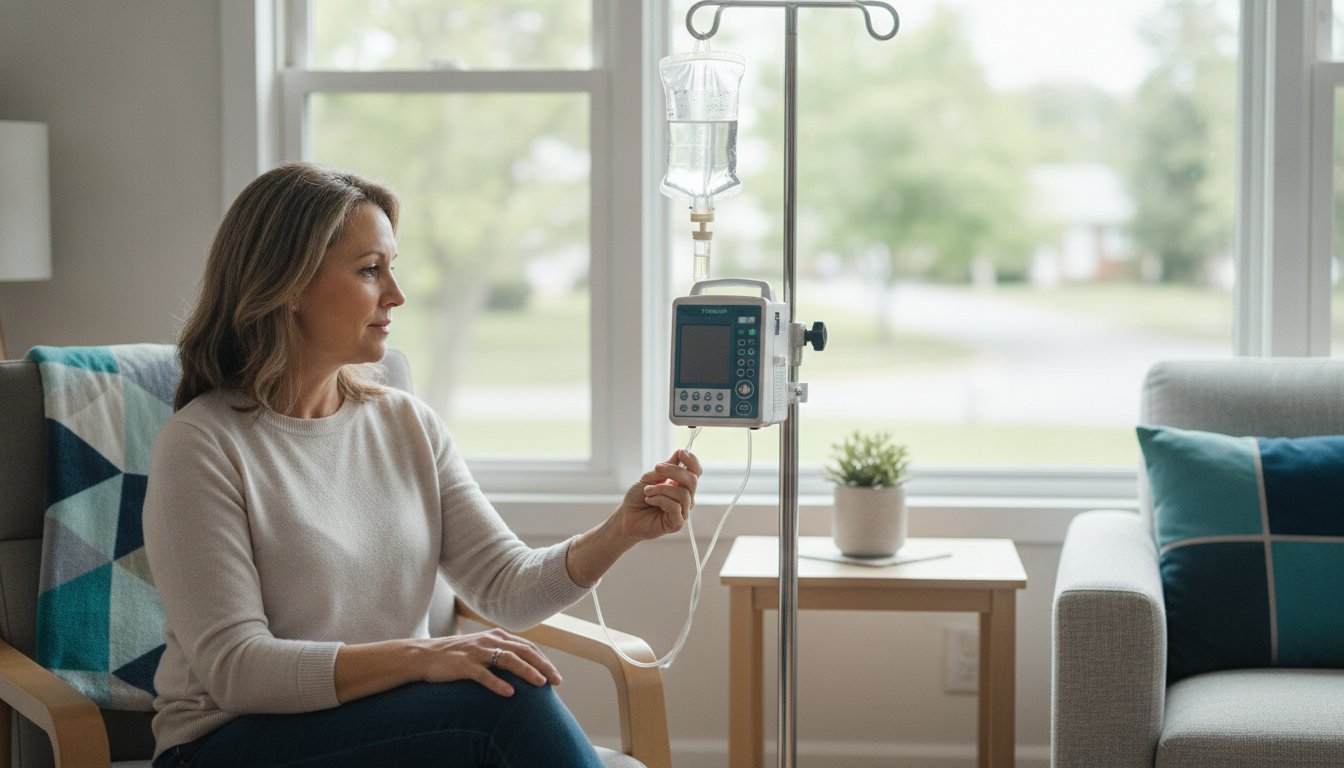
What if the most sophisticated clinical safety net wasn’t found within hospital walls, but right in your own living room? It’s completely natural to feel a sense of trepidation as you transition from a supervised ward to the quiet of your home. You might find yourself managing a catheter with questions about infection or feeling overwhelmed by the technical requirements of medical equipment. We recognize that the fear of a complication or being alone during a reaction can feel heavy. However, achieving safe IV medication administration at home is a reality for the 58% of infusion patients who now receive care in their own residences, supported by the same rigorous standards found in high-acuity settings.
In this guide, you’ll discover how a combination of specialized equipment, precise clinical protocols, and dedicated expert support ensures your therapy remains effective and secure. We’ll walk through the safety measures that protect your health, explain how to manage your equipment with total confidence, and clarify exactly when it’s time to call a professional for guidance. Our goal is to provide you with the peace of mind that comes from knowing you’re supported by a clinical safety net that remains a steady, reliable presence throughout your journey.
Key Takeaways
- Understand the clinical supervision and technological advancements that allow home-based infusion to meet the same rigorous safety standards as traditional hospital care.
- Learn about the professional “Triple-Check” systems and sterile compounding protocols that ensure the precision and integrity of every medication dose.
- Gain clarity on how specialized equipment, such as infusion pumps and elastomeric devices, is carefully selected to match your specific therapeutic requirements.
- Master practical techniques for safe IV medication administration at home, including the “SASH” protocol and the creation of a dedicated “Clean Zone” in your residence.
- Discover the benefits of partnering with a local Central New York clinical team for faster medication delivery and personalized, neighborly support.
Why Home IV Administration is a Proven, Safe Alternative to Hospital Care
Home IV administration is a clinically supervised method of receiving specialty medication in a residential setting, effectively moving the high standards of a medical facility into the comfort of your own living space. While many once believed that complex treatments required a hospital bed, modern advancements in medical technology have revolutionized intravenous therapy. Today, sophisticated delivery systems and remote monitoring tools allow for safe IV medication administration at home, making long-term hospital stays unnecessary for many patients managing chronic or acute conditions.
The transition to home care isn’t just about convenience; it’s a strategic choice for better health outcomes. In a hospital, you’re often exposed to a variety of pathogens that can lead to healthcare-associated infections. By receiving care in your own residence, you significantly reduce your exposure to risks like MRSA or C. diff. There’s also a profound psychological benefit to healing in a familiar environment. Being near family and sleeping in your own bed reduces the stress often associated with clinical settings, which can positively influence your body’s recovery process.
To better understand how this process works in a home setting, watch this helpful video:
The Shift Toward Home-Based Clinical Excellence
Specialized pharmacies like Vital Care of Syracuse bridge the gap between the hospital and your front door by providing a dedicated “Home Infusion Team.” This group, consisting of pharmacists, nurses, and patient advocates, works in unison to monitor your progress and ensure your equipment is functioning perfectly. Home infusion is a multi-disciplinary care model that prioritizes patient autonomy without sacrificing clinical rigor. This partnership ensures that while you’re the one in your home, you’re never truly alone in your care.
Safety Statistics: Home vs. Hospital
Clinical data consistently shows that home-based care is a high-quality alternative to acute facilities. Studies regarding catheter-related bloodstream infections (CRBSI) often reveal that infection rates in the home are comparable to, or even lower than, those in hospitals. This is partly because you aren’t sharing staff or equipment with dozens of other patients. Additionally, many patients experience a reduction in “white coat hypertension,” a spike in blood pressure caused by the stress of being in a medical office. Lower stress levels lead to more accurate monitoring and can improve the overall efficacy of your therapy. For many in New York, this approach provides a cost-effective way to receive safe IV medication administration at home without compromising the excellence of the care received.
The Clinical Safety Net: How Specialized Providers Protect You
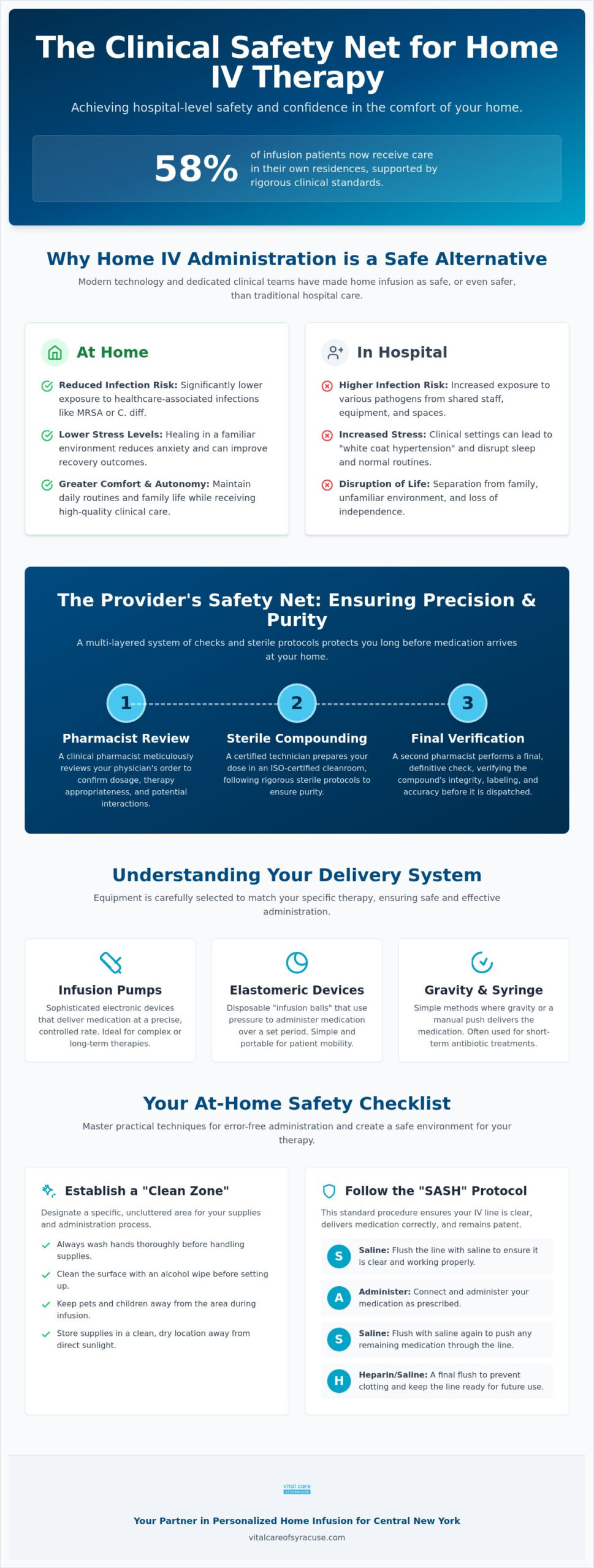
To ensure safe IV medication administration at home, specialized providers implement a multi-layered safety net that begins long before the medication reaches your door. This process is built on a “Triple-Check” system, a disciplined clinical protocol designed to eliminate human error. It starts with a pharmacist’s meticulous review of your physician’s order to confirm dosage and appropriateness. A certified technician then prepares the dose under strict supervision, and a second pharmacist performs a final, definitive verification of the compound’s integrity. This level of scrutiny provides a steady, reliable hand that guides your therapy from the pharmacy to your bedside.
Pharmacy Excellence and Sterile Compounding
The heart of this safety net is the ISO-certified cleanroom. Inside these highly controlled environments, medications are compounded under rigorous sterile conditions to ensure they’re completely free from contaminants. This is particularly vital for patients in Buffalo or Utica, where medications must remain stable during transit. Stability testing ensures that your therapy maintains its potency and safety from the moment it leaves the pharmacy until it’s administered. By utilizing patient-specific dosing, clinical teams reduce the risk of medication errors, tailoring each dose to your exact physical requirements and health profile. This precision isn’t just about technical excellence; it’s about protecting your personal well-being through every step of the process.
24/7 Monitoring and Emergency Protocols
Your safety net extends far beyond the pharmacy walls. The Medicare home infusion therapy benefit recognizes the essential role of qualified healthcare professionals in this process, ensuring that home care is a regulated and respected clinical path. For residents in Syracuse and surrounding areas, this means having access to a 24/7 clinical lifeline. If you have a question at 2 AM or notice a change in your symptoms, an on-call clinical pharmacist is available to provide immediate, expert guidance. These professionals don’t just wait for you to call. They proactively monitor your lab results and progress, reaching out to adjust your care plan or consult with your physician before issues arise. This constant vigilance transforms a complex medical requirement into a manageable, transparent part of your daily life. By choosing a partner that prioritizes this level of detail, you can focus on your recovery while Vital Care of Syracuse manages the complexities of your clinical support.
Understanding Delivery Systems: Elastomeric Balls, Gravity, and Pumps
The transition to home care involves more than just a change in location; it requires selecting the precise tools that align with your medical needs and your daily routine. In Central New York, clinical teams utilize a range of sophisticated delivery systems designed with built-in safeguards to ensure your therapy is consistent and secure. Understanding these devices is a vital step toward achieving safe home IV treatment. Whether you’re receiving safe IV medication administration at home for a short course of antibiotics or long-term nutritional support, the equipment is chosen to act as a reliable partner in your recovery.
Device selection isn’t random. It’s a calculated decision based on the viscosity of the medication, the required infusion rate, and the level of precision needed. For example, Parenteral Nutrition (TPN) requires the exactitude of a smart pump to manage complex nutrient flows, whereas certain anti-infective therapies might be better suited for simpler, portable devices. Modern equipment is built with “Safety by Design” features, including air-in-line sensors and pressure monitors that act as a constant watch over your infusion process.
Ambulatory Pumps and Precision Dosing
Smart ambulatory pumps are the gold standard for therapies requiring high precision. These devices are programmed with specific safety limits to prevent “free-flow” accidents or dosing errors. If you’re moving around your home in Albany or simply sitting with family, these pumps remain lightweight and portable, ensuring your therapy doesn’t tether you to a single room. They also feature robust battery backups and fail-safes; if a power outage occurs, the pump’s internal battery takes over immediately to maintain your therapy’s continuity. This technology provides a steady, reliable hand, allowing the device to handle the technical complexities while you focus on healing.
Elastomeric ‘Home Infusion Balls’ and Gravity Drip
Some therapies are best delivered through the elegant simplicity of an elastomeric device, often called an “infusion ball.” These devices don’t require batteries or complex programming; instead, they use a pressurized internal reservoir to deliver medication at a steady, pre-set rate. They’re silent, discreet, and highly effective for antibiotics. Other patients may use a gravity drip, where a roller clamp is used to manually regulate the flow. While this requires a bit more hands-on management, your clinical team provides thorough training to ensure you can adjust the clamp with total confidence. The choice of device is a clinical decision made to maximize both safety and patient lifestyle.
It’s common to feel a flicker of “beep anxiety” when you first hear a pump alarm. It’s important to remember that these sounds aren’t signals of a catastrophe; they’re the pump’s way of communicating. Most often, a beep simply means there’s a small kink in the tubing (an occlusion) or that the medication bag is nearly empty. Your training will cover these common alerts, transforming those sounds from sources of worry into helpful reminders that your equipment is working exactly as it should to protect you.
Your At-Home Safety Checklist: Steps for Error-Free Administration
Transforming a corner of your living room into a temporary clinical space is a significant step, but it’s one you can take with total confidence. The foundation of safe IV medication administration at home begins with the creation of a “Clean Zone.” In a typical New York home, this should be a hard, non-porous surface like a kitchen table or a dedicated desk, rather than a couch or carpeted area. Before you begin, clear the space of clutter, keep pets in another room, and wipe the surface thoroughly with a disinfectant. By establishing this physical boundary, you create a structured environment that minimizes distractions and helps you maintain focus on the task at hand.
Once your environment is prepared, your clinical routine follows the “SASH” protocol. This disciplined sequence ensures your catheter remains clear and your medication is delivered effectively. SASH stands for:
- Saline: Flush the line to ensure it is open and clear.
- Administer: Connect your medication and begin the infusion as trained.
- Saline: Flush again to ensure all medication has entered the bloodstream.
- Heparin (or Saline): A final flush to prevent blood clots from forming in the catheter.
Hand hygiene remains your most powerful tool against infection. While you don’t always need sterile gloves for routine medication connections, a thorough, 20-second scrub with soap and water is non-negotiable. Save the sterile gloves for specific tasks like dressing changes where your nurse has provided specialized training. During every administration, take a moment to inspect your catheter site. Recognizing early signs of phlebitis, such as a red streak or warmth along the vein, or infiltration, characterized by coolness and swelling, allows you to act quickly and notify your clinical team before a minor issue becomes a complication.
The ‘Five Rights’ of Medication Safety at Home
Professional nurses rely on the “Five Rights” to prevent errors, and you can apply these same standards at your kitchen table. Before you spike a bag or connect a syringe, verify the “Right Patient, Right Drug, Right Dose, Right Route, and Right Time.” Check the pharmacy label against your discharge orders to ensure the names match exactly and that the medication hasn’t reached its expiration date. This simple habit acts as a final, definitive check that ensures you’re receiving the exact therapy your physician intended. If you ever feel uncertain about a label or a dosage, reaching out for expert clinical support from Vital Care of Syracuse can provide the immediate clarity you need.
Managing the Access Point: PICC and Midline Care
Your PICC or midline is your lifeline, and protecting it is a daily priority. Perform a “touch test” by gently feeling around the dressing for tenderness or fluid. It’s essential to keep this area dry; use a high-quality waterproof cover or plastic wrap when showering, and avoid activities that involve heavy lifting or repetitive arm motions. If the line ever feels sluggish when you’re flushing, or if the dressing becomes loose, don’t attempt to push the catheter back in or force a flush. These are the moments when your clinical safety net is most important, providing the steady guidance needed to keep your access point secure and functional.
Personalized Home Infusion in Central New York: The Vital Care Difference
Choosing the right partner is the final, essential step in ensuring safe IV medication administration at home remains a seamless part of your daily life. Vital Care of Syracuse serves as a dedicated clinical bridge for families across Syracuse, Rochester, and Buffalo, extending our reach to ensure high-quality care is accessible throughout the region. We understand that the transition from a hospital bed to your own home requires more than just equipment; it demands a steady, reliable hand that understands the local landscape. By maintaining close, collaborative relationships with major regional health systems like St. Joseph’s and Upstate University Hospital, we ensure your discharge and subsequent home therapy are handled with the clinical rigor you deserve.
Our role is to act as your protective advocate, managing the complex coordination between your physicians and your residential environment. We don’t just deliver medication; we provide a comprehensive safety net that prioritizes your comfort and clinical outcomes. This localized approach allows for a level of responsiveness that national providers often struggle to match. When you’re a part of our care community, you aren’t just a patient on a roster. You’re a neighbor receiving professional clinical care delivered with a neighbor’s touch.
Serving Our Neighbors from Syracuse to Binghamton
The logistics of home care require absolute precision, especially when it comes to maintaining the integrity of your medications. Our local delivery systems are designed to ensure that every shipment arrives at your door in Buffalo or Utica at the exact temperature required for stability. This regional focus allows us to navigate the unique challenges of Central New York winters and rural routes without compromising your schedule. Our deep roots in the community mean we understand the specific needs of New York patients, providing a level of familiarity that fosters trust. You can learn more about the benefits of a local home infusion company and how our presence in the community enhances your overall safety.
Getting Started with Safe Home Care
Initiating your therapy is a structured, transparent process designed to remove the burden from your shoulders. Your doctor works directly with our clinical team to facilitate the referral, ensuring all medical orders are perfectly aligned with your home environment. We also act as your insurance navigator, handling the intricate “paperwork” safety net so you can focus entirely on your recovery. We believe that safe IV medication administration at home should be accessible and stress-free. Our team is ready to guide you through every technical and administrative step with quiet confidence and expertise. Contact our clinical team today to discuss your specific needs, including anti-infective therapy at home, and discover how we can support your journey toward health.
Move Forward with Confidence in Your Home Care
Transitioning to home-based therapy is a significant milestone in your recovery, and it’s one you don’t have to navigate alone. By understanding the sophisticated clinical safety net and the precision of modern delivery systems, you can achieve safe IV medication administration at home with the same level of security found in a hospital. We’ve explored how a dedicated local team, rigorous sterile protocols, and a clear safety checklist empower you to manage your health in the environment where you feel most comfortable. This transition isn’t just about convenience; it’s about reclaiming your autonomy while remaining under the watchful eye of compassionate experts.
As an ACHC Accredited provider, Vital Care of Syracuse is committed to maintaining the highest standards of excellence for our neighbors in Syracuse, Rochester, and Buffalo. Our 24/7 local clinical support ensures that expert guidance is always a phone call away, providing you with a steady, reliable hand throughout your treatment journey. You deserve the peace of mind that comes from professional expertise delivered with genuine concern for your well-being. Speak with a Clinical Pharmacist about Safe Home Infusion today to learn how we can support your specific therapy needs. We look forward to being your dedicated partner in health and healing.
Frequently Asked Questions
Is it possible to get an air embolism from a home IV?
It is highly improbable to experience an air embolism during your therapy because modern infusion equipment is engineered with sensitive air-in-line detectors. These smart sensors automatically pause the flow if they detect a significant air gap in the tubing. Small incidental bubbles are typically absorbed harmlessly by the body, so you can feel secure that your equipment is actively monitoring your safety throughout every minute of the process.
What should I do if my infusion pump starts beeping?
If your pump begins beeping, your first step should be to look at the display screen to read the specific alert code or message. Most alarms are triggered by simple, non-emergency issues such as a kinked tube or an empty medication bag that needs replacing. Once you identify the cause, you can often resolve it by straightening the line or resetting the device as outlined in your patient training manual.
Can I administer my own IV antibiotics if I live alone?
You can absolutely manage your own IV antibiotics while living alone, provided you have completed our comprehensive training and demonstrate confidence in the process. We work closely with you to ensure you are comfortable with the equipment and the “SASH” protocol before your first solo administration. To provide an extra layer of security, our clinical team remains available 24/7 to answer questions, ensuring you never feel isolated.
How do I know if my IV site is infected?
You can identify a potential infection by looking for persistent redness, warmth, or swelling around the catheter insertion site. If you notice any unusual discharge, a foul odor, or if you develop systemic symptoms like fever and chills, contact your nurse immediately. Regular daily inspections of the area are the best way to ensure safe IV medication administration at home and prevent minor irritations from escalating into complications.
What happens if I miss a dose of my home IV medication?
If you miss a dose, you should contact your clinical pharmacist right away rather than attempting to double the next scheduled administration. Different medications have specific protocols for missed doses, and your pharmacist will provide clear, patient-centered instructions on whether to administer the dose late or wait for the next interval. This proactive communication ensures your therapeutic levels remain stable and your treatment plan stays on track.
Can I travel within New York while on home infusion therapy?
Travel within New York is certainly possible, provided we coordinate your supplies and medication deliveries with enough lead time. Whether you are heading to the Adirondacks or visiting family in Buffalo, our team can help you plan the logistics to ensure your therapy continues without interruption. We recommend discussing your travel dates with us at least one week prior to departure to ensure a smooth and stress-free transition.
How do I safely dispose of used needles and IV bags at home?
You must place all used needles and sharp objects into a puncture-resistant sharps container, which we provide as part of your standard supply kit. Once the container reaches the fill line, it should be sealed and disposed of at a designated community collection site according to local regulations. Standard IV bags and tubing that do not contain hazardous medication can typically be placed in your regular household trash, but never in recycling.
Is home IV therapy covered by Medicare or private insurance in NY?
Home infusion is a covered benefit for most New York residents, though the specific details depend on your individual Medicare or private insurance plan. While Medicare provides a specific home infusion therapy benefit for certain services, many private insurers offer even broader coverage for a wider range of specialty medications. Our administrative team handles the entire insurance verification process for you, providing transparency and peace of mind regarding your coverage.
Leave a Reply