



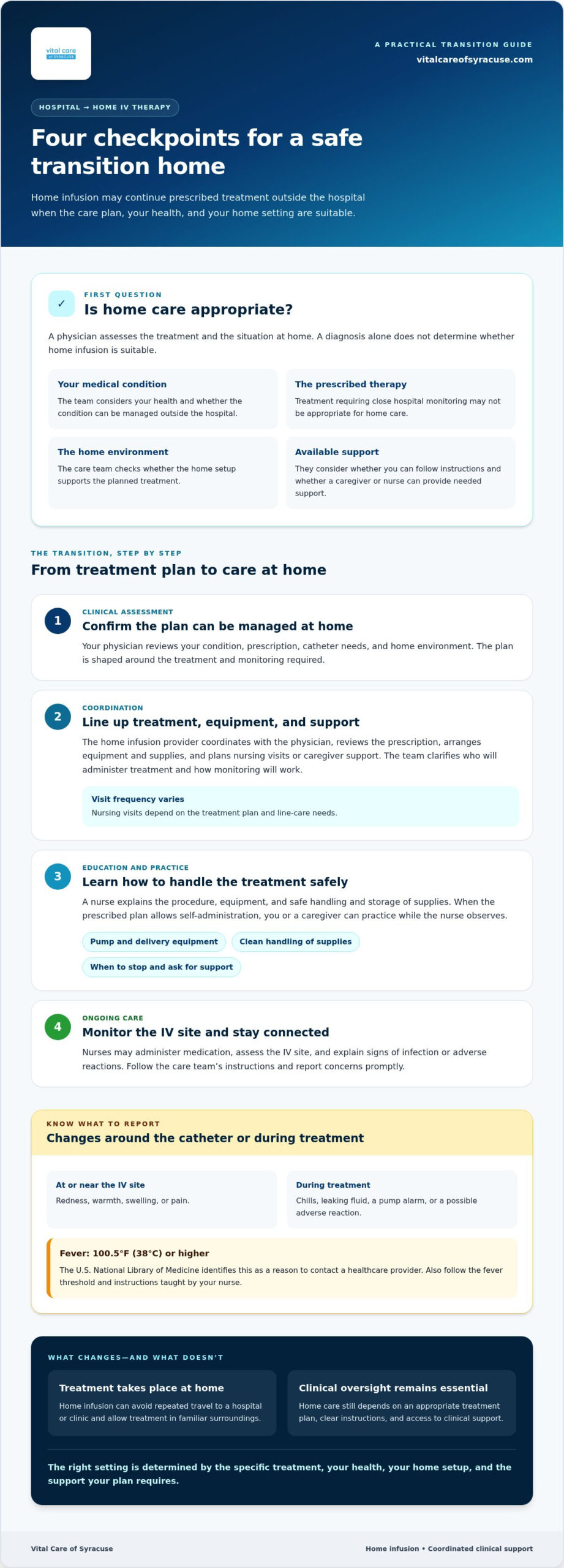
Leaving the hospital doesn’t have to mean stopping IV treatment. Switching from hospital to home IV therapy may be an option when your healthcare provider determines that your condition, prescribed treatment, and home environment are suitable for care outside the hospital. Your care team coordinates the transition so treatment can continue at home with appropriate clinical support.
It’s understandable to have questions about what changes after leaving hospital care, especially when an IV line, medication schedule, or infection risk is part of your recovery. Home infusion delivers prescribed medication, fluids, or nutrients through an IV, with a care plan tailored to the treatment and support you need.
This article explains what home IV infusion involves, when it may be used, and how infection risks relate to care at home and in hospital. You’ll also learn what the transition typically involves, from planning to patient and caregiver education, so you can understand what to expect.
Key Takeaways
- Home IV treatment can continue outside the hospital when the prescribed therapy, your health, and your home setup are suitable.
- Learn what nurses teach patients and caregivers about administering treatment, handling equipment, and recognizing concerns that need attention.
- Explore the conditions home infusion may support, including infections requiring IV antibiotics and certain complex treatment needs.
- Understand how care teams coordinate the move home, from the physician’s prescription and treatment plan to equipment and ongoing monitoring.
What Is Home IV Infusion Therapy?
Home IV infusion delivers prescribed medication, fluids, or nutrients through a catheter into a vein. Your physician’s prescription and an assessment of your treatment needs, health, and home environment shape the care plan.
Infusion Nursing and Monitoring
Infusion nursing combines treatment support with education and observation at home. A nurse may administer medication, assess the IV site, and explain signs of infection or adverse reactions. The Infusion Nurses Society’s 2024 Infusion Therapy Standards of Practice describes home as an appropriate setting when the patient is stable and the plan suits that setting.
Nurses also teach patients and caregivers how to use equipment and contact the care team with concerns. Visit frequency depends on the treatment plan and line-care needs. Knowing what to report, such as redness, warmth, swelling, or pain near the catheter, helps you respond promptly.
Eligibility and Safety Assessment
A physician assesses whether home infusion suits your medical condition, prescribed therapy, and living environment. A treatment requiring close hospital monitoring may not be appropriate for home care, while a manageable condition may allow a home plan. The assessment also considers whether you can follow instructions and whether a caregiver or nurse can provide the support you need.
Home suitability depends on the specific treatment, not simply a diagnosis such as cancer. Before care begins, the team reviews the medication plan, catheter needs, equipment, and monitoring arrangements. A fever above the normal level taught by the nurse, chills, or changes around the infusion site should be reported. The U.S. National Library of Medicine identifies a fever of 100.5°F (38°C) or higher as a reason to contact a healthcare provider.
Training for Self-Administration
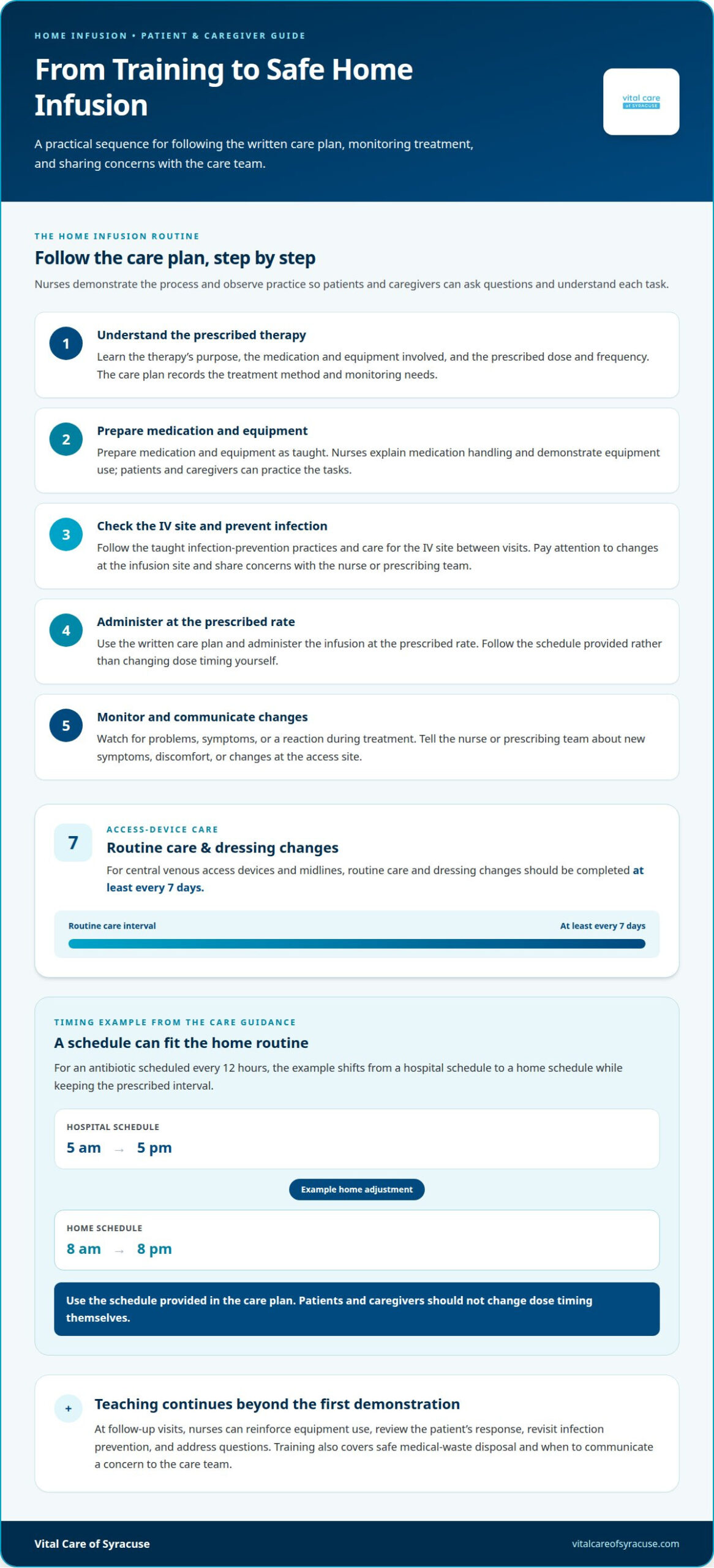
Training prepares you or a caregiver to administer medication when the prescribed plan allows it. A nurse explains the procedure, safe handling and storage of supplies, and equipment use. You’ll learn which steps require clean handling and how to recognize concerns such as leaking fluid or a pump alarm.
Practice is part of the preparation. A nurse can observe you handling supplies and explain when to stop and call for support. This guidance can make home treatment more manageable, particularly if repeated travel to an infusion center would be difficult. Home care still requires a suitable plan and access to clinical support.
Conditions treated with home infusion
Home infusion may be prescribed for infections requiring IV antibiotics, dehydration, or nutritional deficiencies. It may also be part of treatment plans for cancer, multiple sclerosis, rheumatoid arthritis, Crohn’s disease, or pain. These examples illustrate why the medication and delivery route matter: some prescribed treatments need to enter a vein rather than pass through digestion. The clinical plan determines the medication, schedule, and monitoring needs, not the diagnosis alone. For example, an antibiotic plan depends on the prescribed medicine and the monitoring it requires.
A home infusion provider coordinates clinical details with the physician overseeing your treatment. This may include reviewing the prescription, arranging equipment and supplies, and planning nursing visits or caregiver support. The provider connects the hospital or clinic treatment plan with the care that can be managed at home. Clear coordination helps ensure supplies and instructions are ready before you leave. It also clarifies who administers treatment and how monitoring fits into the plan.
Receiving treatment at home can avoid repeated travel to a hospital or clinic and let patients remain in familiar surroundings during infusion. That can be especially useful for people in rural or underserved communities who face long trips for appointments. Home treatment does not remove the need for clinical oversight; it changes where scheduled care takes place. Access depends on the prescribed plan and whether home delivery and appropriate support can be arranged for that patient.
Equipment is selected for the prescribed therapy, and a nurse explains its use to the patient or caregiver. Training can cover the pump or other delivery method, tubing, supply handling, and the steps for reporting a problem. A family member or friend may learn to administer medication when the care plan calls for it. This preparation makes responsibilities clearer before treatment begins. Patients exploring home infusion therapy can learn how specialized treatment plans support care beyond a hospital or clinic.
Infection risk in home versus hospital care
Home and hospital infusion involve different exposure settings, but neither removes infection risk. The CDC estimates that about 1 in 31 hospitalized patients in the United States has a healthcare-associated infection on any given day. That figure covers hospitalized patients generally, not infection rates specific to IV infusion. Hospital care also brings patients into shared clinical spaces, while home treatment limits contact with other patients during administration.
At home, safe practice depends on clean handling and careful observation. Before giving medication or fluids, a home health nurse checks that the IV is functioning and looks for signs of infection. Patients and caregivers should follow their training when handling supplies, keep equipment clean, and avoid touching connection points unnecessarily. Specialized pharmacies prepare home infusion treatments in environments meeting USP 797 standards, supporting safe preparation before medication reaches the home.
Used supplies need appropriate disposal. Put used needles in a sharps container, and place disposable tubing, bags, gloves, and similar items in a plastic bag for the trash. Store medicines and supplies as directed, and report changes around the infusion site, such as redness, swelling, warmth, leaking fluid, or pain. These steps help the care team respond to potential problems without assuming every irritation is an infection.
Hospital capacity matters because inpatient care takes place in a setting where healthcare-associated infections occur. Home infusion avoids travel and shared treatment areas, but hospital-wide estimates should not be treated as a direct comparison with home-infusion rates. Home treatment still requires clinical oversight, appropriate administration, and communication with your care team. A nurse’s site check and your observations both contribute to monitoring.
Some patients prefer home treatment because prescribed antibiotics, fluids, or hydration can be administered without repeated clinic visits. The choice should reflect your prescribed therapy and monitoring needs, not an assumption that one setting eliminates risk. Make sure you know whom to contact about concerning changes and how to reach emergency help for severe symptoms.
Hospital-to-home IV therapy transitions
If you’re switching from hospital to home IV therapy, start by speaking with the physician overseeing your treatment. Your physician provides the prescription and assesses whether your health and treatment plan support home care. The hospital team then coordinates with the home infusion provider, sharing the medication plan, schedule, catheter needs, and monitoring requirements.
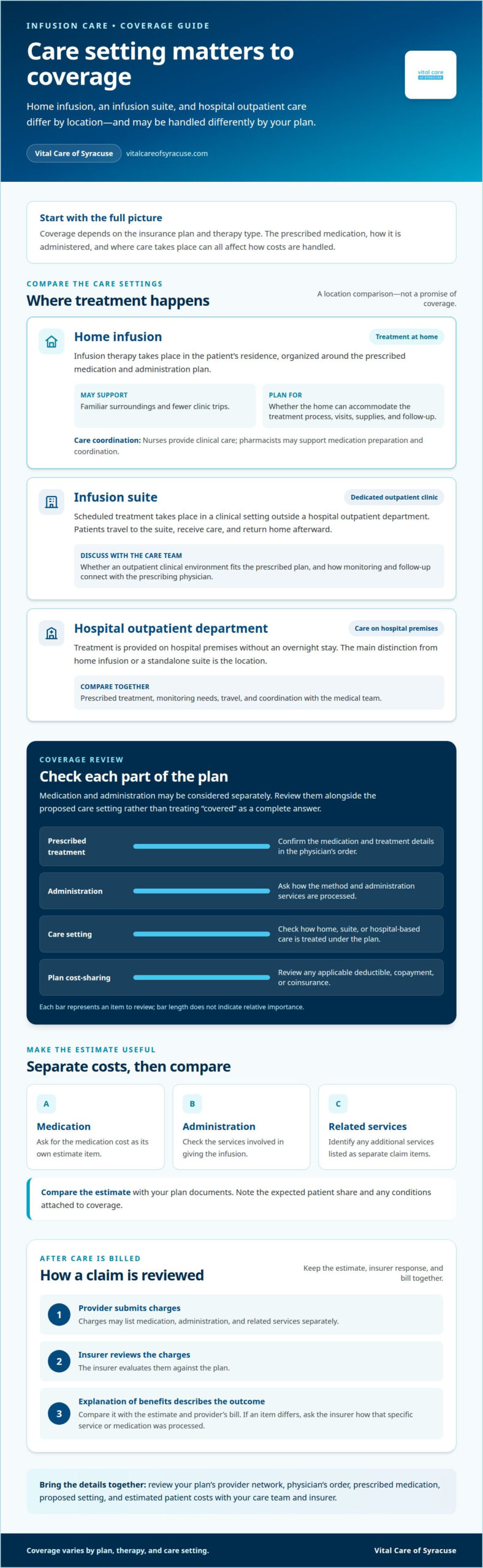
Before discharge, discuss referrals, coverage, out-of-pocket costs, and prior authorization with your healthcare team. Coverage varies by insurance plan and therapy type. These details help shape the transition plan, including which supplies and equipment must be ready, who will administer each dose, and what nursing support is needed. For parenteral nutrition, for example, the plan accounts for the prescribed nutrients and their delivery equipment.
The first home visit usually takes 2-3 hours for education, equipment setup, and comfort. A nurse reviews the treatment instructions, checks the infusion equipment, and clarifies the patient’s or caregiver’s role. There’s also time to discuss whom to contact and what changes to report. Home IV antibiotic courses for serious bacterial infections frequently last four to six weeks, so the schedule and support plan should cover the prescribed course.
The process of switching from hospital to home IV therapy relies on a clear handoff between care settings. Before the first home dose, make sure the medication instructions, infusion schedule, supplies, and follow-up plan are understood. Clarify whom to contact about a missed dose, equipment concern, or symptom change. Home infusion outcomes can be as good as, or sometimes better than, outcomes in acute-care settings; the appropriate setting depends on the treatment and monitoring needs.
For support coordinating prescribed infusion care, explore home infusion services.
Vital Care of Syracuse: Anti-infective Therapy
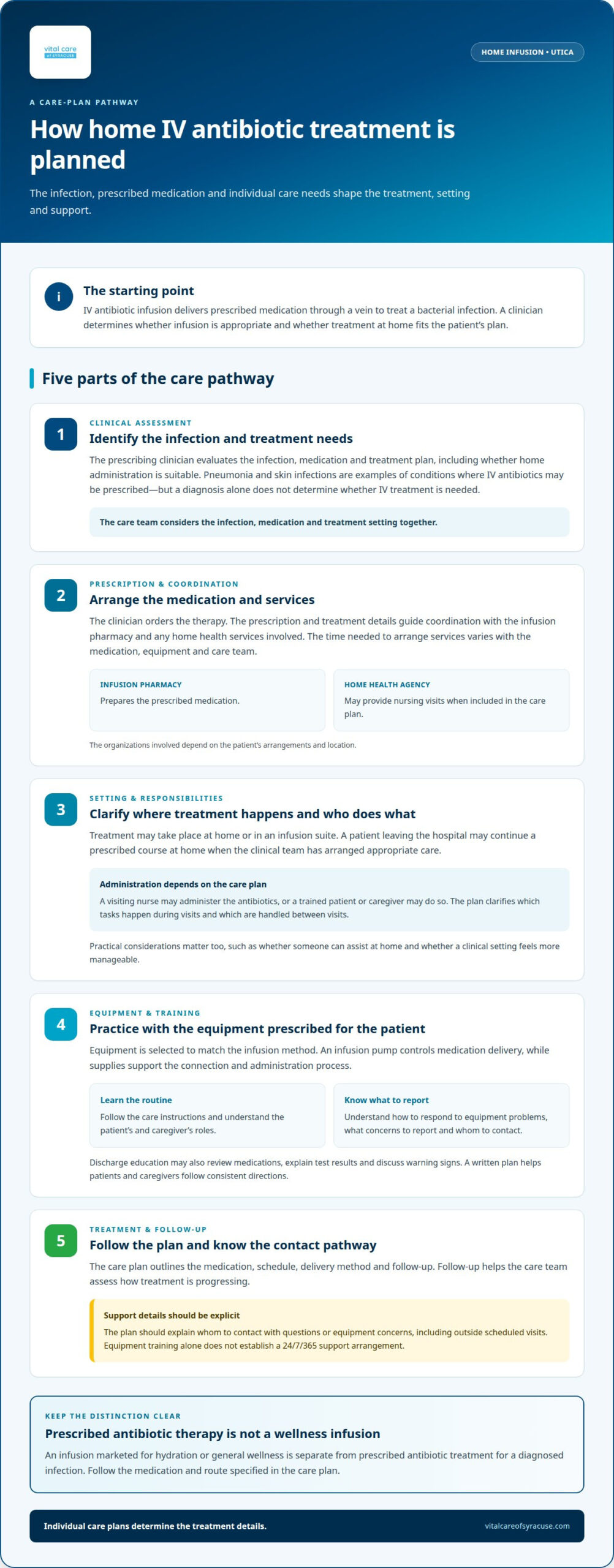
Vital Care of Syracuse provides anti-infective therapy for patients whose prescribed treatment includes infusion care at home or in an infusion suite. This may be appropriate when your physician determines that IV antibiotics can continue beyond a hospital stay and your care plan supports infusion outside the hospital. The team coordinates treatment administration and monitoring so you understand how infusion fits into your infection care.
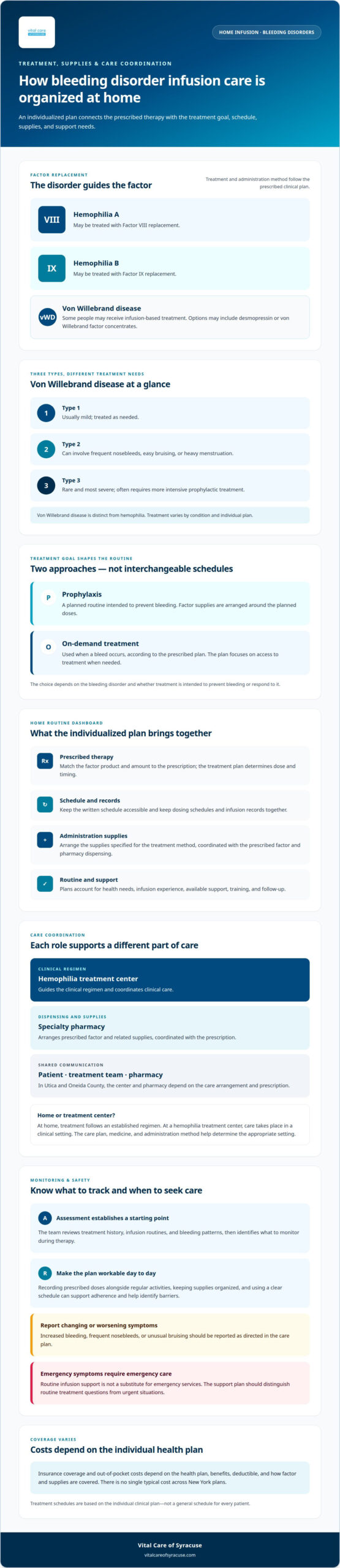
Vital Care of Syracuse also provides immunoglobulin (IVIG/SCIG), parenteral nutrition (TPN), and hemophilia and bleeding disorder therapy. These services address different prescribed infusion needs, so your treatment plan should guide which type of care is appropriate.
For home infusion of a prescribed anti-infective treatment, contact Vital Care of Syracuse to discuss the next step with the care team.
Take the Next Step With Confidence
Switching from hospital to home IV therapy is more than a change of setting; it’s an opportunity to consider how treatment fits into daily life. Before the transition, think about what would help you feel prepared: clear instructions, a workable schedule, and knowing whom to contact with care questions. Sharing these priorities with your healthcare team can make the decision more personal and practical.
Home infusion is an option to discuss when your prescribed treatment and care needs align with home-based support. Vital Care of Syracuse provides infusion therapies including anti-infective therapy, immunoglobulin (IVIG/SCIG), and parenteral nutrition (TPN). If you’re exploring these services as part of your care plan, contact Vital Care of Syracuse to learn more and discuss the next step.
Contact Vital Care of Syracuse to discuss your home infusion needs. A thoughtful next step can help you approach the transition with greater clarity and feel more prepared for the care ahead.
Frequently Asked Questions
Why You Need IV Medicines at Home?
Home IV medication may be appropriate when a prescribed treatment needs to enter the bloodstream through a vein. For example, a physician may prescribe IV antibiotics for an infection or choose IV treatment when oral medication is ineffective, unavailable, or not well tolerated. Home administration can also reduce repeated clinic travel when the treatment plan allows. Your prescribing clinician determines the medication and setting based on your needs.
How do infusion pharmacies ensure safe administration of infusion drugs?
Infusion providers coordinate with the prescribing physician and clinical team to support safe treatment. Vital Care of Syracuse works with physicians, nurses, and pharmacists on dosing, monitoring, and response. Infusion therapy is considered safe when provided by licensed, experienced clinicians following established protocols. Your care plan also clarifies who administers treatment, how you’re monitored, and how concerns are communicated to your healthcare team.
How much does an IV drip at home cost?
Home infusion costs depend on the prescribed therapy, clinical services, supplies, and insurance plan. There isn’t one fixed amount that applies to every patient or treatment. Vital Care of Syracuse states that coverage varies by insurance plan and therapy type, and assists with insurance verification, prior authorizations, and reimbursement coordination. The cost depends on the case and is provided after a quote request, with medication and care needs affecting the amount.
Is it possible to get IV fluids without going to the hospital?
Yes, IV fluids can be administered at home when prescribed by a physician and clinically appropriate. For example, a care plan may include IV hydration, with the route and setting based on your condition and monitoring needs. Home infusion is not a substitute for emergency evaluation. Your healthcare provider determines whether home treatment fits your diagnosis, prescribed fluid, and required level of supervision.
What is included in a home IV kit?
A home IV kit is assembled around your prescribed medication and delivery method, so its contents vary by treatment. It may include the prescribed solution, catheter-related supplies, tubing, and equipment needed for administration. Use only supplies provided for your care plan and follow your nurse’s instructions for storage and handling. Your nurse can explain which items are single-use and how to dispose of them safely.
When should you call for help?
Call the nurse for redness, swelling, warmth, leaking fluid, or pain around the infusion site, or if the catheter or tubing comes out. Contact a healthcare provider for a fever of 100.5°F (38°C) or higher, according to the U.S. National Library of Medicine. Call 911 for breathing problems, chest pain, dizziness, or signs of an allergic reaction such as hives or shortness of breath.
Leave a Reply