



Feeling ready for home SCIG is not just about memorizing a checklist. It means having the chance to learn with clinical guidance and understand how your prescribed plan applies to you. It is understandable to feel uneasy about handling supplies, managing an infusion, or knowing what to do if something feels wrong. SCIG self-administration training Syracuse patients receive should reflect their prescription, abilities, and care plan, not follow a one-size-fits-all lesson.
Supervised teaching can help you understand the process, practice the steps relevant to your prescribed therapy, and learn when to pause and seek guidance. This article explains what training may cover, how clinical supervision can support learning, and what questions to bring to your prescribing clinician and infusion team. Vital Care of Syracuse coordinates personalized infusion treatment plans with prescribing physicians, with clinical monitoring guided by established protocols. Your prescription materials and clinical team remain the source for medication-specific instructions.
Key Takeaways
- SCIG is immunoglobulin therapy delivered under the skin. Training supports, but does not replace, the treatment plan set by your prescribing clinician.
- SCIG self-administration training Syracuse patients receive can include a care-plan review, clinician-led teaching, and practice as directed.
- Your prescribed medication determines the relevant supplies and technique. Keep its specific instructions accessible and follow your care team’s guidance.
- Discuss home treatment and an infusion suite with your care team, including your comfort preferences and whether home-based care suits your plan.
- Vital Care of Syracuse coordinates personalized infusion treatment plans with prescribing physicians and monitors patients according to established protocols.
What SCIG self-administration training in Syracuse is designed to help you learn
Starting a new treatment can bring practical questions alongside hope for a routine that fits your life. SCIG self-administration training Syracuse patients receive is intended to build understanding of their prescribed therapy, not teach a standard method for everyone. Learning should follow the medication, the clinician’s plan, and the patient’s needs and comfort.
Training may help you understand how your care plan relates to preparation, which medication-specific technique your clinical team has prescribed, and when to pause and seek guidance. The goal is not just to remember a sequence of tasks. It is to know which instructions apply to you, where to find them, and whom to contact when you are uncertain. A caregiver may also take part when appropriate, particularly if they will support treatment at home.
- Review the treatment plan and the instructions for your prescribed medication.
- Learn about the supplies and technique that apply to your care, as directed by your clinical team.
- Discuss what to do if you have a question, notice a concern, or feel unsure about a step.
- Consider whether you or a caregiver would benefit from more explanation or support.
Learning needs differ. Some patients may be preparing to manage treatment themselves, while others may need caregiver involvement or ongoing clinical support. Training can help you and your care team discuss what feels manageable, but it does not mean every patient will administer treatment independently. Your prescribing clinician’s assessment and instructions remain central.
How SCIG differs from IVIG
SCIG means subcutaneous immunoglobulin therapy: immunoglobulin is delivered into the tissue beneath the skin. IVIG, by contrast, is delivered into a vein. These are different routes for prescribed immunoglobulin treatment, and neither is universally safer, easier, or more effective for every person. For a broader overview of immunoglobulin therapy, including its administration routes, consult this reference alongside your clinician’s advice.
Who helps guide SCIG learning?
Your prescribing clinician sets the treatment plan, and the infusion care team helps explain the directions relevant to your care. The prescriber determines the prescribed therapy, while the clinical team can support your understanding and address questions about following the plan. Medication-specific technique, supplies, and safety directions should come from these sources, not from general advice that may not fit your prescription.
SCIG is prescribed immunoglobulin therapy delivered into tissue beneath the skin rather than directly into a vein. That describes the route, not an individual treatment recommendation. If an instruction is unclear or something about treatment concerns you, seek guidance from your clinical team before making assumptions. A careful discussion can make the learning process more personal, practical, and aligned with your care plan.
What to expect during supervised SCIG self-administration training
Training is easier to approach when you know its purpose: to help you understand the care plan and learn the parts of treatment relevant to your prescription. In Syracuse, care can involve coordination between your prescribing physician and infusion care team, with clinical monitoring guided by established protocols. The details are personalized, so another patient’s routine may not match yours.
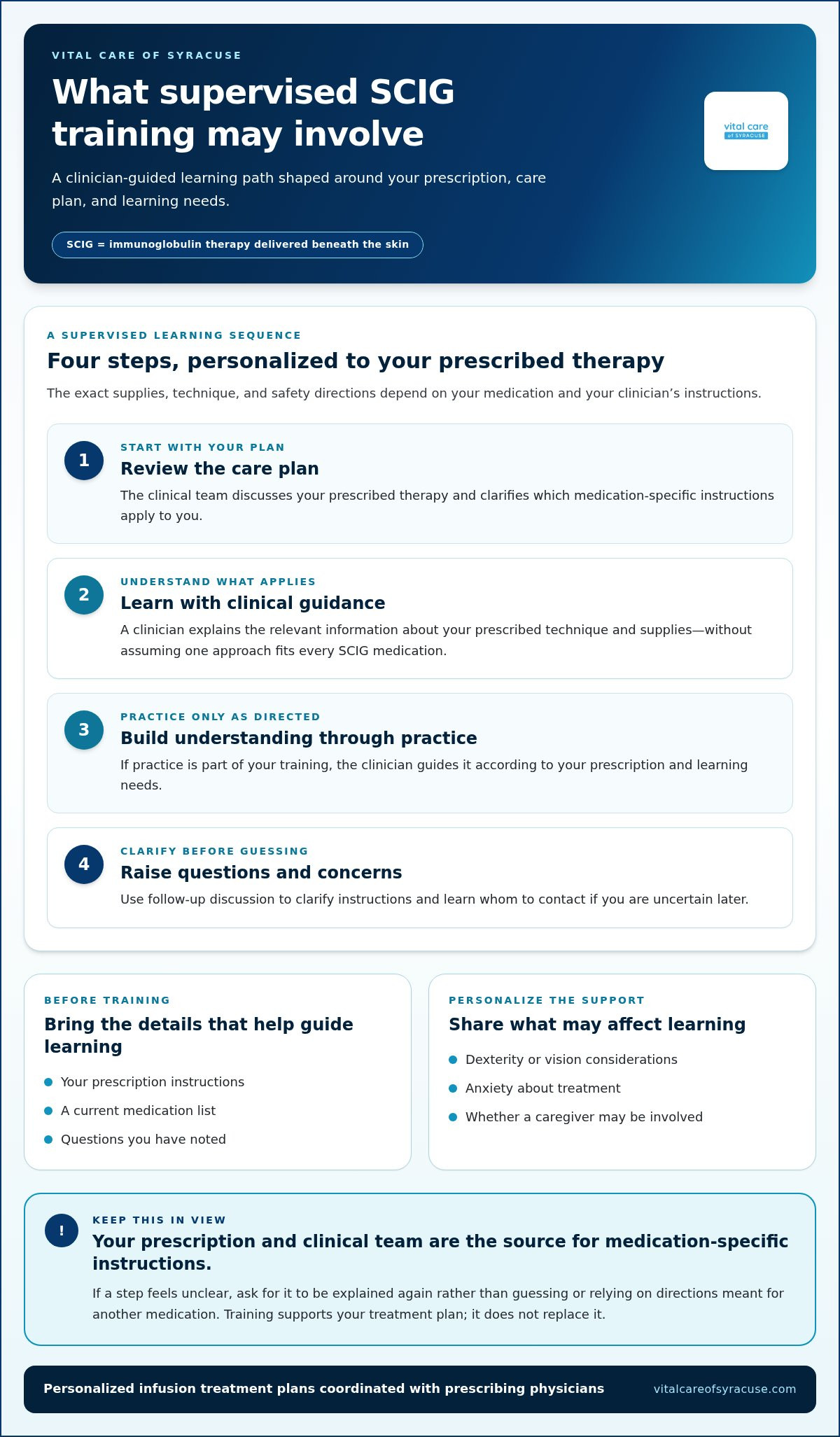
A supervised learning process may follow steps like these:
- Review the care plan. The clinical team discusses the prescribed therapy and clarifies which medication-specific instructions apply to you.
- Learn with clinical guidance. A clinician explains relevant information about your prescribed technique and supplies without assuming that one approach fits every SCIG medication.
- Practice as directed. If practice is part of your training, the clinician guides it according to your prescription and learning needs.
- Raise questions and concerns. Use follow-up discussion to clarify instructions and learn whom to contact if you are uncertain later.
SCIG training is individualized and follows the patient’s prescribed treatment plan. The exact supplies, technique, and safety instructions depend on the medication and your clinician’s directions. Vital Care of Syracuse coordinates personalized treatment plans with prescribing physicians. Its experienced nurses and pharmacists monitor patients according to established protocols.
Preparing for a training conversation
Bring your prescription instructions, a current medication list, and any questions you have noted. Consider practical factors that may affect learning, such as dexterity, vision, anxiety about treatment, or whether a caregiver may be involved. Sharing these details helps the care team understand what support or explanation may be useful. Do not assume that a particular piece of equipment or preparation routine applies to your prescription.
Building confidence with clinician-guided practice
During practice, the clinical team can guide learning in a way that reflects your prescribed therapy. If an instruction feels unclear, ask for it to be explained again rather than guessing or relying on directions meant for another medication. Questions about technique, supplies, or an unexpected concern are best addressed using your medication-specific clinical guidance.
Write down questions as they come up, including what to do if you are unsure about a step and how to reach the appropriate member of your care team. Patients and caregivers can both ask questions, and the discussion can account for who will take part in treatment at home. Learning is a process, not a test. Clarity matters more than trying to appear confident.
For patients receiving prescribed immunoglobulin care, Vital Care of Syracuse’s personalized infusion care is coordinated with the prescribing physician. This local coordination connects treatment planning and clinical monitoring with the established care plan.
Home SCIG or an infusion suite: how to discuss the right setting
Choosing where to receive prescribed SCIG involves more than deciding whether home or a clinic feels more convenient. The treatment plan and clinical suitability come first, while your comfort, support needs, and preferences also matter. SCIG self-administration training Syracuse patients receive can clarify what learning and support may involve, but training alone does not determine which setting is appropriate.
Home-based care may suit someone who prefers treatment in familiar surroundings and whose care plan supports that setting. An infusion suite provides a clinical setting for treatment and may feel more reassuring if you prefer care outside the home. Neither option is automatically right for everyone. Your prescribing clinician helps determine whether home-based care is appropriate, considering your prescribed medication and individual clinical needs.
Vital Care of Syracuse offers home infusion services and infusion suites in East Syracuse. These are care-setting options to discuss as part of a personalized plan. The treatment plan determines which setting is appropriate for your prescribed therapy. For a broader look at the benefits of a local home infusion company in Central New York, consider how local coordination may fit your care needs.
Questions that can shape the care-setting discussion
Bring your preferences and practical concerns to your prescribing clinician and infusion care team. Discuss whether you feel comfortable learning treatment at home, what support a caregiver could provide, and whether an infusion-suite setting feels more reassuring. Ask how your prescribed medication and clinical circumstances affect the choice. These questions keep the conversation focused on your plan rather than assumptions about home or suite care.
- Does my treatment plan allow for home-based care?
- What support would be available in the setting recommended for me?
- How should my comfort or caregiver needs factor into the decision?
- What should I do if my needs or circumstances change?
How local coordination supports continuity
Care-setting decisions depend on individual clinical needs and the prescribed treatment plan. Vital Care coordinates personalized plans with prescribing physicians, connecting the setting discussion with the broader approach to care. Its clinical team monitors patients according to established protocols. For patients in East Syracuse and the broader Central New York region, local coordination supports communication around prescribed infusion care, while the clinician’s guidance remains central to deciding which setting is appropriate.
If you are discussing prescribed SCIG care, learn about Vital Care of Syracuse’s infusion care as part of understanding local treatment coordination. Your care team can help you weigh comfort and support needs alongside the clinical factors that guide the setting decision.
How to prepare for SCIG training and follow-up in Syracuse
A little preparation can make a training conversation more useful and help you leave with fewer unanswered questions. For SCIG self-administration training Syracuse patients can gather their medication-specific instructions and note anything they want the care team to clarify. The goal is not to learn a universal procedure from a checklist. It is to understand how your prescribed plan applies to you.
Before training or a follow-up discussion, consider gathering these items and questions:
- Your prescription instructions and any written guidance for your medication.
- A current list of medications you take, so the care team has relevant information during the discussion.
- Questions about which supplies and directions apply to your treatment plan, including any storage instructions for your medication.
- Questions about whom to contact if an instruction is unclear, treatment is interrupted, or you have a concern or unexpected symptom.
- Notes about what you would like to review again, such as a direction that feels difficult to remember or a point you want a caregiver to understand.
Keep medication-specific directions accessible and follow the care plan set by your prescribing clinician. If treatment is missed or interrupted, do not guess how to resume it. Follow the instructions provided for your care and contact the clinical team as directed. Report concerns or unexpected symptoms through the contact pathway in your clinical care instructions, so the team can address your question in the context of your prescription.
Questions to bring to the care team
Use the conversation to clarify what applies specifically to you. Ask which instructions are tied to your prescribed medication, how to respond if a direction is unclear or treatment is interrupted, and how follow-up will be coordinated with your prescribing clinician. If a caregiver may help, ask how they can be included in education and communication. Clear answers can make it easier to follow instructions consistently.
- Which written instructions should I use for my prescribed treatment?
- Who should I contact if I am unsure what to do or have a concern?
- How will follow-up and communication with my prescribing clinician be handled?
Keeping a useful treatment record
Your care team may recommend tracking treatment details as part of your care plan. Ask what information would be useful to record and how it will support follow-up. There is no single format that applies to everyone. You can also note questions or concerns as they arise, including what happened and when, then raise them with the team. A record can help you describe your experience, but it does not replace medication-specific instructions or clinical guidance.
Vital Care of Syracuse coordinates personalized infusion care with prescribing physicians, helping connect patient questions with the established care plan. Learn more about Vital Care of Syracuse’s infusion services online.
Getting SCIG care coordinated with Vital Care of Syracuse
Understanding your prescribed treatment is one part of preparing for infusion care. Coordination among you, your prescribing physician, and the infusion care team can connect the treatment plan with practical questions about education, monitoring, and care setting. Vital Care of Syracuse is a licensed and accredited infusion therapy provider serving East Syracuse and the broader Central New York region.
Vital Care works with prescribing physicians to coordinate personalized treatment plans. Experienced nurses and pharmacists monitor patients according to established protocols, keeping care connected to the plan developed for each person. If you are considering SCIG, your prescribing clinician can discuss whether the therapy is suitable for you and what education fits your medication and circumstances. SCIG self-administration training Syracuse patients receive should follow those individualized directions, not replace the prescriber’s guidance.
What local infusion coordination can involve
Care coordination brings together your questions, the prescribing physician’s treatment plan, and the infusion team’s role in supporting and monitoring care. Vital Care offers home infusion services and infusion suites in East Syracuse. The appropriate setting depends on the prescribed therapy and individual clinical needs, so the two care-setting options do not mean that SCIG is suitable for every setting or patient.
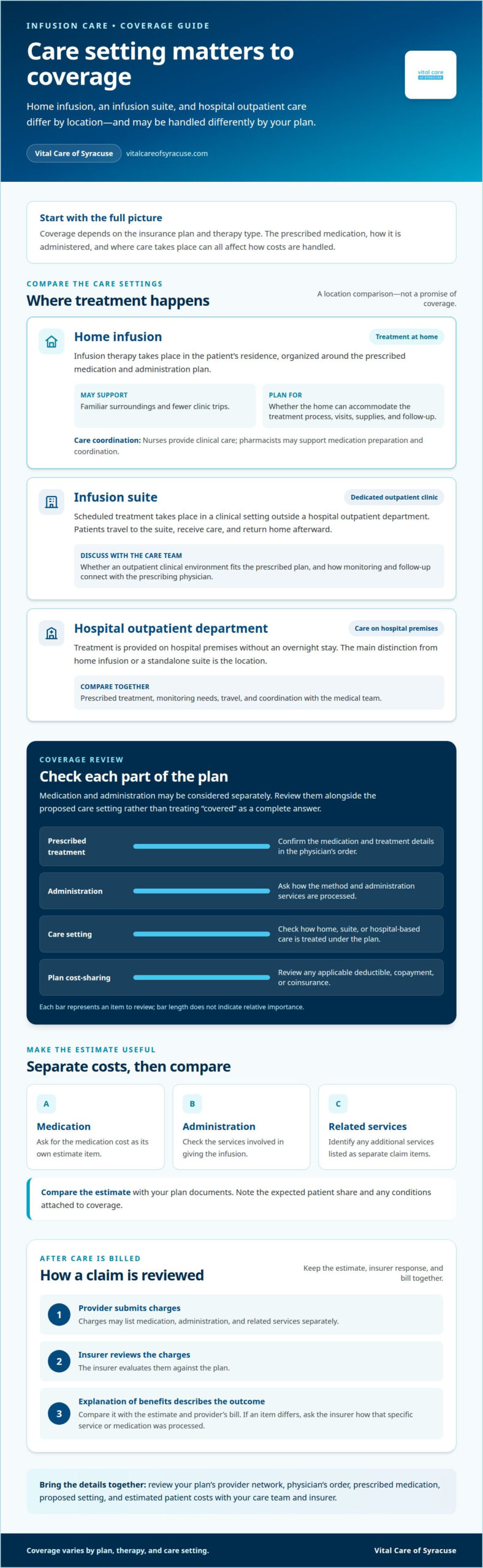
Insurance coverage also deserves a clear conversation. Benefits vary by plan and therapy type, and Vital Care assists with insurance verification, prior authorizations, and reimbursement coordination. Verification can help clarify benefit information, but it does not guarantee coverage or payment. You can discuss plan-specific questions with the care team and your insurer while your prescribing clinician guides treatment decisions.
A clear next step for Syracuse patients
If you are exploring SCIG or preparing for training, start by discussing treatment suitability and education with your prescribing clinician. Bring practical questions about follow-up, monitoring, and coordination to the infusion care team. Sharing concerns about learning or managing treatment helps the team understand what information and support may be useful within your prescribed plan.
Vital Care coordinates infusion care with the prescribing physician and supports personalized planning. If you would like to discuss coordination for prescribed infusion care, reach out to Vital Care of Syracuse. The care team can explain how it works with your clinician and help you identify questions to bring forward.
Take Your Next Step With Confidence
Preparing for home treatment does not mean you need every answer before you begin. Bring your questions to the people involved in your care, including your prescribing clinician and infusion care team. Ask what learning support fits your prescribed therapy, how to handle uncertainty, and what follow-up will look like for you. Your plan guides the process, while your needs and comfort shape the conversation.
If you are considering SCIG self-administration training Syracuse, remember that building confidence may take discussion and practice guided by medication-specific instructions. Ask for clarification, involve a caregiver, and speak up when something feels difficult. These conversations help keep decisions connected to your individual treatment plan.
Vital Care of Syracuse can coordinate prescribed infusion care with your clinician. Discuss infusion care coordination with Vital Care of Syracuse and take a thoughtful next step toward understanding the support available for your care in Syracuse, Albany, Rochester, Utica, Buffalo, Auburn, or Binghampton.
Frequently Asked Questions
What does SCIG self-administration training involve?
SCIG self-administration training Syracuse patients receive is guided by the clinical team and tailored to the prescribed medication and care plan. It may cover how to understand medication-specific directions, where to find relevant instructions, and how to raise questions or seek guidance. If written directions seem unclear, pause and ask the prescribing clinician or infusion team rather than relying on general online instructions. Training details vary by individual plan.
Can I administer SCIG at home in Syracuse?
Home administration may be appropriate when it fits the prescribed treatment plan and clinical assessment. Your prescribing clinician and infusion care team guide that decision based on your circumstances and medication. Vital Care of Syracuse provides home infusion services in its New York service region. Discuss your preference for home care with your clinician as part of treatment planning.
Is SCIG self-administration training difficult?
Learning a new treatment can feel unfamiliar, and people vary in what they find challenging. Clinician-guided education and practice, when included in the care plan, can give you space to ask questions and become more familiar with your prescribed instructions. If dexterity, vision, anxiety, or caregiver support is a concern, raise it with your clinical team. Training does not guarantee that everyone will administer treatment independently, and it is appropriate to discuss what support you may need.
How is SCIG different from IVIG?
SCIG is delivered into tissue beneath the skin, while IVIG is given intravenously, or into a vein. Both are forms of immunoglobulin therapy, but the route that fits a patient depends on the prescribed treatment and individual clinical considerations. If you are weighing treatment options, ask your prescribing clinician how each route relates to your care plan. Do not assume one method is better for everyone based on another patient’s experience.
What should I do if I have a reaction or concern during SCIG?
Follow the medication-specific safety instructions and care plan provided by your clinical team. If a concern arises, use the contact pathway identified in those instructions to reach the appropriate clinical resource. For an emergency, seek emergency services. Do not try to diagnose a reaction yourself or change, delay, or stop prescribed treatment unless a qualified clinician directs you to do so. If you are unsure which instructions apply, contact your care team for guidance.
Can a caregiver learn to help with SCIG?
A caregiver may be able to participate in treatment education when that fits the patient’s needs and clinical guidance. Discuss their involvement with the prescribing clinician and infusion team, especially if they may support communication or help the patient understand the care plan. Their participation does not automatically mean they are qualified to administer treatment. The clinical team should clarify what role, if any, is appropriate and provide instructions specific to the patient’s prescribed therapy.
Does insurance cover SCIG therapy in New York?
Coverage varies by insurance plan and therapy type, so benefits and patient costs cannot be assumed in advance. Vital Care of Syracuse assists with insurance verification, prior authorizations, and reimbursement coordination. This process can help clarify how a particular plan applies to a prescription. Coverage and clinical eligibility depend on the plan, prescription, and relevant clinical considerations. Patients in the New York service region, including Syracuse, Albany, Rochester, Utica, Buffalo, Auburn, and Binghampton, can discuss coordination with the care team.
Leave a Reply