


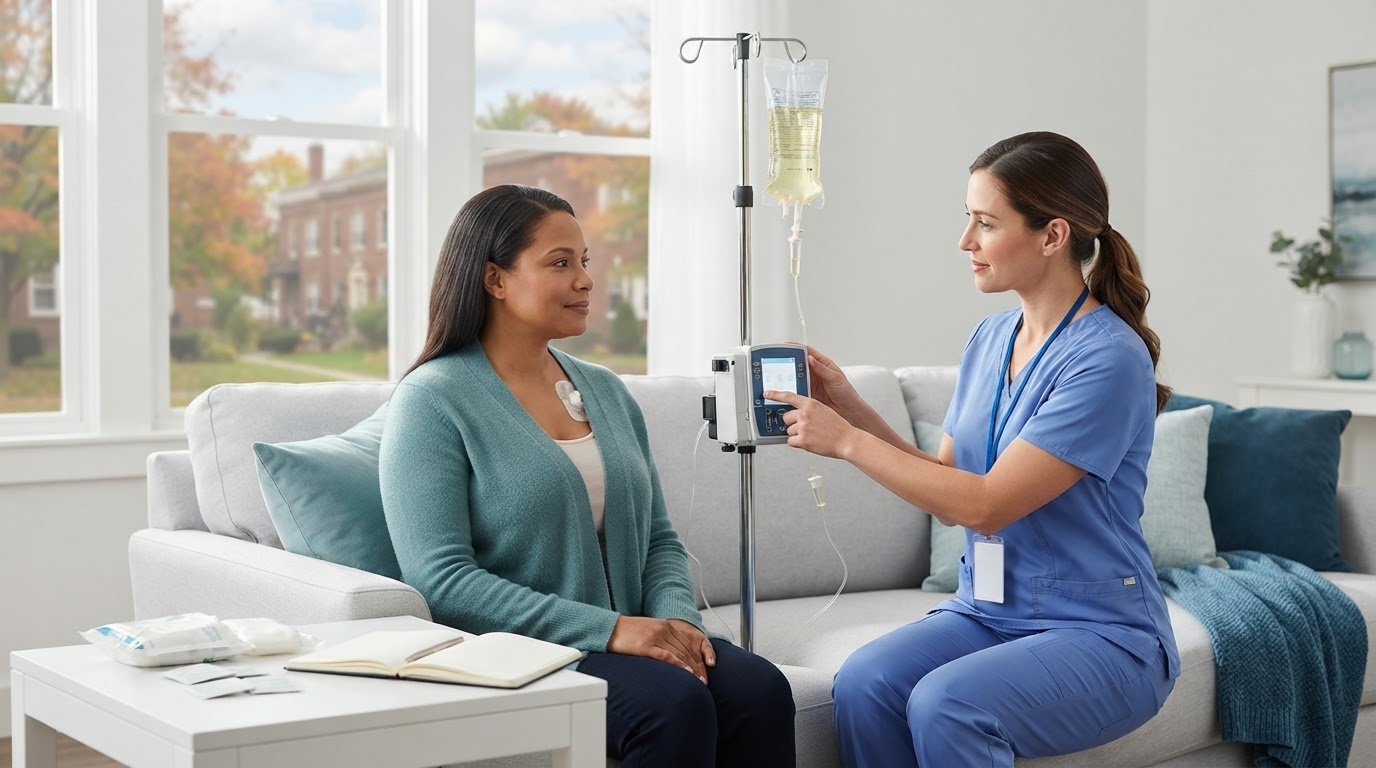
A search for “home parenteral nutrition for gastroparesis Albany” often reflects a deeper concern: whether nutrition support beyond eating or tube feeding might be considered, and how it could be managed at home.
It’s understandable to want clear answers. Total parenteral nutrition (TPN) delivers nutrients through a vein, but it isn’t a default treatment for gastroparesis. A prescribing clinician may consider it when a person’s nutritional needs can’t be met through the digestive tract, weighing potential benefits, risks, and other options with the patient.
This guide explains what may prompt a TPN discussion, what clinical and practical questions to raise with your healthcare team, and how home infusion care can be coordinated. Vital Care of Syracuse is a licensed and accredited infusion therapy provider that works with prescribing providers to coordinate parenteral nutrition therapy. Depending on the care plan, Albany-area patients may receive infusion support at home or in the provider’s on-site infusion suite in East Syracuse.
Key Takeaways
- TPN is a clinician-directed nutrition-support option, not an automatic response to gastroparesis.
- Your prescribing provider evaluates your nutrition needs and other clinical considerations before discussing TPN.
- Home infusion and an on-site infusion suite in East Syracuse are different care settings that may be considered within an individual plan.
- Practical questions about nutrition goals, care needs, and infusion arrangements can help guide a conversation with your healthcare team.
- Home parenteral nutrition for gastroparesis in Albany can be coordinated with a prescribing team and infusion professionals.
What Home Parenteral Nutrition for Gastroparesis in Albany Means
Eating and meeting nutrition needs can become difficult when gastroparesis disrupts daily routines. A meal may leave someone feeling uncomfortably full, or nausea may make it hard to eat enough. These experiences deserve a thoughtful clinical assessment, but symptoms alone don’t establish that a person needs parenteral nutrition.
Parenteral nutrition is nutrition delivered into the bloodstream through a vein, bypassing the digestive tract. Total parenteral nutrition (TPN) is a form of this support prescribed to help meet a person’s nutrition needs. It doesn’t correct delayed stomach emptying or treat gastroparesis itself. A clinician determines whether it may fit an individual’s medical and nutrition situation.
For a visual introduction to preparing nutrition for home infusion, watch this video from Cleveland Clinic:
How Gastroparesis Can Affect Nutrition
Gastroparesis involves delayed stomach emptying that isn’t explained by a blockage. The stomach moves food into the small intestine more slowly than expected, which can affect how eating feels and how much a person can manage. The Gastroparesis overview describes the condition and its possible causes and symptoms.
Some people may struggle to take in enough food or fluids, while others may maintain their nutrition through an individualized plan. Nutrition concerns can arise if intake remains limited. Symptoms and their effects vary, so a person’s experience alone cannot determine whether TPN is appropriate. The prescribing clinician considers the broader clinical picture, including nutrition status and what support can be taken through the digestive tract.
What Parenteral Nutrition Does and Does Not Do
Nutrition taken by mouth travels through the digestive system. Tube feeding also delivers nutrition into the digestive tract, while parenteral nutrition delivers nutrients intravenously. The prescribing team selects and adjusts the approach according to the patient’s needs. Difficulty eating alone does not determine whether TPN is appropriate.
TPN provides nutrition support when a clinician determines it is needed. It does not directly improve stomach emptying, resolve the underlying cause of gastroparesis, or guarantee relief from symptoms. Treatment of gastroparesis and support for nutrition are related but distinct goals, and a care plan may address them separately.
For Albany-area readers exploring home parenteral nutrition for gastroparesis Albany, the starting point is a conversation with the prescribing team. They can explain whether this form of nutrition support is being considered and how it relates to the person’s overall care plan.
How Clinicians Decide Whether TPN May Be Appropriate
Considering TPN is a clinical decision, not a conclusion a person needs to reach alone. The prescribing provider reviews the diagnosis, the patient’s nutrition needs, and the care already in place. The National Institute of Diabetes and Digestive and Kidney Diseases overview of gastroparesis explains the condition and its evaluation. A clinician uses the patient’s individual history and current circumstances to guide treatment discussions.
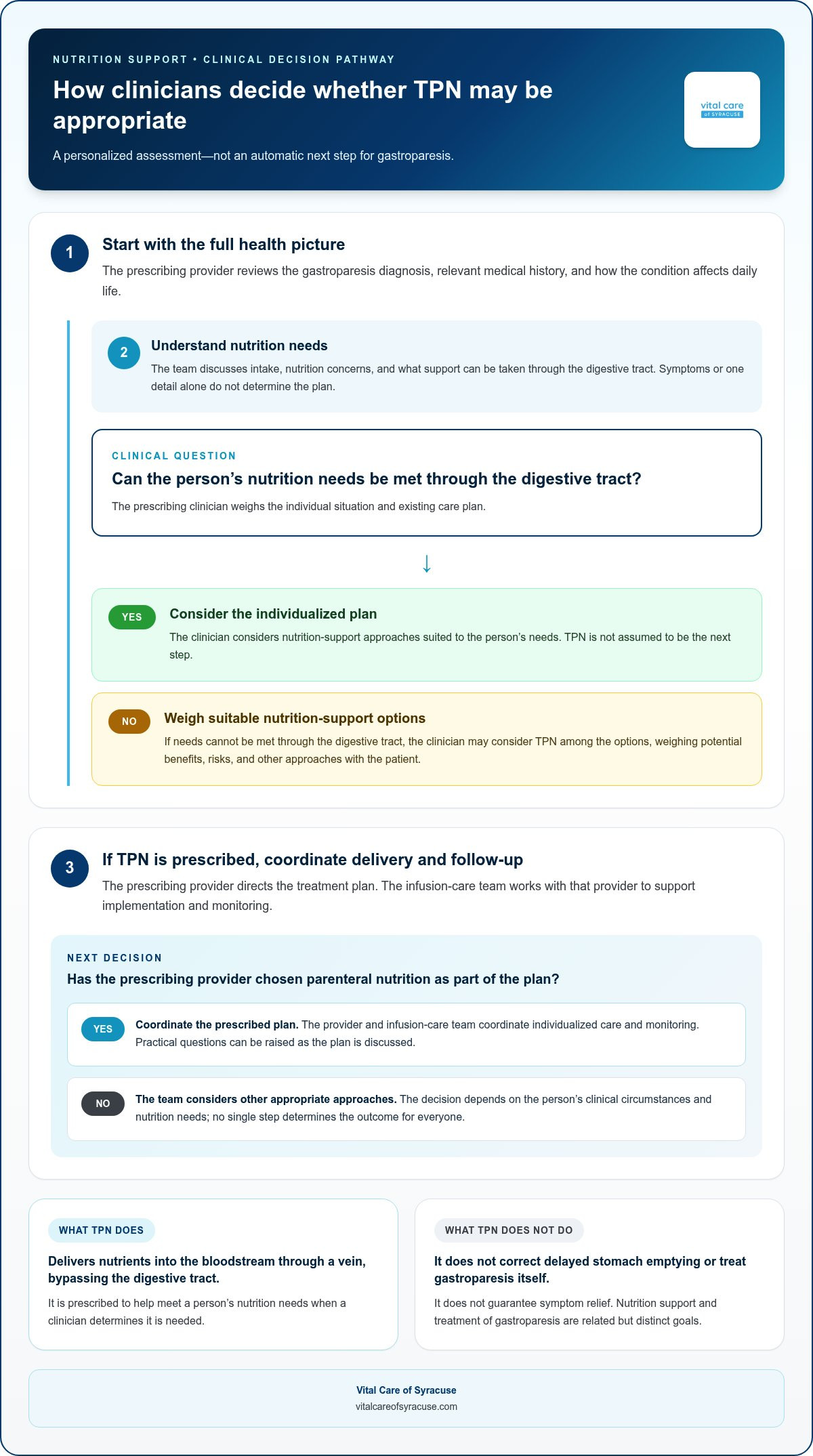
A care discussion may follow a sequence like this, with details adapted to the person rather than treated as a fixed eligibility checklist:
- Review the diagnosis and current health picture. The prescribing provider considers the gastroparesis diagnosis, relevant medical history, and how the condition is affecting daily life.
- Understand nutrition concerns. The team discusses intake, nutrition needs, and any concerns about maintaining adequate nourishment. A symptom or single detail doesn’t determine the plan on its own.
- Consider nutrition-support options. The clinician evaluates which approaches may be suitable, taking the patient’s situation and existing care plan into account. TPN is considered in that context, not assumed to be the next step.
- Coordinate the plan and follow-up. If parenteral nutrition is prescribed, the prescribing provider and infusion-care team coordinate the individualized plan and monitoring. Patients can raise questions and practical concerns as the plan is discussed.
This coordination connects the clinical decision with how care will be delivered. The prescribing provider directs the treatment plan, while the infusion team works with that provider to support its implementation and monitoring. Patients can also share what has been difficult, what support they already receive, and what questions they have. No single step determines the outcome in every case.
Questions the Care Team May Consider
The conversation may explore how eating and drinking are going, what nutrition concerns have arisen, and what the current care plan includes. The prescribing clinician assesses these details alongside the patient’s medical circumstances and evaluates appropriate nutrition-support options. Patients can help by describing changes in intake or daily routines and asking about the purpose, practical demands, and follow-up involved in a proposed plan.
Why TPN Is Not a Default for Every Patient
Gastroparesis alone doesn’t establish that TPN is appropriate. A diagnosis describes a health condition, but it doesn’t automatically determine which treatment a person needs. The care team weighs individual clinical considerations and nutrition needs before recommending an approach, and the decision may differ from one patient to another.
For Albany-area patients discussing home parenteral nutrition for gastroparesis Albany, a coordinated conversation can make the decision process clearer. Vital Care of Syracuse works with prescribing providers on parenteral nutrition therapy and personalized treatment plans. Patients can learn about Vital Care of Syracuse’s infusion support and how it coordinates care with prescribing providers.
Home TPN or an Infusion Suite: Understanding Care and Safety
Once a prescribing provider has recommended parenteral nutrition, the care setting becomes part of the practical conversation. Home infusion and an on-site infusion suite are two possible settings, not competing treatment recommendations. The choice is coordinated around the prescribed plan and the patient’s needs, preferences, and circumstances. Neither setting is automatically the right fit for everyone.
Home parenteral nutrition involves receiving prescribed nutrition intravenously at home with support from an infusion-care team. The Home Parenteral Nutrition (HPN) resource offers general background on this type of care. The prescribing provider directs the treatment plan and coordinates with the infusion team so that care and monitoring align with the patient’s clinical needs.
What Coordinated Home Infusion Care Involves
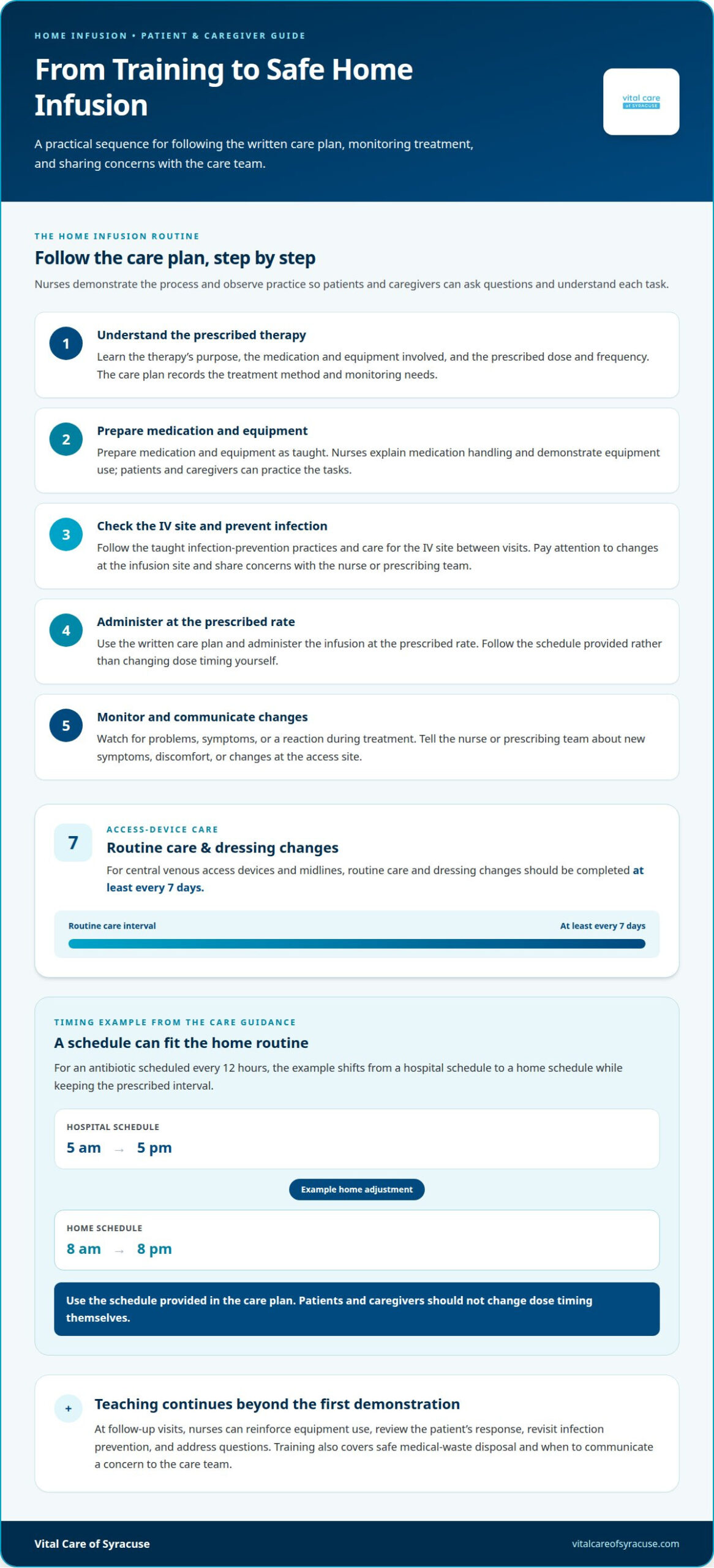
Home infusion care connects the prescribing provider’s treatment plan with the practical support needed to carry it out. Nurses and pharmacists contribute to monitoring and follow established protocols, while coordinating with the prescribing team. Their roles help support a complex therapy plan with clinical oversight beyond the provider’s office.
Specific arrangements are individualized. The care team coordinates according to the prescription and patient’s situation, rather than relying on one routine for everyone. Patients can ask how care will be organized, who is involved, and how monitoring relates to their plan. Clear communication helps everyone understand their role.
When an On-Site Infusion Suite May Fit a Patient’s Preferences
Some patients may prefer receiving infusion care in an on-site suite rather than at home. Vital Care of Syracuse has infusion suites in East Syracuse, New York. A suite may suit someone who prefers a dedicated care setting, while home infusion may better suit someone who values receiving care at home. These are personal considerations, not measures of which setting is clinically superior.
For Albany-area patients, the care setting is discussed in coordination with the prescribing provider and infusion team. Vital Care’s East Syracuse suite is one care-setting option, and the team considers the individual plan and preferences when coordinating care.
Whichever setting is considered, safety depends on a care plan directed by the prescribing provider and supported by licensed, experienced clinicians following established protocols, with close monitoring and coordination with prescribing providers. Patients can raise practical concerns, such as comfort receiving care at home or a preference for a dedicated suite. For those exploring home parenteral nutrition for gastroparesis Albany, it helps to understand how the prescribed plan, monitoring, and care setting fit together for their circumstances.
Preparing for a Home TPN Conversation in the Albany Area
Thinking about TPN can bring clinical and practical questions at once. Preparing for an appointment can help you understand the recommendation, share what matters in daily life, and clarify how care would be coordinated. You don’t need to decide on your own whether TPN is right for you. The prescribing team can explain how the option fits your individual care plan.
Before the conversation, consider writing down your questions and gathering relevant information about your current nutrition support and care. Share what you’ve noticed about eating, drinking, and everyday routines, along with concerns you want the team to understand. This isn’t a self-assessment for starting therapy. It gives your clinicians useful context for a personalized discussion.
Questions to Discuss With the Prescribing Team
Use these prompts to guide a conversation with your prescribing team. Prioritize the questions most relevant to your circumstances:
- How will you determine whether TPN fits my diagnosis, nutrition needs, and overall treatment plan?
- What nutrition-support goals would this plan address, and how would the team monitor it?
- How would the prescribing provider and infusion-care team coordinate responsibilities?
- What would home infusion involve in my circumstances, and how would it compare with an on-site infusion suite?
- What practical considerations should I discuss, such as comfort receiving care at home or preferences about the care setting?
- Who should I contact with routine questions about the plan, and how will changes in my care be communicated?
It may help to bring a written list of current medications, nutrition support, and questions, if those details are available. You can also note concerns about how a proposed plan might fit into your home routine. Sharing this context helps the team make the discussion specific to you.
Planning for Coverage and Care Coordination
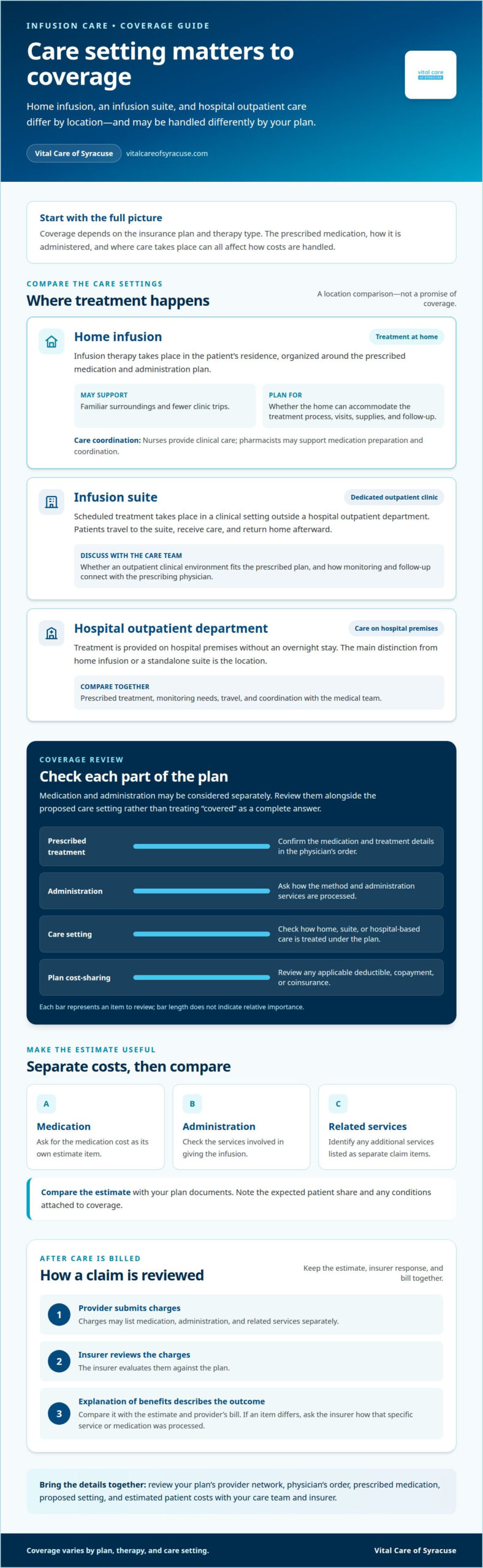
Insurance coverage for parenteral nutrition varies by plan and therapy. Verification and prior authorization may be part of the coordination process, but neither guarantees coverage or approval. Discuss benefits, required documentation, and potential patient responsibility as the plan is arranged. Coverage details for one person or therapy may not apply to another.
Vital Care of Syracuse assists with insurance verification, prior authorizations, and reimbursement coordination as part of infusion-care support. This administrative coordination works alongside the prescribing provider’s clinical plan; it doesn’t replace the provider’s decision about treatment. Understanding who is handling each step can make the process more organized, even when the health plan must review coverage.
For Albany-area patients considering home parenteral nutrition for gastroparesis Albany, discussing both clinical goals and practical arrangements can bring important questions into one conversation. To discuss parenteral nutrition coordination and infusion-care support, connect with Vital Care of Syracuse.
Vital Care of Syracuse: Albany Home TPN Support
For patients and caregivers considering parenteral nutrition, a clear connection between the prescribing provider and infusion-care team can make a complex plan easier to understand. Vital Care of Syracuse is a licensed and accredited infusion therapy provider serving New York, including Albany, Syracuse, Rochester, Utica, Buffalo, Auburn, and Binghampton. The team provides parenteral nutrition therapy and coordinates care with prescribing physicians.
Each treatment plan is personalized in coordination with the prescribing provider. The clinical plan remains connected to the patient’s needs, while the infusion-care team supports its delivery and monitoring. Care settings may include home infusion or an on-site infusion suite in East Syracuse, depending on the individual care plan.
What Patients Can Expect From the Infusion-Care Relationship
The relationship brings together the patient, prescribing healthcare provider, and infusion-care professionals. The prescribing provider directs the treatment plan, while Vital Care’s experienced nurses and pharmacists monitor patients and follow established protocols. This coordination connects the clinical plan with infusion care while preserving the prescribing provider’s role.
Patients and caregivers can ask questions about the plan, describe practical concerns, and stay engaged in conversations with the care team. A patient-centered approach recognizes that understanding the process matters alongside clinical direction. The team coordinates care around the prescribed plan, while recognizing that individual experiences and needs differ. No particular outcome can be promised.
A Local Next Step for Albany Patients
For Albany-area patients, local context matters when discussing how infusion care will fit into a broader treatment plan. Vital Care of Syracuse serves Albany and other communities across Central New York, including Syracuse, Rochester, Utica, Buffalo, Auburn, and Binghampton. Its care model includes home infusion and an East Syracuse infusion-suite option, based on the patient’s care plan.
Patients and caregivers can use the questions in this guide to frame a conversation about clinical goals, care setting, and coordination with the prescribing team. Vital Care works alongside that team to support personalized parenteral nutrition care. The prescribing provider remains central to decisions about whether TPN is appropriate.
If you’re exploring home parenteral nutrition for gastroparesis Albany, review Vital Care of Syracuse’s parenteral nutrition services and discuss coordinated infusion care with your prescribing team.
Take the Next Step at Your Own Pace
Considering home parenteral nutrition for gastroparesis Albany can feel like a lot to process, especially before you know what a treatment plan could involve. You don’t need to resolve every question at once. Start with the concern that feels most important today, and ask your prescribing team to put it in the context of your health and nutrition needs.
It may also help to think about what would make care understandable and manageable for you, including the support you value and what you’d like clarified before making decisions. These preferences belong in the conversation. A thoughtful plan should be discussed with you, and it’s reasonable to take time to understand the options.
When you’re ready to learn more about infusion-care support connected with this therapy, explore parenteral nutrition services and coordinated infusion care. Vital Care of Syracuse works alongside your prescribing team to coordinate personalized infusion care. Contact Vital Care of Syracuse to discuss parenteral nutrition support and your care-coordination needs.
Frequently Asked Questions
Is TPN used for gastroparesis?
A clinician may consider parenteral nutrition when a person’s nutrition needs can’t be met adequately through other suitable approaches. Gastroparesis alone doesn’t establish that TPN is appropriate. TPN provides nutrition support; it doesn’t treat the underlying condition or directly correct delayed stomach emptying. The prescribing healthcare provider makes an individualized decision based on the patient’s clinical circumstances, nutrition needs, and overall care plan.
Can home parenteral nutrition be provided in Albany, New York?
Yes. Vital Care of Syracuse provides home infusion services in Albany and other communities across Central New York, including Syracuse, Rochester, Utica, Buffalo, Auburn, and Binghampton. Home administration is considered when clinically appropriate and coordinated with the prescribing provider. Review the provider’s parenteral nutrition information to learn about its infusion-care support. Individual treatment plans, coverage, and timing vary.
Is home TPN safe for someone with gastroparesis?
Home TPN is considered safe when provided by licensed, experienced clinicians following established protocols, with close monitoring by nurses and pharmacists and coordination with prescribing providers. Vital Care of Syracuse’s experienced nurses and pharmacists monitor patients as part of infusion care. Home treatment isn’t suitable for every patient, and no care setting can guarantee a particular outcome. The prescribing provider and infusion team determine whether home administration fits the patient’s circumstances and coordinate the monitoring plan.
Can a person eat by mouth while receiving TPN?
Some people may continue eating by mouth while receiving TPN, but the right approach depends on their condition and prescribed care plan. TPN doesn’t automatically mean all oral intake must stop. Don’t change eating, drinking, or nutrition instructions based on general information. Ask the prescribing provider how oral intake fits with your plan, and bring specific questions about meals, fluids, or changes in appetite to the care team.
How long does someone with gastroparesis need TPN?
There isn’t a set duration based on a gastroparesis diagnosis alone. The length of treatment depends on a person’s clinical needs and response, which the prescribing provider assesses over time with the infusion-care team. The plan may be reviewed as circumstances change, but a typical timeline or predicted outcome can’t be given for every patient. Patients and caregivers can ask how progress will be reviewed and what factors guide reassessment.
Does insurance cover home TPN for gastroparesis in New York?
Coverage varies by insurance plan and therapy type, so approval isn’t guaranteed. The patient’s specific benefits and clinical documentation inform the review. Vital Care of Syracuse assists with insurance verification, prior authorizations, and reimbursement coordination, helping patients understand the administrative process without promising a coverage decision, approval timeline, or out-of-pocket amount. Albany-area patients can explore the provider’s parenteral nutrition services to learn about care coordination alongside the prescribing team.
Leave a Reply