



What if arranging home infusion starts not with choosing a location, but with a conversation about what is clinically appropriate and comfortable for you? If you’re wondering about “coordinating home infusion with my doctor,” it’s understandable to have questions about who handles the prescription, how monitoring is arranged, and whether treatment at home suits your needs.
Your prescribing doctor and infusion provider work together to shape a plan around your prescribed therapy and care needs. Your doctor provides the treatment order and clinical guidance, while the infusion team coordinates care details with the prescriber. Home infusion may suit some therapies and patients; an on-site infusion suite may be a better fit for others.
This guide explains what to discuss with your doctor, how the prescriber and infusion provider coordinate treatment, and what to consider when choosing between home care and an infusion suite. Vital Care of Syracuse is a licensed and accredited infusion therapy provider that coordinates personalized treatment plans with prescribing physicians. It offers home infusion and on-site infusion suites in East Syracuse. Clear communication can help you understand your options and take part in planning care that fits your needs.
Key Takeaways
- Learn which questions can help you discuss treatment suitability and care-setting preferences with your prescriber.
- Understand how coordinating home infusion with my doctor involves your prescriber and infusion team working together on a treatment plan.
- Compare home infusion and an on-site infusion suite while keeping clinical needs and personal circumstances in view.
- Prepare relevant medication details, treatment questions, and practical concerns before your appointment.
- See how Vital Care of Syracuse coordinates personalized infusion plans with prescribing physicians.
What coordinating home infusion with your doctor actually involves
Home infusion means receiving prescribed medication by intravenous (IV) infusion or injection at home when a clinician determines that setting is appropriate for the therapy and your individual needs. Treatment involves more than moving a prescription from a clinic to your home. Your care team coordinates the prescribed medication, treatment plan, and clinical support. Infusion therapy can be delivered through different methods, and the method depends on the treatment plan.
Your prescriber evaluates the medication, diagnosis, and clinical circumstances, then establishes the treatment plan. The infusion provider works with the prescriber to coordinate care. You contribute your knowledge of your routines, concerns, and preferences. If you’re searching for “coordinating home infusion with my doctor,” think of it as a shared process, not a clinical decision you’re expected to manage alone.
For a visual introduction to home infusion pharmacy practice, watch IU Health’s video about the SASH protocol:
Who is involved in a coordinated infusion plan?
The central partners are you, your prescribing physician, and the infusion provider. Your physician guides clinical decisions and establishes the plan; the infusion provider coordinates treatment details with the prescriber. Nurses and pharmacists monitor patients and follow established protocols as part of the care team. Their work connects the prescribed therapy with the clinical support needed to carry it out.
Coordinated home infusion is prescribed treatment delivered at home when clinically appropriate, with the prescriber, infusion provider, and patient working together on a personalized plan. Each person’s responsibilities depend on the therapy and your circumstances. Share what you understand about the plan, mention anything that could affect care at home, and speak up if instructions or next steps aren’t clear.
Why discuss home infusion with the prescriber?
Your prescriber considers how the medication, diagnosis, and clinical needs relate to the treatment setting. Home may suit some plans, while an infusion suite may be more appropriate in other circumstances. Your preferences matter, but they don’t replace a clinical assessment. You and your care team can discuss which setting fits both the treatment plan and your situation.
Before the discussion, consider what matters to you: comfort at home, concerns about managing treatment in your space, or questions about monitoring and support. Share your current medications and relevant allergies, and ask what steps will involve you. If your prescription is for IV antibiotics, the guide to anti-infective therapy at home offers additional context for that treatment. Clear questions help you take an active role while leaving clinical decisions to your prescriber and infusion team.
How your doctor and infusion provider coordinate the next steps
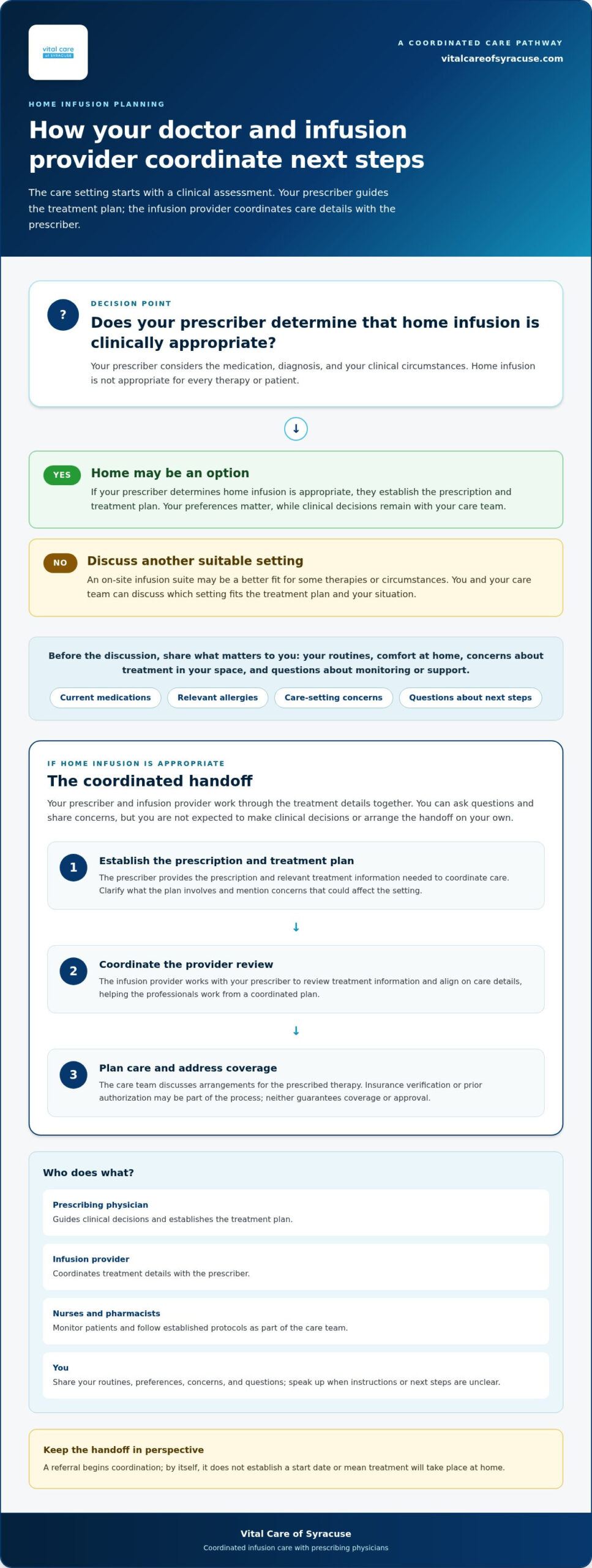
Once you raise the possibility of home infusion, the process moves through connected decisions. Your prescriber assesses the clinical question and establishes the treatment plan. The infusion provider works with the prescriber to review and coordinate practical care details. You can share preferences and ask questions, but you aren’t expected to make clinical decisions or arrange the handoff between care teams on your own.
A typical sequence looks like this:
- Discuss whether home care may be suitable. Your prescriber considers the prescribed medication, diagnosis, and clinical circumstances. Home infusion isn’t appropriate for every therapy or patient, so the care setting is part of the clinical discussion.
- Establish the prescription and treatment plan. If your prescriber determines that infusion therapy is appropriate, they provide the prescription and relevant treatment information needed to coordinate care. Clarify what the plan involves and share concerns that could affect the setting.
- Coordinate a provider review. The infusion provider works with your prescriber to review treatment information and align on care details. This handoff helps the professionals responsible for your treatment work from a coordinated plan.
- Plan care and address coverage. The care team discusses arrangements for your prescribed therapy. Insurance verification or prior authorization may be part of this process, but neither guarantees coverage or approval.
What happens after you raise home infusion with your doctor?
Your physician considers whether the prescribed therapy and your clinical needs can be supported in a home setting. If home infusion is clinically appropriate, the prescription and relevant treatment details allow the infusion provider to coordinate the plan with your prescriber. If another setting better fits your circumstances, that can be discussed too. A referral begins coordination, but it doesn’t by itself establish a start date or mean treatment will take place at home.
The prescriber establishes the treatment plan, and the infusion provider works with that clinician to coordinate its delivery and related care. This handoff keeps clinical decisions with your care team while giving you the opportunity to raise preferences, understand next steps, and ask who will address questions as the plan develops. The National Home Infusion Association also describes the collaboration among physicians, pharmacists, nurses, and patients that supports home infusion care.
How insurance coordination fits into the process
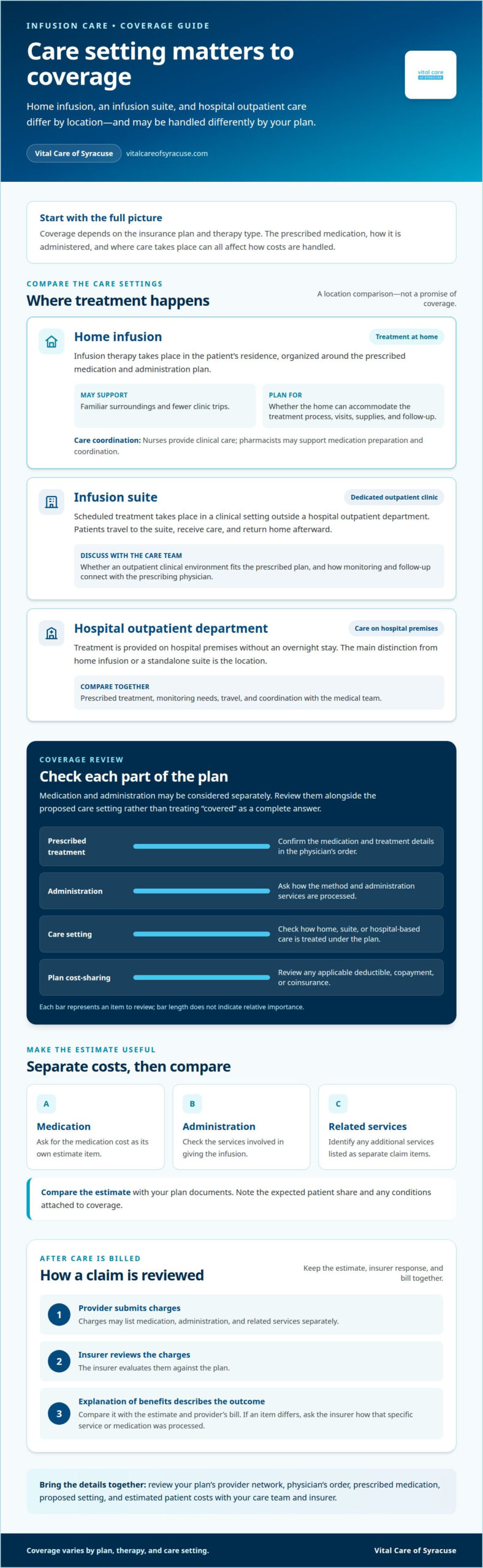
Coverage varies by insurance plan and therapy type, so it helps to distinguish coverage review from clinical approval. Vital Care of Syracuse assists with insurance verification, prior authorizations, and reimbursement coordination as part of organizing infusion care. These steps can clarify coverage information, but the insurer determines authorization under the applicable plan.
To make a coverage conversation more useful, have your insurance details available and note questions about the prescribed therapy, authorization, or reimbursement. Ask what information is still needed and who will follow up on coordination. For patients considering home infusion, Vital Care of Syracuse’s infusion care connects treatment planning with coordination alongside the prescribing physician.
Home infusion or an infusion suite: how to discuss the care setting
Choosing where to receive infusion therapy is a clinical decision shaped by the prescribed treatment and your circumstances, not simply a choice between convenience and safety. Home infusion can provide treatment in familiar surroundings when clinically appropriate. An on-site infusion suite provides a different care setting. Neither option is automatically right for every patient or therapy.
Use this comparison to organize a conversation with your prescriber and infusion team. It highlights considerations to discuss, not a recommendation for one setting over another.
| Consideration | Home infusion | On-site infusion suite |
|---|---|---|
| Care environment | Treatment takes place in your home, if clinically appropriate. | Treatment takes place in a dedicated infusion setting. |
| Clinical fit | Suitability depends on the prescribed therapy and your clinical circumstances. | The prescriber and infusion team consider whether the suite fits your treatment plan. |
| Your preferences | Discuss how receiving treatment at home fits your comfort and routines. | Discuss whether receiving treatment at an infusion site better fits your needs. |
| Care planning | The infusion provider coordinates the plan with your prescriber. | The infusion provider coordinates the plan with your prescriber. |
What should guide the choice between home and suite-based care?
Consider the prescribed therapy, your clinical needs, where you feel comfortable receiving care, and practical circumstances in your home or daily routine. These points help your prescriber and infusion team understand what matters to you, but clinical appropriateness remains central. Vital Care of Syracuse offers home infusion and on-site infusion suites in East Syracuse, coordinating personalized plans with prescribing physicians around each patient’s treatment needs.
The right care setting is the one that is clinically appropriate and responsive to the patient’s treatment needs and circumstances. If you’re asking about “coordinating home infusion with my doctor,” share your preferences while relying on your prescriber and infusion team to assess the treatment plan together.
How safety and monitoring fit into the decision
Home treatment isn’t automatically less safe, and it isn’t automatically suitable. Safety depends on the therapy, individual clinical circumstances, and appropriate clinical oversight. Vital Care of Syracuse is a licensed and accredited infusion therapy provider. Its nurses and pharmacists monitor patients and follow established protocols. The care team considers these factors as part of a treatment plan, without assuming every medication or patient is a fit for home infusion.
Ask how the proposed setting relates to your specific therapy and what monitoring is part of the plan. Explain any concerns about receiving care at home or at a suite. Your input helps the team understand your needs, while the prescriber and infusion provider coordinate the setting and care details based on clinical judgment. The decision should reflect your individual plan rather than a general assumption about home or facility-based treatment.
What to prepare before talking with your doctor about home infusion
A little preparation can make your appointment feel more manageable and help your prescriber understand what matters to you. You don’t need to know whether home infusion is clinically suitable before raising the topic. Bring the questions and details you have, and let your healthcare professionals assess the treatment plan and explain the options.
If you’re thinking about coordinating home infusion with my doctor, use the checklist below to organize the conversation. Write down questions in advance, bring a current medication list, or ask someone you trust to help you remember the answers.
Questions to bring to the prescribing doctor
Start with the treatment itself, then ask how the care team will coordinate it. These prompts can help you understand the decision without feeling that you have to make clinical judgments on your own:
- Could my prescribed therapy be appropriate for home infusion in my circumstances, or might an on-site infusion setting be considered?
- What information about my treatment and health will you coordinate with the infusion provider?
- How will the care team monitor my treatment, and who should I contact with questions about the plan?
- What should I understand about insurance verification or prior authorization, and who can explain the next steps?
- How can my preferences or concerns about receiving care at home or in an infusion suite be considered?
You may not get every answer in one conversation, and that’s okay. Ask your prescriber to clarify unfamiliar terms or identify which questions the infusion team can address as coordination progresses.
Information and concerns to share with the care team
Bring details that can help your clinicians review your circumstances and coordinate thoughtfully. An accurate medication list is especially useful. Include prescription medicines and other products you take, and note relevant allergies or past treatment concerns. Don’t change or stop a medication to prepare for the appointment unless your prescriber directs you to do so.
- Write down the prescribed therapy and what you understand about the treatment plan so far.
- Describe practical concerns about treatment in your home, such as space, privacy, or whether you feel comfortable receiving care there.
- Share your preference for home or an on-site setting, while remaining open to the team’s clinical assessment.
- Keep a separate note for questions about monitoring, provider coordination, coverage, and authorization.
Be direct about what feels uncertain. For example, if you’re worried about managing treatment at home, explain what specifically concerns you so the prescriber and infusion team can discuss it in relation to your plan. Before you leave, ask how to share follow-up questions or relevant changes with the established care team. Your preparation supports the conversation; treatment decisions remain with qualified healthcare professionals.
For support with coordinated infusion planning, connect with Vital Care of Syracuse.
How Vital Care of Syracuse supports coordinated infusion care
Planning infusion care can involve clinical decisions, treatment coordination, and practical questions about coverage. Vital Care of Syracuse is a licensed and accredited infusion therapy provider that works with prescribing physicians to organize personalized treatment plans. This collaboration connects the prescriber’s clinical direction with the infusion team’s role in coordinating care, while keeping your needs and preferences part of the conversation.
Home infusion may be appropriate for some therapies and patients, while an on-site infusion suite may better fit other treatment plans. Vital Care offers home infusion and on-site infusion suites in East Syracuse. The appropriate setting depends on clinical judgment and individual circumstances, not a one-size-fits-all assumption about where infusion should take place.
A local partner for coordinated infusion in Central New York
For patients and caregivers, a local infusion provider can help connect the prescribing physician with the team supporting treatment. Vital Care’s nurses and pharmacists monitor patients and follow established protocols, coordinating with prescribers around personalized treatment plans. The clinical team supports the prescribed care and does not replace the physician’s decisions.
Vital Care serves East Syracuse and the broader Central New York region, including Syracuse, Utica, Buffalo, Rochester, Albany, Auburn, and Binghampton. If you’re discussing treatment options with your physician, share your preferred setting and any concerns so they can be considered alongside clinical needs. The overview of local home infusion care in Central New York offers more context on coordinated care close to home.
A clear next step for patients and caregivers
Start by discussing the prescribed therapy with your doctor and asking whether home infusion or an on-site suite could be clinically appropriate for your circumstances. Your prescriber can establish the treatment plan and coordinate relevant information with the infusion provider. You can help by sharing your care preferences, current medication details, and questions about monitoring or next steps.
As care is coordinated, insurance verification, prior authorizations, and reimbursement questions may also need attention. Vital Care assists with these processes, helping patients and caregivers understand the coordination involved without promising a coverage decision. Keep a note of any unclear details and bring your questions to the care team so the appropriate person can address them.
For people coordinating home infusion with my doctor, knowing who is involved and what to discuss can make the process more understandable. Patients in East Syracuse and across Central New York can learn more about Vital Care of Syracuse and its infusion services as they continue the conversation with their prescribing physician.
Take the next step with a clear question
You don’t have to settle every detail before opening the conversation. Choose one question that matters most to you, such as whether your prescribed therapy may be suitable for home treatment or what the care team needs to coordinate. Then bring your preferences and concerns to your prescribing doctor. A thoughtful discussion can help you understand the options and decide what information you need before moving forward.
If you’re still wondering about “coordinating home infusion with my doctor,” remember that asking questions is a meaningful first step, not a commitment to a particular care setting. Your clinical team can guide treatment decisions while you share what matters to you.
When you’re ready to explore coordinated infusion care, learn about coordinated infusion care with Vital Care of Syracuse. You can move forward one informed step at a time.
Frequently Asked Questions
Can all infusion therapies be administered at home?
No, not every infusion therapy or patient is suited to home administration. The prescriber considers the medication, diagnosis, and your clinical circumstances before recommending a setting. Even when a therapy is delivered by infusion, the care team needs to assess whether home treatment fits your needs. If you’re searching “coordinating home infusion with my doctor,” start by asking your prescriber whether home care is appropriate for your specific treatment plan.
Is home infusion safe outside of a hospital setting?
Home infusion can be safe when clinically appropriate and provided by licensed, experienced clinicians following established protocols. Nurses and pharmacists monitor patients, with care coordinated alongside the prescribing provider. Ask what monitoring applies to your therapy, what changes or concerns you should report, and how to reach the care team using the instructions provided for your treatment. These details can help you understand the support built around your plan.
What happens if my doctor changes my medication or treatment plan?
Tell your prescribing doctor about any proposed change and follow the clinician’s directions before adjusting your infusion treatment. The prescriber should coordinate updated treatment information with the infusion provider so the care team can align its plan with the new prescription. If you receive different instructions from different members of the team, pause and ask them to clarify which plan to follow before proceeding with a change.
Will insurance cover home infusion in New York?
Coverage varies by insurance plan and therapy, so home infusion isn’t automatically covered in every situation. Vital Care of Syracuse assists with insurance verification, prior authorizations, and reimbursement coordination, but these steps don’t guarantee approval. Patients across Central New York, including Syracuse, Utica, Buffalo, Rochester, Albany, Auburn, and Binghampton, can discuss coverage questions with the care team and their insurer as their treatment plan is coordinated.
Can my family caregiver be part of the home infusion discussion?
Yes, you can include a family caregiver in the conversation if you’d find their support helpful. They may help you remember questions, take notes, or describe practical concerns about care at home. You can also ask the clinician to explain the plan in a way you and your caregiver understand. Your healthcare professionals remain responsible for clinical decisions, while you decide how you’d like a caregiver involved in discussions.
Can I receive infusion treatment at a suite instead of at home?
Yes, an on-site infusion suite may be an option, depending on your prescribed therapy and clinical circumstances. Vital Care of Syracuse has infusion suites in East Syracuse. If you prefer receiving treatment at a care site or have concerns about managing it at home, share those points with your prescriber. The prescribing physician and infusion team can consider your preferences alongside the needs of your treatment plan.
Leave a Reply