



The trip to the clinic might be doing more harm than good. For people living with Myasthenia Gravis, the physical effort of navigating Rochester traffic, finding parking, and sitting through a lengthy infusion in a busy clinical environment can deplete the very muscle strength that treatment is meant to preserve. It’s a quiet contradiction that too many patients simply accept as part of managing their condition.
If you’ve been wondering whether you can safely receive IVIG for myasthenia gravis at home in Rochester, you’re asking exactly the right question. The fatigue, the infection risk of shared clinical spaces, the sheer difficulty of driving from Brighton or across Monroe County when weakness is at its worst — these aren’t minor inconveniences. They’re real clinical concerns that deserve a real solution.
This guide is here to answer that question with clarity and confidence. You’ll learn how hospital-grade IVIG therapy can be administered safely in your own home, what the process looks like when coordinated by a locally owned Rochester team, and how this approach can meaningfully reduce the physical toll of your treatment while keeping the quality of your care fully intact.
Key Takeaways
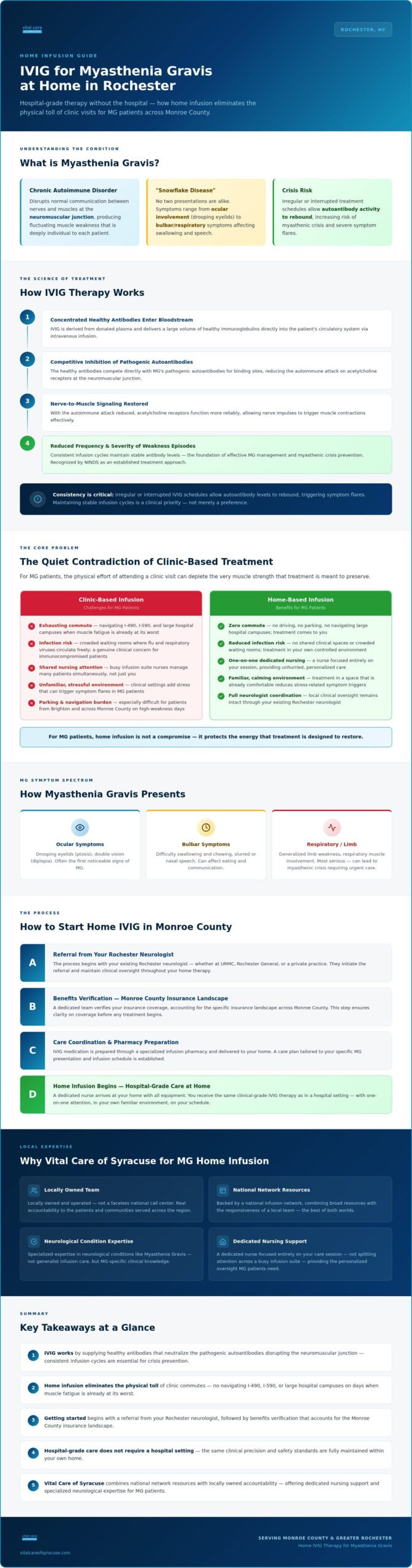
- IVIG therapy works by supplying healthy antibodies that neutralize the pathogenic autoantibodies disrupting the neuromuscular junction in Myasthenia Gravis — and regular maintenance infusions play a critical role in preventing myasthenic crisis.
- Receiving IVIG for myasthenia gravis at home in Rochester eliminates the physical toll of clinic commutes, removing the strain of navigating I-490, I-590, and large hospital campuses on days when muscle fatigue is already at its worst.
- Starting home infusion therapy begins with a referral from your Rochester neurologist, followed by a benefits verification process that accounts for the specific insurance landscape across Monroe County.
- Vital Care of Syracuse brings together the resources of a national infusion network and the accountability of a locally owned team — offering dedicated nursing support and specialized expertise in neurological conditions like Myasthenia Gravis.
- Hospital-grade care does not require a hospital setting — this guide explains exactly how that standard of safety and clinical precision is maintained within your own home.
Managing Myasthenia Gravis in Rochester: The Role of IVIG Therapy
Intravenous immunoglobulin, or IVIG, has become one of the most important therapeutic tools available for managing autoimmune neuromuscular disorders. At its core, it works by introducing a concentrated preparation of healthy antibodies derived from donated plasma into the bloodstream. For Myasthenia Gravis patients, this matters enormously because those donated antibodies help neutralize the pathogenic autoantibodies that are actively disrupting communication at the neuromuscular junction, the precise point where nerve signals instruct muscles to contract. The result, when therapy is administered consistently, is a meaningful reduction in the frequency and severity of muscle weakness episodes.
Consistent is the operative word. For patients managing ocular symptoms like drooping eyelids or bulbar involvement affecting swallowing and speech, irregular or interrupted IVIG schedules can allow autoantibody activity to rebound. Maintaining stable antibody levels through regular infusion cycles isn’t a convenience consideration; it’s a clinical priority that directly influences quality of life and crisis prevention.
Understanding the Myasthenia Gravis Challenge
Myasthenia gravis is a chronic autoimmune disorder that disrupts the normal communication pathway between nerves and muscles, producing weakness that fluctuates in ways that are deeply individual to each patient. Clinicians sometimes call it a “snowflake disease” because no two presentations are alike. One patient may experience primarily ocular symptoms; another may face significant bulbar or respiratory involvement. Treatment protocols must reflect that variability, and anything that adds physical stress to an already demanding condition, including a lengthy drive to a clinical infusion suite on a day when grip strength and stamina are already compromised, can trigger genuine symptom flares rather than simply causing discomfort.
Why Rochester Patients are Switching to Home IVIG
Many Rochester-area patients have historically received IVIG through URMC or Rochester General, and those institutions provide excellent neurological care. What they can’t always offer is the kind of unhurried, one-on-one environment that home infusion provides. Receiving IVIG for myasthenia gravis at home in Rochester means avoiding crowded waiting rooms where flu and respiratory viruses circulate freely, a genuine clinical concern for immunocompromised patients. It means treatment happens in a space that’s already familiar and calming, with a dedicated nurse focused entirely on your session rather than managing a busy infusion suite.
The shift toward home-based neurology support across Monroe County reflects a broader recognition that the setting of care affects the quality of care. Local clinical oversight remains intact through coordination with your existing neurologist, ensuring that the transition from a hospital-based environment to your home doesn’t mean stepping away from professional accountability. For many patients, pursuing IVIG for myasthenia gravis at home in Rochester isn’t a compromise. It’s simply the smarter way to protect the energy that treatment is designed to restore.
How IVIG Therapy Stabilizes Myasthenia Gravis Symptoms
Understanding precisely what happens during an IVIG infusion helps explain why consistency in treatment scheduling isn’t just a clinical preference — it’s the foundation of effective Myasthenia Gravis management. When immunoglobulin is introduced intravenously, the concentrated antibodies it carries enter the bloodstream and begin competing with pathogenic autoantibodies for binding sites. This competitive inhibition reduces the autoimmune attack on acetylcholine receptors at the neuromuscular junction, allowing nerve-to-muscle signaling to function more reliably. The National Institute of Neurological Disorders and Stroke recognizes IVIG as an established treatment approach for MG, particularly during acute exacerbations and as ongoing maintenance therapy for patients with generalized weakness.
The practical benefits of this mechanism are tangible. Patients who maintain regular infusion cycles frequently report measurable improvements in daily function: steadier swallowing, reduced ptosis, and returning strength in the proximal limb muscles that govern activities like climbing stairs or lifting arms overhead. These aren’t dramatic overnight transformations. They’re gradual, cumulative gains that depend on keeping antibody levels within a therapeutic range rather than allowing them to peak and crash between irregular treatments.
Initial treatment often involves a loading phase, typically administered over several consecutive days, to bring immunoglobulin levels up quickly. Once stabilized, maintenance infusions are scheduled at intervals your neurologist determines based on your individual response, often every three to four weeks. Each session can run anywhere from two to six hours depending on the prescribed dose and your infusion tolerance, which is exactly why the setting of care matters so much. Spending that time at home rather than in a clinical suite changes the entire texture of the experience.
The Science of Immunoglobulin for Neurology
IVIG has a half-life of roughly three to four weeks in the body, which directly informs why spacing between maintenance infusions is carefully calculated rather than arbitrary. Miss a cycle, and autoantibody activity can rebound before the next dose arrives. This is meaningfully different from plasmapheresis, which physically removes pathogenic antibodies from the plasma but doesn’t supply replacement immunoglobulin, making it better suited for acute crises than long-term stabilization. During home infusions, Vital Care of Syracuse nurses monitor vital signs, infusion rate tolerance, and any early signs of adverse response throughout the session, maintaining the same clinical vigilance you’d expect in a hospital-based setting.
Long-Term Outcomes and Quality of Life
Sustained, well-managed IVIG therapy tends to smooth out the symptom cycle that many MG patients describe as exhausting in its own right: the brief windows of relative strength followed by sharp functional decline as antibody levels drop. Reducing that oscillation allows for something genuinely meaningful, returning to work, engaging with Rochester’s community, or simply managing a full day without rationing energy. Coordination with your existing neurologist remains central throughout, ensuring that any adjustments to your protocol reflect both lab values and lived experience. If you’re ready to explore what that kind of continuity looks like in practice, learn how Vital Care of Syracuse supports home-based neurological infusion from the first referral onward.
The Benefits of Choosing Home Infusion Over Rochester Clinics
There’s a particular kind of exhaustion that Myasthenia Gravis patients know well: the depletion that arrives before treatment even begins. On infusion day, that might mean navigating I-490 through the Midtown interchange or sitting in stop-and-go traffic on I-590 South while muscle fatigue is already building. It might mean circling the Linden Oaks campus searching for accessible parking, then walking a distance that would feel manageable on a good day but feels genuinely punishing on a difficult one. By the time a patient settles into a clinic chair, they’ve already spent energy they didn’t have. Choosing IVIG for myasthenia gravis at home in Rochester removes that entire layer of physical cost from the treatment equation.
Scheduling flexibility compounds this benefit considerably. Clinical infusion suites operate on their own timetables, often requiring early morning appointments that conflict with the natural symptom rhythms of MG. Many patients report that mornings bring their worst weakness. Home infusion allows treatment to be scheduled around your actual life, your stronger hours, your family commitments, your work schedule, rather than around a clinic’s availability.
Comfort and Environmental Control
A four-to-six hour infusion session is a meaningful block of time, and where you spend it matters. At home, you choose the chair. You control the temperature. You have access to your own kitchen, your preferred blanket, and the quiet that a shared clinical suite simply cannot offer. There’s no ambient anxiety from other patients managing their own difficult days nearby. That absence of clinical stress isn’t a minor comfort consideration; elevated anxiety has a documented relationship with neuromuscular symptom exacerbation in autoimmune conditions, making a calm environment genuinely therapeutic rather than simply pleasant.
Privacy, too, carries real weight. Receiving treatment in your own living room means your health journey remains yours, without the subtle exposure that comes from sitting in a shared infusion bay.
Safety and Infection Prevention in Monroe County
Many MG patients are managing concurrent immunosuppressant therapy, which meaningfully raises their vulnerability to opportunistic infections. Shared clinical environments carry inherent pathogen exposure risks, particularly during respiratory virus season across Monroe County. Home infusion minimizes exposure to community pathogens for immunocompromised MG patients by replacing a high-traffic clinical setting with a controlled, familiar environment.
One-on-one nursing attention reinforces this safety advantage. A dedicated Vital Care of Syracuse nurse isn’t dividing attention across multiple patients simultaneously; their focus remains entirely on your session, your vital signs, and your infusion tolerance throughout. Patients exploring the financial side of this transition will find it useful to review Medicare home health coverage guidelines, which outline how home-based infusion services may be covered under existing benefits. Choosing IVIG for myasthenia gravis at home in Rochester isn’t a step away from rigorous clinical care. It’s a step toward care that’s structured around protecting you.
Starting Your Home IVIG Journey: Safety and Insurance in Monroe County
The path to receiving IVIG for myasthenia gravis at home in Rochester is more straightforward than most patients expect, and understanding each step before you begin removes a great deal of uncertainty from the process. What follows is a clear picture of how that journey unfolds, from your first conversation with your neurologist to the moment your dedicated nurse arrives at your door.
The process moves through four distinct phases:
- Step 1: Referral from your Rochester neurologist. Your neurologist initiates the transition by writing a home infusion referral and providing the clinical documentation that establishes medical necessity. Vital Care of Syracuse coordinates directly with neurology offices across Monroe County to gather what’s needed without placing that administrative burden on you.
- Step 2: Benefits verification. The Vital Care of Syracuse team reviews your specific insurance coverage, whether through Medicare, Medicaid, or a private plan, before a single infusion is scheduled. This step protects you from unexpected billing surprises.
- Step 3: Clinical assessment and home safety review. A clinician evaluates your home environment to confirm it can support infusion safely, checking for adequate space, appropriate seating, and reliable access for nursing staff.
- Step 4: Scheduling your first home visit. Once approvals are in place, your first infusion is scheduled at a time that works around your life, not around a clinic’s calendar.
Navigating Insurance and the Medicare Part B Home IVIG Benefit
A permanent Medicare Part B benefit now covers home IVIG administration for qualifying patients with primary immune deficiency disease, and many MG patients whose condition meets specific clinical criteria may be eligible for coverage under related provisions. This is a meaningful distinction that most Rochester-area patients haven’t been clearly informed about, and it’s one that competing providers rarely explain in any useful detail.
Prior authorization is where home infusion transitions can stall. The Vital Care of Syracuse team manages that process directly, handling insurer documentation requirements and following up on pending approvals so treatment timelines stay on track. For patients with private coverage or Medicaid managed care plans common across Monroe County, the team’s familiarity with local plan structures helps anticipate requirements before they become delays. If out-of-pocket costs remain a concern after benefits verification, the team can discuss available financial assistance pathways during your intake conversation.
The First Home Visit: What to Expect
Your first visit establishes the foundation for every infusion that follows. Your Vital Care of Syracuse nurse arrives with all necessary equipment, sets up a clean, organized infusion space within your home, and walks through the session with you in real time. Emergency protocols are reviewed clearly, including how to recognize and respond to any adverse reaction, and your caregiver is included in that education if they’re present. Infusion pump operation, post-infusion care, and what to monitor in the hours after your session are all covered before the nurse leaves.
Hospital-grade safety doesn’t require a hospital building. It requires trained clinicians, proper equipment, and a clear protocol. That’s precisely what each home visit delivers. Contact Vital Care of Syracuse to begin your benefits verification and take the first step toward home infusion.
Personalized MG Care with Vital Care of Syracuse
There’s a meaningful difference between receiving care from a large, anonymous health system and receiving it from a team that considers itself part of your community. Vital Care of Syracuse occupies a distinctive position in the Rochester home infusion landscape: a locally owned and operated provider backed by the clinical infrastructure and supply chain resources of a national network. That combination matters practically. It means patients pursuing IVIG for myasthenia gravis at home in Rochester aren’t choosing between robust resources and personal accountability. They’re getting both.
Large hospital systems deliver excellent neurology care, but their home infusion extensions often inherit the same institutional scale that makes personalized attention difficult to sustain. Vital Care of Syracuse is structured differently. Decisions are made locally, relationships are built intentionally, and the team serving Monroe County patients is genuinely invested in this community because they live and work here too.
Dedicated Nursing for Rochester Patients
Immunoglobulin administration for neurological conditions requires a specific depth of clinical knowledge that goes beyond general infusion competency. Vital Care of Syracuse nurses bring specialized training in IVIG protocols for conditions like Myasthenia Gravis, including infusion rate management, adverse reaction recognition, and the particular monitoring considerations that MG patients require. Equally important is consistency: seeing the same nurse across your infusion visits builds a therapeutic relationship where subtle changes in your presentation don’t go unnoticed. That continuity is genuinely difficult to replicate in a rotating clinical suite environment. For a broader perspective on how home-based neurological care is evolving across the region, the team’s approach is reflected in their work supporting home infusion for neurological disorders in Syracuse.
A Partner in Your MG Journey
Effective home infusion doesn’t operate in isolation from your existing care team. Vital Care of Syracuse coordinates directly with neurology practices across Monroe County, including URMC and Rochester General, to ensure that your home infusion protocol reflects your neurologist’s current clinical guidance. Treatment notes, dosing adjustments, and any changes in your condition move between care settings without you carrying that administrative weight yourself.
When questions arise between scheduled visits, patients aren’t left without support. Clinical availability extends beyond the infusion chair, providing the kind of responsive partnership that chronic condition management genuinely requires. Understanding why a locally rooted provider structures care this way is worth exploring further through their perspective on the benefits of a local home infusion company in Central New York.
Receiving IVIG for myasthenia gravis at home in Rochester starts with a single conversation. Contact Vital Care of Syracuse to begin your referral, verify your benefits, and take the first step toward care that’s built around your life.
Your Path to Better MG Management Starts Here
Living with Myasthenia Gravis is demanding enough without treatment adding to that burden. This guide has walked through why consistent IVIG therapy is central to symptom stability, how the home setting removes the physical cost of clinic-based care, and what the referral and insurance process actually looks like in Monroe County. The picture that emerges is straightforward: IVIG for myasthenia gravis at home Rochester is a clinically sound, logistically achievable choice that protects the energy treatment is designed to restore.
Vital Care of Syracuse brings specialized neurological IVIG expertise, dedicated nursing support, and genuine local accountability to every patient relationship. Clinical questions don’t wait for business hours, and neither does their commitment to your care. As a locally owned Monroe County provider, the team is invested in this community in ways that a distant, institutional provider simply can’t replicate.
You don’t have to navigate this transition alone. Contact Vital Care of Syracuse to begin your home infusion journey and take the first step toward treatment that works with your life, not against it.
Frequently Asked Questions About IVIG for Myasthenia Gravis at Home in Rochester
Is IVIG at home for Myasthenia Gravis safe for Rochester patients?
Yes, home IVIG is clinically safe for appropriately selected MG patients, and safety standards don’t diminish because the setting changes. A trained nurse arrives with hospital-grade equipment, monitors your vital signs throughout the session, and follows the same adverse reaction protocols used in clinical infusion suites. The key distinction is that you’re receiving one-on-one attention rather than shared clinical oversight, which many patients find actually strengthens the safety experience.
Does Medicare cover home IVIG for Myasthenia Gravis in 2026?
Medicare coverage for home IVIG depends on your specific diagnosis coding and how your neurologist documents medical necessity. Medicare Part B covers IVIG administration for qualifying conditions, and many MG patients may be eligible under applicable provisions. Coverage isn’t automatic, and prior authorization requirements vary. Vital Care of Syracuse handles the benefits verification and authorization process directly, so you understand your coverage position before any infusion is scheduled.
How long does a typical home IVIG infusion for MG take?
Most home IVIG sessions for Myasthenia Gravis run between two and six hours, depending on your prescribed dose and your individual infusion tolerance. Patients new to IVIG typically start at a slower infusion rate that’s gradually increased across sessions as tolerance is established. Your nurse manages that pacing throughout the visit. Because treatment happens at home, that time can be spent resting comfortably rather than sitting in a shared clinical environment.
Can I switch from a Rochester hospital to home infusion mid-treatment?
Transitioning mid-treatment is entirely feasible and happens regularly for Rochester-area MG patients. Your neurologist writes a home infusion referral, and Vital Care of Syracuse coordinates with their office to obtain the necessary clinical documentation and current protocol details. There’s no required gap in treatment during the transition. The goal is continuity, ensuring your infusion schedule stays on track without interruption while the administrative shift happens in the background.
What kind of nursing support is provided during a Rochester home infusion?
A dedicated Vital Care of Syracuse nurse manages your entire session from setup through completion. That includes preparing the infusion site, monitoring vital signs at regular intervals, adjusting the infusion rate as needed, and responding to any early signs of an adverse reaction. Unlike a busy clinical suite where a nurse may be managing several patients simultaneously, your home visit involves undivided clinical attention. Consistency in nursing assignment across visits also means your nurse becomes familiar with your individual presentation over time.
Do I need special equipment in my Rochester home for IVIG?
No, you don’t need to purchase or install any specialized equipment beforehand. Your nurse arrives with everything required, including the infusion pump, IV supplies, and the IVIG medication itself, which is sourced and delivered through Vital Care of Syracuse’s pharmacy coordination. What your home does need is a comfortable chair or recliner, adequate lighting, and reliable access for nursing staff. A clinical assessment during intake confirms your space is suitable before your first session is scheduled.
How do I get my Rochester neurologist to refer me for home IVIG?
The most direct approach is raising it at your next appointment. Many neurologists across Monroe County are already familiar with home infusion referrals and can initiate the process with a written order and supporting clinical documentation. If your neurologist is less familiar with the pathway, Vital Care of Syracuse can communicate directly with their office to explain what’s needed. You don’t need to navigate that coordination yourself; the intake team handles it as part of getting you started with IVIG for myasthenia gravis at home in Rochester.
What are the side effects of IVIG for Myasthenia Gravis?
Common side effects include headache, fatigue, mild fever, and muscle aches, particularly in the hours following an infusion. These reactions are generally manageable and often diminish as your body adjusts across treatment cycles. Pre-medication with acetaminophen or diphenhydramine is sometimes used to reduce infusion-related discomfort. Less common but more serious reactions, such as changes in blood pressure or allergic responses, are monitored closely by your nurse throughout each session. Any concerns that arise between visits can be directed to the Vital Care of Syracuse clinical team.
Leave a Reply