



Clotting-factor treatment at home can make bleeding disorder care more manageable when it follows an individualized treatment plan. Hemophilia A may be treated with Factor VIII, and hemophilia B with Factor IX. Some people with von Willebrand disease may also receive infusion-based treatment. The right approach depends on the condition and whether treatment is intended to prevent bleeding or respond to it.
It’s understandable to want clear answers about what home infusion involves, how often treatment is needed, and which supplies must be ready. Bleeding disorder home infusion in Utica can be organized around the prescribed therapy, care needs, and treatment schedule, rather than a one-size-fits-all routine.
This guide explains which bleeding disorders may be treated with infusion therapy, what shapes an individualized care plan, and how factor supplies and schedules fit into care at home. You’ll also learn what the process can involve and when specialized home infusion support may be a helpful next step.
Key Takeaways
- Infusion therapy may support treatment for hemophilia and some forms of von Willebrand disease; the therapy depends on the specific condition and treatment goal.
- A personalized care plan connects the prescribed therapy with the patient’s needs, helping shape how treatment is organized at home.
- Supply planning and treatment schedules are coordinated around the prescribed regimen, so you can understand what goes into maintaining care at home.
- Learn how specialized home infusion support can fit into bleeding disorder care and when Vital Care of Syracuse may be a helpful next step.
What is infusion therapy used to treat?
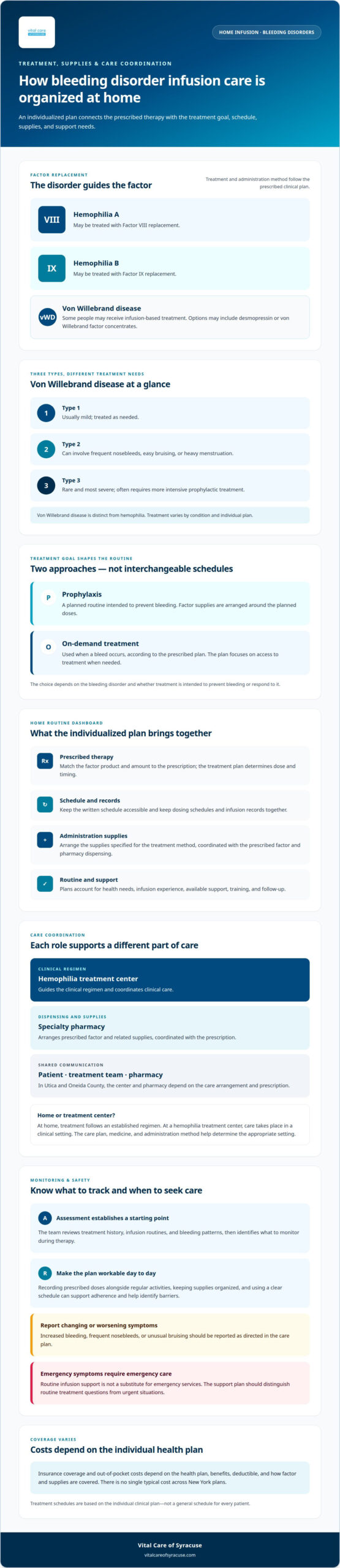
Infusion therapy treats some bleeding disorders by delivering prescribed medicine into a vein or under the skin. Hemophilia A may be treated with Factor VIII replacement, while hemophilia B may be treated with Factor IX. A plan may provide prophylaxis to prevent bleeding or on-demand treatment when a bleed occurs. The choice depends on the disorder and treatment goal.
Von Willebrand disease is distinct from hemophilia, though treatment may use similar infusion techniques. Type 1 is usually mild and treated as needed. Type 2 can involve frequent nosebleeds, easy bruising, or heavy menstruation. Type 3 is rare and most severe, often requiring more intensive prophylactic treatment. Treatment varies and may use desmopressin or von Willebrand factor concentrates.
Home infusion and treatment at a hemophilia treatment center use the prescribed therapy in different settings. At home, treatment follows an established regimen; at a center, care takes place in a clinical setting. The care plan, medicine, and administration method help determine which setting is appropriate.
Coordination connects the treatment plan with factor supplies and pharmacy dispensing. The hemophilia treatment center guides the clinical regimen, while a specialty pharmacy arranges the prescribed medicine and related supplies. For example, a prophylactic schedule needs to align with the prescribed factor product and planned doses. Home infusion in Utica relies on communication among the patient, treatment team, and pharmacy.
In New York State, follow the prescribed plan for the specific bleeding disorder and coordinate factor dispensing with the treatment team and pharmacy. Treatment schedules are based on the individual clinical plan, not a general schedule for every patient.
Insurance coverage and out-of-pocket costs depend on the health plan, benefits, deductible, and how factor and supplies are covered. There is no single typical cost that applies across New York plans.
Near Utica, a hemophilia treatment center coordinates clinical care, while a specialty pharmacy handles prescribed factor and supplies. The center and pharmacy serving someone in Utica or Oneida County depend on the care arrangement and prescription. Infusion therapy requires coordination between those roles.
Customized care plans for bleeding disorder patients
A tailored plan connects the prescribed therapy with each patient’s routine, experience, and support needs. It also sets out how treatment, monitoring, and urgent concerns are handled.
Patient Intake and Eligibility
Home infusion eligibility depends on the prescribed treatment, the patient’s health needs, and whether care can be delivered safely at home. Intake gathers details about the bleeding disorder, current therapy, infusion experience, and available support. The care team uses this information to plan training, supplies, and follow-up. Patients who need additional guidance may require more preparation before home treatment begins.
There isn’t one universal eligibility checklist for every patient. The assessment considers the prescribed regimen, the patient’s ability to follow its steps, and the support available at home.
Assessment and Ongoing Monitoring
Assessment establishes a starting point for an individualized plan. The team reviews treatment history, infusion routines, and bleeding patterns, then identifies what to monitor during therapy. For example, a patient using prophylaxis has a different routine from someone receiving on-demand treatment. Follow-up helps the team recognize changing needs and coordinate adjustments with the prescribing clinician.
Patients can support adherence by fitting prescribed doses into practical routines, such as recording treatment alongside regular daily activities. A clear schedule and organized supplies make it easier to follow the plan and notice missed doses. These details can also help the care team identify barriers, such as difficulty managing infusion steps or keeping treatment materials organized.
New or worsening symptoms during or after an infusion deserve attention. For example, increased bleeding, frequent nosebleeds, or unusual bruising should be reported as directed in the care plan. Severe symptoms or a medical emergency require emergency care; routine infusion support is not a substitute for emergency services.
A support plan should identify who handles routine treatment questions and what steps to take in urgent situations. This distinction matters: patients need clear clinical follow-up, while emergency symptoms require emergency care. A defined plan can support confidence and help treatment fit daily life without implying that round-the-clock clinical support is available.
Clotting factor supplies and schedules
A reliable home routine starts with the prescribed factor, treatment schedule, and supplies matched to the infusion method. For hemophilia A, this may involve Factor VIII; for hemophilia B, Factor IX. The treatment plan determines the dose and timing, while the pharmacy coordinates dispensing with the prescription. Keep the written schedule accessible to track each dose.
Prophylactic therapy follows a planned routine intended to prevent bleeding. On-demand treatment is used when a bleed occurs, according to the prescribed plan. These schedules are not interchangeable. For example, a patient prescribed prophylaxis needs factor supplies arranged around planned doses, while an on-demand plan focuses on access to treatment when needed. Nurses and the clinical team can coordinate supply planning with the pharmacy.
- Match the factor product and amount to the prescription.
- Arrange the administration supplies specified for the treatment method.
- Keep the dosing schedule and infusion records together.
Training matters as much as having supplies on hand. A qualified clinician should teach the patient or caregiver how to prepare the prescribed treatment, follow the correct administration technique, record the dose, and respond if an infusion cannot be completed. For home hemophilia infusion, the described needle insertion technique uses about a 30-degree angle with the bevel facing up. Patients should follow the technique taught for their own prescribed care.
Supply planning also means following the product’s handling instructions and organizing treatment materials for each scheduled dose. The pharmacy and care team coordinate the product and supplies with the prescription, while infusion records show which doses were used. If the prescribed regimen changes, the schedule and supply plan need to reflect that change so the factor supply stays aligned with the current plan.
Safe home infusions require instruction in the prescribed technique, the correct factor and administration supplies, and a clear dose schedule. Patients should know how to document treatment and whom to contact with routine questions. Emergency symptoms require emergency care.
Personalized bleeding disorder care plans
A useful care plan connects the prescribed therapy with the patient’s bleeding pattern, treatment goals, and daily routine. For hemophilia A, the plan may involve Factor VIII replacement; hemophilia B plans may use Factor IX. Details depend on the prescribed regimen, whether doses are intended to prevent or treat bleeds, and how treatment is managed at home.
Personalization also matters for von Willebrand disease, which is different from hemophilia. Treatment varies by type and clinical needs. A plan may account for whether treatment is used as needed or more intensively for severe disease. This distinction helps align treatment with the patient’s condition instead of applying one schedule to every bleeding disorder.
Daily routines can influence how a plan works in practice. A patient with planned prophylactic doses may use a written calendar to organize treatment around work, school, or family responsibilities. Someone using on-demand treatment needs clear instructions for following the prescribed plan when bleeding occurs. Recording doses and bleeding episodes gives the care team useful details to review how treatment fits the patient’s needs.
Care planning should also identify who coordinates each part of treatment. The prescribing clinician guides therapy decisions, while the pharmacy coordinates prescribed factor and supplies. If the treatment regimen changes, the schedule and supply arrangements should reflect the updated plan. Keeping those details aligned helps prevent confusion between an earlier routine and the current prescription.
For Utica patients, the central takeaway is to treat the care plan as a practical guide, not a generic template. It should clearly connect the specific disorder, prescribed therapy, dose schedule, supplies, and follow-up. A patient who has questions about how personalized bleeding disorder care support fits into home treatment can take the next step by discussing the care plan with the infusion team.
Vital Care of Syracuse: Hemophilia and Bleeding Disorder Therapy
Vital Care of Syracuse provides Hemophilia and Bleeding Disorder Therapy through home infusion for patients whose prescribed care is suited to treatment at home. This can be a next step when you and your care team are organizing factor therapy, supplies, and a personalized schedule. The therapy supports complex bleeding disorder needs as part of the plan established for your condition.
Care planning connects prescribed treatment with practical details, including infusion routines and supply coordination. If you’re considering home infusion for a bleeding disorder in Utica, Vital Care of Syracuse provides specialized infusion support. The service is not emergency medical care; urgent or severe symptoms require emergency attention.
Contact Vital Care of Syracuse to discuss Hemophilia and Bleeding Disorder Therapy and home infusion.
Make your next care conversation count
Your next step can be a focused conversation about how bleeding disorder home infusion in Utica fits the care plan guiding treatment. Bring questions about daily life, such as how the prescribed regimen can fit into routines and what support can help make treatment manageable. A clear discussion can connect clinical direction with practical home care.
Vital Care of Syracuse provides Hemophilia and Bleeding Disorder Therapy and also offers Anti-infective Therapy, Immunoglobulin (IVIG/SCIG), and Parenteral Nutrition (TPN). If you’re considering home infusion for bleeding disorder treatment, contact Vital Care of Syracuse today to discuss the next step. Thoughtful planning can help you move forward with greater clarity and confidence.
Frequently Asked Questions
Can hemophilia be managed at home with infusions?
Some hemophilia treatment can be managed at home with prescribed infusions when the care plan and clinical situation support it. Factor VIII is used for hemophilia A, and Factor IX for hemophilia B. Home administration requires appropriate training and coordination with the treating clinician. If symptoms change or a dose cannot be administered, follow the instructions in the patient’s care plan.
What bleeding disorder medications can be infused at home, including clotting factor and emicizumab?
Medication depends on the diagnosis and prescription. Hemophilia A and B may involve infused Factor VIII and Factor IX, respectively. Emicizumab, also called Hemlibra, is a preventive therapy, not a clotting-factor product; its schedule may be once weekly or less frequent. Treatment for von Willebrand disease differs and may involve desmopressin or von Willebrand factor concentrates, as prescribed.
How do patients arrange home infusion through a hematologist, specialty pharmacy, or treatment center?
Patients can start with the treating hematologist, who determines the prescribed therapy and coordinates the clinical plan with a treatment center. The specialty pharmacy uses the prescription to arrange the medication and related supplies. Before treatment begins, the care team and pharmacy coordinate the regimen, administration instructions, and delivery arrangements. Insurance verification and prior authorization may also be part of planning.
Are there 24-hour support or emergency delivery services for bleeding disorder home infusion near Utica?
Home infusion planning should not be treated as 24-hour emergency care or emergency delivery. Factor supplies and treatment schedules are arranged through the prescribed care plan and pharmacy, while urgent bleeding or severe symptoms require emergency attention. For routine questions about a dose, supply coordination, or the treatment schedule, use the contact instructions provided by the patient’s care team.
Leave a Reply