



If you’ve searched “home infusion for Crohn’s disease Rochester,” you may be wondering what treatment involves and whether it can take place at home or in an infusion suite. These are reasonable questions, especially when your care plan involves a gastroenterologist, an infusion provider, and your insurance plan.
Home infusion may suit some patients, but the right setting depends on the prescribed medication, clinical considerations, and your preferences. Vital Care of Syracuse is a licensed and accredited infusion therapy provider serving Rochester, with home infusion services and on-site infusion suites in East Syracuse. Its nurses and pharmacists coordinate personalized treatment plans with prescribing physicians and monitor patients according to established protocols.
This guide explains how infusion therapy may fit into clinician-directed Crohn’s care, what to consider when comparing home and suite-based treatment, and how to prepare for a conversation with your care team. It also outlines practical coordination steps involving your prescriber, infusion provider, and insurance plan.
Key Takeaways
- Understand how infusion therapy may be included in a clinician-directed Crohn’s care plan.
- Learn how the prescribed medication and clinical considerations help guide the choice of treatment setting.
- Compare home infusion with an on-site infusion suite in East Syracuse based on your preferences and routine.
- Use a focused checklist to prepare for a conversation with your prescribing clinician about home infusion for Crohn’s disease Rochester.
- Learn how Vital Care of Syracuse coordinates infusion care with prescribing physicians and supports Rochester patients through home infusion and East Syracuse suites.
Home infusion for Crohn’s disease in Rochester: what it means
Considering infusion for Crohn’s disease can raise practical questions: What does treatment involve? Where will it take place? Who coordinates the care? Infusion therapy delivers medication directly into the bloodstream through an IV or injection. The route depends on the prescribed medication. Infusion may be part of a care plan, but it is not a cure or a universal first step.
Crohn’s disease is a form of inflammatory bowel disease (IBD) that can affect people differently. A general overview of Crohn’s disease can provide background, but it can’t determine which treatment is right for you. Your gastroenterologist or other prescribing healthcare provider considers your diagnosis, medication, and clinical circumstances when deciding whether infusion is appropriate and where it may be given. There is no single treatment pathway or schedule for every patient.
This video shows a home infusion demonstration. It’s in Spanish. Its visual content may help illustrate a process, but it is not a substitute for instructions from your care team.
How Crohn’s disease and infusion therapy relate
Infusion is a way to deliver certain prescribed medications, not a treatment that automatically applies to everyone with Crohn’s. Whether it belongs in your plan depends on your clinician’s assessment and the medication selected. Ask your prescriber what the proposed therapy is intended to do, how it fits into your care, and which route and setting are suitable. Discuss questions about benefits, risks, or treatment changes with that clinician.
What home infusion means for Rochester patients
Home infusion means treatment is administered at a patient’s home when the prescribed medication and clinical considerations make that setting appropriate. The plan is individualized, so home treatment should not be assumed to suit every therapy or patient. An infusion suite is an on-site setting where treatment takes place away from home. Vital Care of Syracuse serves Rochester and other communities in New York, including Syracuse, Albany, Utica, Buffalo, Auburn, and Binghampton, with home infusion services and infusion suites in East Syracuse.
The difference is more than location. Home treatment may suit someone who prefers receiving care in familiar surroundings, while a suite provides a designated place for an infusion visit. Neither option is automatically better. Your prescriber and infusion-care team can consider the medication, your clinical needs, and your preferences together. For Rochester patients exploring home infusion for Crohn’s disease Rochester, this discussion is a practical first step toward understanding which options fit the prescribed plan.
How Crohn’s infusion care is planned and coordinated
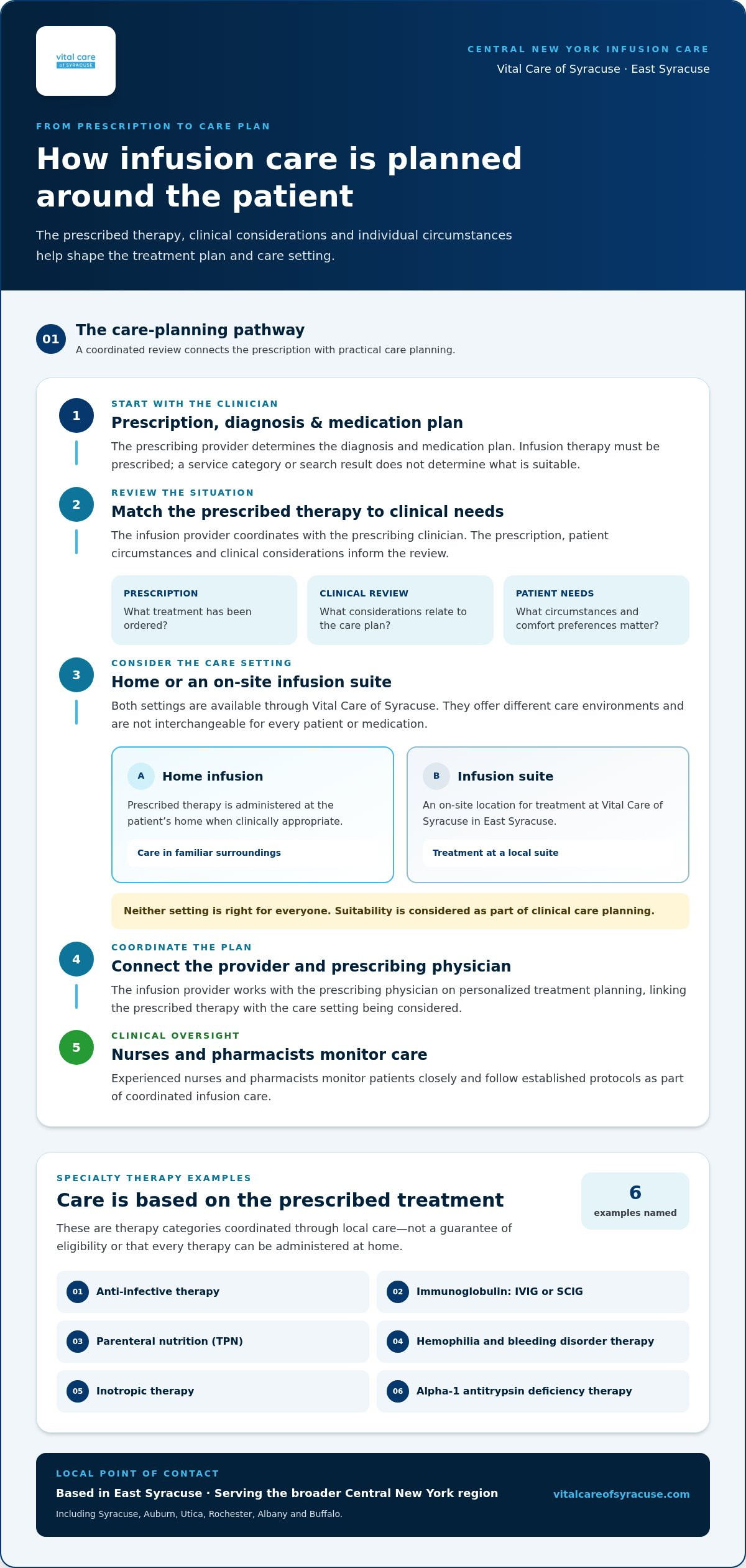
When infusion is being considered, the first step is not simply choosing a location. The prescribing clinician determines whether a particular medication fits the patient’s Crohn’s care plan. The diagnosis, treatment goals, medication instructions, and individual clinical considerations inform whether infusion is appropriate and which setting may be suitable. Because Crohn’s affects people differently, no single therapy sequence or infusion schedule applies to everyone.
Understanding the condition can help you prepare for that discussion. The National Institute of Diabetes and Digestive and Kidney Diseases (NIDDK) provides information about Crohn’s symptoms and causes. Your healthcare provider can explain how your diagnosis and clinical circumstances shape treatment decisions.
From prescription to an individualized infusion plan
The process starts with your gastroenterologist or prescribing healthcare provider, who selects the therapy and decides whether infusion is part of your plan. If infusion is prescribed, the infusion provider coordinates with that clinician to develop a plan around the prescription and your needs. Vital Care of Syracuse coordinates personalized treatment plans with prescribing physicians, supporting communication as care moves from prescription to an infusion setting.
Planning may involve these steps:
- Prescriber decision: Your clinician determines whether the medication and infusion route are appropriate for your treatment plan.
- Care coordination: The infusion provider works with the prescribing physician to align the infusion plan with the prescription and clinical considerations.
- Setting discussion: The care team considers whether home infusion or an infusion suite is suitable, alongside your preferences and practical needs.
Insurance coordination may also be part of the process. Coverage requirements can affect how a prescribed therapy is arranged. It helps to understand which steps involve your prescriber, infusion provider, and health plan. For Rochester patients exploring home infusion for Crohn’s disease Rochester, clarifying those roles can make the process easier to follow.
How clinical oversight supports treatment
Individualized planning continues through clinical oversight. Vital Care’s nurses and pharmacists monitor patients and follow established protocols. They support the prescribed infusion plan in coordination with the prescribing physician, with care shaped by the therapy and the patient’s needs. Discuss questions about your Crohn’s treatment or proposed changes with your prescriber.
Before treatment moves forward, make sure you understand who is coordinating each part of your care and which setting is planned. A clear plan connects the prescription, your clinical needs, and the chosen setting.
For an overview of how coordinated home infusion care can fit into a prescribed plan, Vital Care of Syracuse works with prescribing physicians to coordinate infusion care.
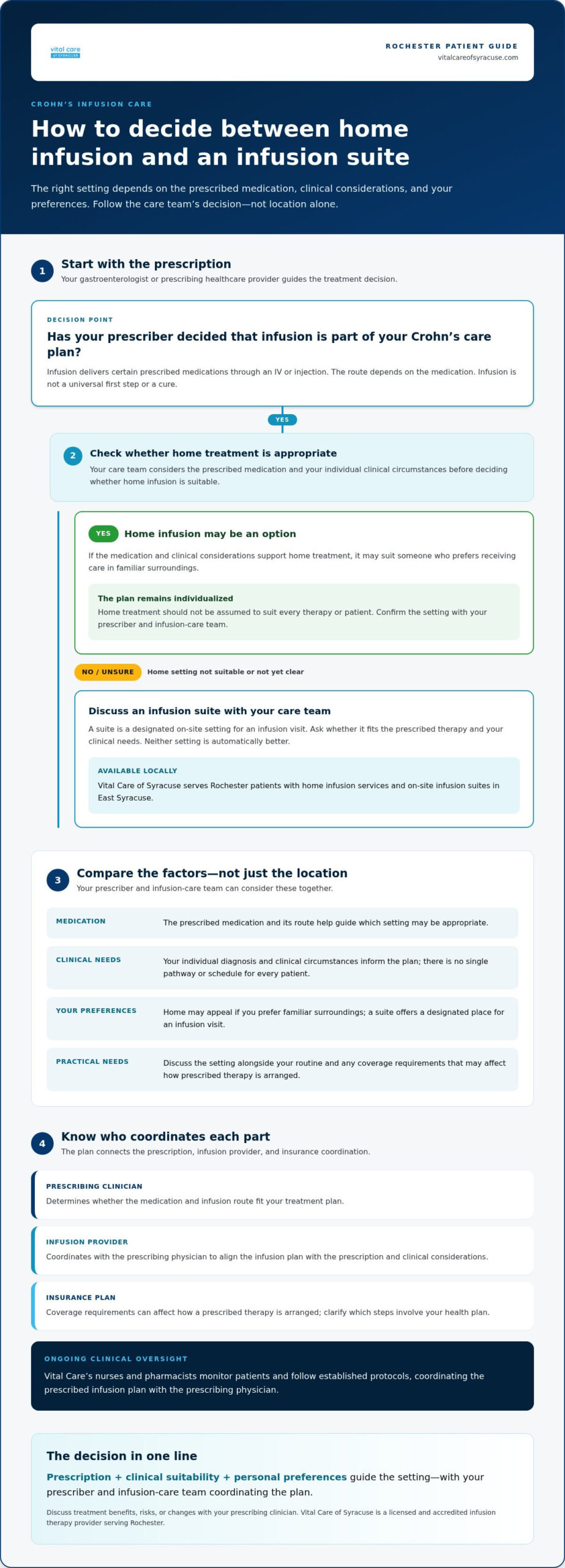
Home infusion or an infusion suite: what should guide the choice?
Choosing where an infusion takes place is both a clinical decision and a personal one. Some patients prefer a familiar home environment; others feel more comfortable receiving treatment at an on-site suite. Neither setting is automatically the better choice. The prescribing provider and infusion team consider the therapy and clinical needs, then discuss how preferences and everyday routines fit the plan.
For Rochester patients, Vital Care of Syracuse offers home infusion and on-site infusion suites in East Syracuse. Use this comparison to organize a conversation with your care team:
| Consideration | Home infusion | Infusion suite in East Syracuse |
|---|---|---|
| Setting | Treatment takes place at home when clinically appropriate for the prescribed therapy. | Treatment takes place at an on-site infusion suite. |
| Comfort preferences | May appeal if receiving care in familiar surroundings feels preferable. | May suit someone who prefers an on-site care setting for treatment. |
| Practical routine | Consider how a home visit fits into your household and daily responsibilities. | Consider travel to East Syracuse and how an off-site visit fits your routine. |
| Clinical suitability | Depends on the medication and the patient’s clinical considerations. | Discuss whether the suite setting fits the prescribed plan and care needs. |
When home infusion may fit a patient’s circumstances
Home administration may be considered when the prescribed therapy and clinical assessment make it appropriate. Receiving care at home can suit someone who prefers familiar surroundings, but it still requires coordination with the infusion team and must fit the patient’s circumstances. The prescriber’s plan and the infusion team’s assessment guide whether home infusion is suitable. Convenience alone does not determine the setting.
Home infusion is considered safe when licensed, experienced clinicians follow established protocols and monitor patients. Vital Care of Syracuse is a licensed and accredited infusion therapy provider. Its nurses and pharmacists monitor patients and follow established protocols. The prescribed therapy, care setting, and clinical assessment all matter, so home treatment should not be assumed to suit everyone.
When an infusion suite may be preferred
An on-site suite in East Syracuse offers another setting for infusion care. Some patients prefer treatment away from home or find an on-site location a better fit for their care planning. This is not a judgment about which setting is safer or more effective for everyone. It is a discussion about clinical suitability and individual preference.
As you consider home infusion for Crohn’s disease Rochester, think about what matters in your daily routine and discuss those preferences alongside the prescribed therapy. Vital Care’s home infusion services and East Syracuse infusion suites give the prescribing provider and infusion team two care settings to consider with you.
Preparing for a Crohn’s home infusion conversation in Rochester
A focused conversation with your prescribing clinician can clarify whether infusion belongs in your Crohn’s treatment plan and what needs to happen next. Bring your questions, describe your concerns, and share your preference about the care setting. This supports an informed discussion, but it does not replace individualized medical advice from your healthcare provider.
Questions to discuss with the prescribing clinician
Use this checklist to guide the conversation. You do not need to know the answers in advance. The aim is to understand how the prescribed therapy, your clinical needs, and your preferences fit together.
- Medication: Is the prescribed medication delivered by infusion or injection, and what is its intended role in my care plan?
- Diagnosis and clinical considerations: How do my Crohn’s diagnosis and individual health circumstances affect whether infusion is appropriate?
- Care setting: Is home administration clinically appropriate for this therapy, or would an on-site infusion suite better fit my needs?
- Plan and support: What should I understand about the prescribed plan, and who should I contact with questions about it?
- Coordination: How will my prescribing clinician and infusion provider work together, and what information or steps are needed from me?
Writing down concerns about treatment or the setting before your appointment can help you raise them during the discussion. Ask your healthcare provider to explain any part of the plan that feels unclear, including how the recommended setting relates to your clinical needs. Decisions about medication and treatment should remain with your prescribing clinician and care team.
Understanding insurance and care coordination
Coverage varies by plan and therapy, so the steps may differ from one patient to another. Vital Care of Syracuse assists with insurance verification, prior authorizations, and reimbursement coordination. These steps connect the prescription and care plan with the insurance process, but they do not replace your insurer’s coverage decisions. Ask how the coordination process applies to your prescribed therapy and what information may be needed from you or your prescriber.
For Rochester patients considering home infusion for Crohn’s disease Rochester, keep the clinical and administrative questions together: confirm the medication and setting with your clinician, then clarify how the infusion provider and insurance plan coordinate next steps. This can help you understand who is handling each part without assuming every plan or therapy follows the same process.
If you’d like a broader overview of infusion care for digestive conditions, the home infusion for GI disorders in Rochester guide can provide useful context alongside this Crohn’s-focused discussion.
Vital Care of Syracuse coordinates prescribed infusion care with physicians and insurance plans. Discuss infusion care coordination as you prepare for your next conversation with your care team.
Crohn’s infusion support for Rochester patients through Vital Care
For Rochester patients considering infusion as part of Crohn’s care, a clear connection between the prescribing clinician, infusion provider, and insurance plan can make the next steps easier to understand. Vital Care of Syracuse is a licensed and accredited infusion therapy provider serving Rochester and other New York communities, including Syracuse, Albany, Utica, Buffalo, Auburn, and Binghampton. It offers home infusion services and on-site infusion suites in East Syracuse, with care coordinated around the prescribing physician’s plan.
How Vital Care coordinates infusion care
Infusion planning starts with the prescription and the clinical considerations that shape the individual plan. Vital Care coordinates personalized treatment plans with prescribing physicians, so the infusion approach reflects the prescribed therapy and the patient’s needs. This supports communication between the clinician directing treatment and the team arranging infusion care.
Clinical oversight is part of that support. Vital Care’s nurses and pharmacists monitor patients and follow established protocols. Their involvement helps keep infusion care aligned with the prescribed plan, while questions about Crohn’s treatment itself remain a conversation for the prescribing healthcare provider. The therapy and clinical circumstances guide whether home administration or a suite setting is appropriate. Neither option should be assumed to fit every patient.
For appropriate care plans, home infusion brings treatment to the patient’s home. The East Syracuse suites offer an on-site alternative for patients whose clinical needs or preferences point toward receiving care there. These are distinct settings, not a ranking of care quality. The prescriber and infusion team consider suitability alongside patient preference and practical circumstances.
A clear next step for Rochester patients
If you’re a patient or caregiver exploring infusion, start by discussing the prescribed therapy and your questions with the clinician managing Crohn’s care. That conversation can clarify whether infusion is part of the plan and which setting may be appropriate. Vital Care works with prescribing physicians and insurance plans to coordinate care, assist with insurance verification and prior authorizations, and support reimbursement coordination. Coverage depends on the insurance plan and therapy, and is considered as part of the process.
Having your prescription, relevant insurance information, and questions about the care setting ready can help you follow how the pieces fit together. You can also explore the Home Infusion for GI Disorders in Rochester: 2026 Patient Resource for broader context about infusion care for gastrointestinal conditions.
Home infusion for Crohn’s disease Rochester is best considered through an individualized discussion with your prescriber and infusion team. To learn more about Vital Care’s infusion services and care coordination, explore Vital Care’s infusion services.
Take the next step with your care team
You do not have to decide on a treatment setting before speaking with your prescriber. Bring questions about the prescribed therapy, your clinical needs, and your preferred setting to your care team. Together, you can clarify which decisions require clinical guidance and how your preferences and insurance plan fit into coordination.
If you’re considering home infusion for Crohn’s disease Rochester, keep the conversation focused on your individual care plan. Your prescribing clinician guides treatment decisions, while an infusion provider helps coordinate infusion care. Take the time you need to understand each step and raise concerns as they come up.
Vital Care of Syracuse supports patients and caregivers navigating infusion care. Learn about infusion care and support from Vital Care of Syracuse, then discuss your treatment plan with your prescribing healthcare provider.
Frequently Asked Questions
Can Crohn’s disease be treated with home infusion?
Yes, Crohn’s disease may be treated with home infusion when the prescribed medication is delivered by infusion and home care is clinically appropriate. Infusion is one route within a clinician-directed plan, not a cure or a standard step for every patient. Ask your gastroenterologist what role the medication serves, how it fits with your other care, and whether the route and setting are suitable for you.
Is home infusion safe for Crohn’s disease?
Home infusion is considered safe when licensed, experienced clinicians follow established protocols and provide close monitoring. Nurses and pharmacists are part of that clinical oversight, with care coordinated alongside the prescribing provider. Safety depends on the prescribed therapy and individual circumstances, so ask your care team what support applies to your plan and how to share concerns during treatment. No care setting can guarantee a particular outcome.
How do I know whether home infusion is appropriate for my Crohn’s treatment?
Your healthcare provider determines appropriateness based on the prescribed medication, your diagnosis, and clinical considerations. To make the discussion useful, bring an up-to-date list of medications and note any questions about receiving care at home. Your prescriber and infusion provider can consider the therapy and your needs together. For patients searching for home infusion for Crohn’s disease Rochester, location alone does not determine eligibility.
Can every Crohn’s medication be given by infusion?
No. Crohn’s medications can have different delivery routes, and only medications prescribed for infusion can be administered that way. The route depends on the specific treatment selected for your care, not simply on having a Crohn’s diagnosis. Ask your prescriber whether your medication is intended for infusion or another route, and do not change a medication or how you take it without guidance from your healthcare provider.
Will insurance cover home infusion for Crohn’s disease in New York?
Coverage varies by insurance plan and therapy, so do not assume that a particular treatment or setting will be covered. Vital Care of Syracuse assists with insurance verification, prior authorizations, and reimbursement coordination. Ask how your plan’s requirements apply to the prescribed therapy and whether authorization steps are needed. The insurer determines coverage; assistance with coordination is not a guarantee of payment.
What happens if I prefer an infusion suite instead of treatment at home?
Share that preference with your prescribing provider and infusion team. Vital Care of Syracuse has on-site infusion suites in East Syracuse, which may be considered alongside home infusion. The care team weighs your preference against the prescribed therapy and clinical considerations. If travel is part of your decision, discuss how an East Syracuse visit fits your circumstances. The setting should be appropriate for your plan.
How does an infusion provider coordinate Crohn’s care with my gastroenterologist?
The infusion provider coordinates the personalized infusion plan with the prescribing physician, who directs medication decisions. Nurses and pharmacists monitor patients and follow established protocols. To understand how communication will work for your plan, ask who will be your point of contact for infusion arrangements and how to share new concerns with your gastroenterologist. The prescriber remains responsible for clinical decisions about Crohn’s treatment.
Can Rochester patients receive home infusion through Vital Care of Syracuse?
Yes, Vital Care of Syracuse serves Rochester and other New York communities with home infusion services. It is a licensed and accredited infusion therapy provider and also has on-site infusion suites in East Syracuse. Whether a particular prescribed therapy is appropriate for home administration depends on the medication and clinical considerations. Vital Care coordinates with healthcare providers and insurance plans around the prescription and care plan.
Leave a Reply