



What if needle anxiety could be part of the treatment-planning conversation, rather than a reason to delay asking about care? If you’re looking for guidance on fear of needles home IV therapy, it’s understandable to feel unsure about what an infusion involves or worry that your concern won’t be taken seriously. You deserve to have it heard without embarrassment.
Being afraid of needles doesn’t automatically determine whether home infusion is suitable. The decision depends on your prescribed therapy, clinical needs, and care plan. Discussing your concerns early can help the team plan with your experience in mind. Vital Care of Syracuse coordinates personalized infusion plans with prescribing physicians and offers home infusion and on-site suites in East Syracuse as care-setting options when clinically appropriate.
This guide explains what to share with your care team, what to expect around IV placement, and how clinical planning and the treatment setting may shape your experience. You’ll also find practical ways to discuss whether home infusion could fit your prescribed care, so you can approach the next conversation feeling more prepared.
Key Takeaways
- Fear of needles home IV therapy can feel more manageable when you share your concerns before treatment planning begins.
- Knowing what to ask about IV placement can reduce uncertainty, even though the process may differ by therapy and care plan.
- Home infusion and an East Syracuse suite offer different care settings. Clinical suitability should guide the choice, not a one-size-fits-all rule.
- Tell your care team about needle fear, any history of fainting, and specific concerns about the planned procedure.
- Vital Care of Syracuse coordinates personalized infusion plans with prescribing physicians, and nurses and pharmacists monitor care.
Fear of Needles and Home IV Therapy: What Your Anxiety May Mean
Feeling uneasy about a needle is a real concern, not a personal failing. It may affect how you think about a prescribed infusion, particularly if you’re unsure what will happen during IV placement. You don’t need to minimize the feeling or have a diagnosis before bringing it up with your care team.
Needle anxiety is worry or distress related to needles or procedures that involve them, such as IV placement. It can range from passing nervousness to fear that feels intense or difficult to manage. If you’re considering fear of needles home IV therapy, putting the concern into words is a useful first step toward a more informed treatment-planning conversation.
Is needle anxiety the same as trypanophobia?
No. People use “trypanophobia” to describe an intense fear of needles, but feeling nervous before an IV does not, by itself, mean you have a phobia. The overview of fear of needles, also known as trypanophobia describes the term and related experiences. Only a qualified professional can assess whether someone meets criteria for a phobia. Whatever label applies, your concern deserves respectful discussion.
There’s no need to decide whether your fear is “serious enough” before speaking up. You might feel tense but still proceed, or find that the thought of placement disrupts sleep or makes you consider delaying treatment. These experiences differ, but each can help your care team understand what support or planning may be useful.
What can make an IV-related fear feel more intense?
Anticipating a procedure can be difficult, especially when you don’t know what the clinician will do, what you may feel, or how long placement might take. A previous uncomfortable or upsetting experience may also shape your expectations, though it isn’t the only reason someone feels anxious. People respond differently, so there’s no single explanation that fits everyone.
Fear can involve emotional distress and physical reactions. Some people notice a racing heart, sweating, nausea, dizziness, or lightheadedness around needles. In some cases, a vasovagal response can cause a sudden drop in blood pressure and lead to fainting. These reactions aren’t a sign of weakness, but dizziness or fainting is important information to share before treatment. Your care team can consider this information when planning your care.
Try describing what happens for you in specific terms: “I feel dizzy when I see the needle,” “I need to know what’s happening before placement,” or “A previous IV experience makes me anxious.” If you’ve fainted, mention that clearly. You can also say whether you prefer an explanation, less visual detail, or time to ask questions. Sharing these preferences gives clinicians a clearer picture of your needs, although it can’t guarantee a particular procedure or outcome.
Needle anxiety doesn’t automatically determine whether home infusion is appropriate. The prescribed therapy and clinical plan matter alongside your concerns. Sharing what you experience gives the care team a chance to consider those factors together, rather than leaving you to manage uncertainty alone.
What to Expect When Home IV Therapy Involves Needle Placement
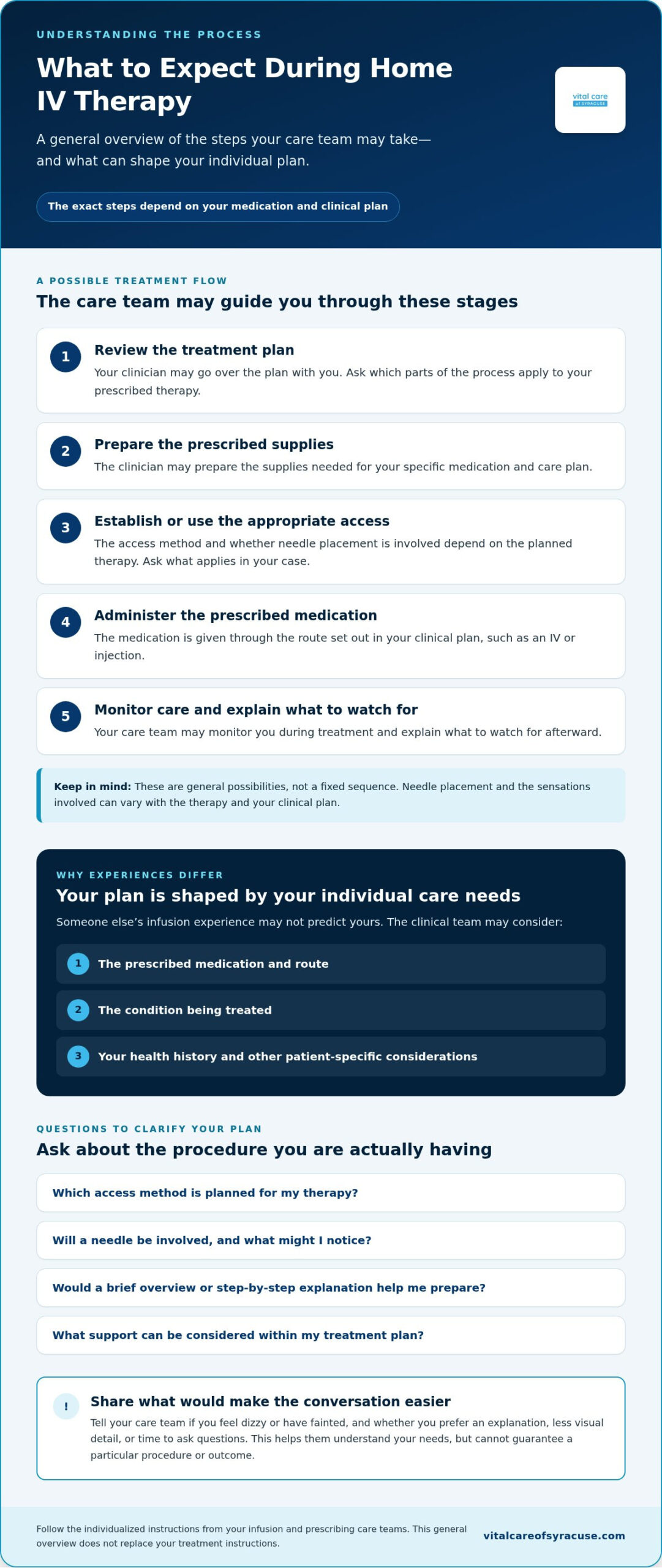
Knowing the broad steps can make planned treatment feel less unfamiliar, though no general description can predict exactly how your infusion will go. Infusion therapy delivers prescribed medication through an IV or injection. The route, equipment, and steps depend on the medication and your clinical plan.
Depending on the treatment, a clinician may review the plan with you, prepare the prescribed supplies, establish or use the appropriate access, and begin administering the medication. The care team may also monitor you during treatment and explain what to watch for afterward. These are general possibilities, not a fixed sequence. Needle placement and the sensations involved can vary, so it’s reasonable to ask what applies to your therapy.
The information here is general and does not replace the individualized treatment instructions from your infusion and prescribing care teams. Follow the guidance they provide for your specific medication and circumstances.
Why the specific medication and treatment plan matter
Different prescribed therapies can involve different routes, supplies, and monitoring needs. The plan may account for the medication, the condition being treated, your health history, and other patient-specific considerations. As a result, someone else’s experience with an infusion may not predict yours, even if the treatment sounds similar. Your clinical team can explain which parts of the process are relevant to your care.
If you’re concerned about fear of needles home IV therapy, focus on the planned procedure rather than trying to prepare from a generic description. Ask your infusion team or prescribing care team which access method is planned, what you may notice, and what support can be considered within your treatment plan. Don’t change or skip prescribed care based on assumptions about how placement will feel.
Questions that can make the process clearer
You can ask for information in a way that suits you. For example, would you prefer a brief overview or a step-by-step explanation before the visit? You can also ask what the clinician will do, whether a needle is involved in the planned access, and what sensations are possible. The team can answer based on your actual therapy rather than offering a one-size-fits-all promise.
- What does my prescribed treatment involve, including the planned route and access?
- What might I see or feel during placement and while medication is being administered?
- Who should I tell if I feel unwell or need clarification during treatment?
- Can we discuss a previous difficult experience or strong reaction before the procedure?
Share relevant details before treatment, including past trouble with placement, fainting, or a reaction that made it hard to continue. You don’t need to provide a perfect medical description. Explaining what happened and what worries you is useful context. Your team can consider your concerns alongside the prescribed therapy and clinical requirements.
For patients in Central New York, home infusion care planning includes coordination with prescribing physicians, connecting the treatment plan with patients’ needs and questions.
Home Infusion or an East Syracuse Suite: Which Setting May Feel More Manageable?
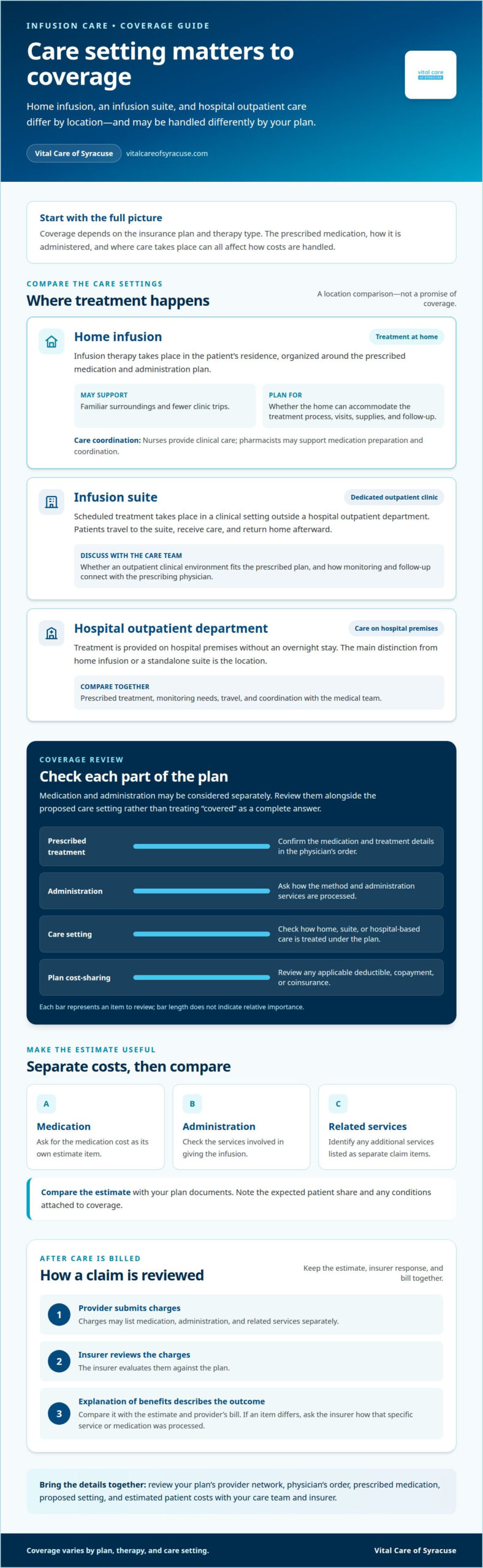
The care setting can shape how an infusion fits into your day, but it can’t determine how you’ll feel about needle placement. Home infusion may appeal if familiar surroundings help you feel more at ease. An on-site suite may suit someone who prefers to receive treatment outside the home. Neither choice is automatically calmer, and a familiar environment doesn’t guarantee an anxiety-free experience.
Use the comparison as a starting point for a conversation, not as a way to decide clinical eligibility on your own. The prescribed therapy, your health needs, and the clinical assessment guide which setting is appropriate. If you have a preference, share it alongside your concerns about needles so the care team can consider both.
| Setting | Possible comfort considerations | Clinical suitability |
|---|---|---|
| Home infusion | Familiar surroundings may feel reassuring to some people. Being at home doesn’t guarantee less anxiety. | An option when the prescribed therapy and clinical assessment support home care. |
| East Syracuse suite | An on-site setting may feel preferable if you’d rather receive treatment away from home. | An alternative care setting when appropriate for the prescribed therapy and individual plan. |
When home infusion may fit a patient’s care plan
Home infusion may be considered when it’s clinically appropriate for the prescribed therapy and the patient’s circumstances. Some people appreciate familiar surroundings or the convenience of receiving care at home, while others may find that being at home doesn’t ease their worries. Your response is personal, so consider what about the setting feels supportive and what might make treatment harder.
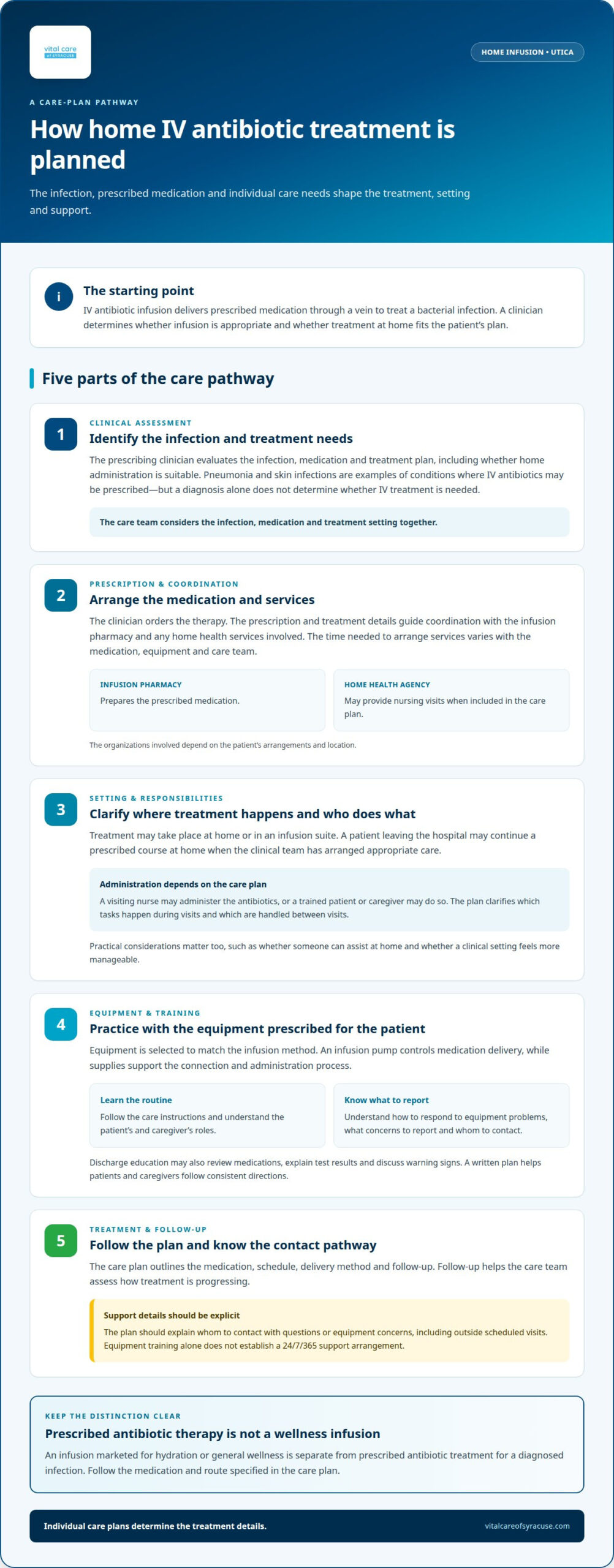
For an example of a prescribed therapy delivered at home, Vital Care of Syracuse explains home anti-infective therapy. The details of an individual infusion still depend on its clinical plan.
What an infusion suite in East Syracuse offers as a setting
An on-site infusion suite in East Syracuse gives patients another care-setting option to discuss with their team. You may prefer a dedicated setting outside your home, or you may feel more comfortable in familiar surroundings. A location preference is useful information, but it doesn’t establish whether a particular therapy can be given there. Clinical suitability remains central.
When discussing fear of needles home IV therapy, try separating two questions: “Which setting feels more manageable to me?” and “Which setting is appropriate for my treatment?” Your care team can consider your preference alongside the prescribed medication and patient-specific needs. You can also ask how your needle-related concerns will be included in planning, whichever setting is selected.
There isn’t one right choice for everyone. A thoughtful discussion can weigh comfort and clinical needs together, without assuming that home or a suite will remove fear. If your preferred setting isn’t suitable for the prescribed care, ask your care team to explain the factors guiding the plan and what the available care-setting options mean for your treatment.
How to Prepare for Home IV Therapy When You Fear Needles
A little preparation can make it easier to explain what you need and understand how your prescribed care is planned. You don’t have to find the perfect words or resolve the fear before speaking with your team. Start with information that could affect the treatment experience, then work through questions and possible coping approaches together.
Share your concerns before the infusion
Raise needle anxiety during treatment planning, rather than waiting until the clinician is ready to begin. The infusion team and prescribing physician can consider what you share alongside the prescribed therapy. Clear communication supports personalized planning, though it can’t guarantee a particular response or remove anxiety.
If it’s hard to start the conversation, try a simple statement such as, “I’m afraid of needles and want to understand what the planned procedure involves.” Be specific about experiences that may matter, especially if you’ve fainted, felt unwell, or had a difficult previous placement. You can also name what worries you most, such as seeing the needle, uncertainty about the steps, or not knowing what you might feel.
Consider writing down your questions ahead of time. You might ask:
- What is planned for my prescribed treatment, and what might I experience?
- Can you explain the steps before they happen?
- Who should I tell if I feel distressed or unwell during care?
- How can I share a concern if I find it difficult to speak in the moment?
These questions aren’t a demand for a specific procedure. They help you understand the plan and give the care team an opportunity to address your concerns within the clinical requirements of your treatment. If your needle fear has made you consider delaying or stopping prescribed care, tell the prescribing physician so you can discuss the concern with them.
Plan supportive coping strategies with your care team
Once your team understands your concerns, discuss whether a simple approach may suit your treatment. Some people may prefer to look away or use a calming focus during placement. Others may want a brief explanation or less detail. Ask what’s practical for your planned care rather than assuming one strategy works for everyone.
Breathing or distraction may help some people feel more settled, but these strategies aren’t a substitute for clinical support or a personalized plan. If you’ve fainted before, make sure the infusion team and prescribing physician know before treatment, and follow their guidance. Don’t try to manage fainting risk on your own.
Follow the individualized instructions provided for your therapy. Don’t change food, drink, or medication routines based on general advice or assumptions. Ask your clinical team what applies to your care. For guidance on home anti-infective therapy, review how prescribed infusion care may be planned for home. To learn about home infusion care, explore the care options available through Vital Care of Syracuse.
How Vital Care of Syracuse Supports Patients Receiving Home IV Therapy
Once you’ve identified what worries you and what you’d like clarified, bring those concerns into a care plan built around your prescribed treatment. Vital Care of Syracuse is a licensed and accredited infusion therapy provider serving Central New York. The team coordinates personalized treatment plans with prescribing physicians, giving patients a clinical point of connection for discussing their therapy and care-setting needs.
Needle anxiety is relevant information for planning, but it doesn’t determine the treatment on its own. Sharing your concerns can help the care team understand your perspective while keeping the prescribed medication and clinical requirements central. Vital Care does not promise an anxiety-free infusion. The goal is coordinated, clinically guided care that considers the individual plan.
Personalized coordination for prescribed infusion care
Infusion care begins with the prescribed therapy and coordination with the physician directing treatment. The plan is personalized, rather than assumed to follow the same approach for every patient. If you’re concerned about IV placement, share that concern as part of discussing your care. Details about the procedure and what may be adjusted should come from the clinical team familiar with your therapy.
Nurses and pharmacists monitor care using established protocols. Their role is clinical monitoring, not psychotherapy or treatment for needle phobia. Telling the team about needle fear, previous difficult experiences, or fainting gives them important context as they coordinate and monitor your prescribed infusion care.
For example, you may want to know how the plan accounts for a prior reaction or how to raise a concern during treatment. These are appropriate topics to discuss with the infusion team and prescribing physician. Clear communication can support personalized planning, but it can’t guarantee a specific procedure, setting, or emotional response.
Explore home and suite-based care in Central New York
Vital Care of Syracuse provides home infusion and on-site infusion suites in East Syracuse. These are care-setting options when clinically appropriate, not a ranking of which environment is best for needle anxiety. Home may feel familiar to one person, while another may prefer an on-site setting. The prescribed therapy and clinical assessment guide suitability, with patient preferences part of the conversation.
Patients across Central New York, including Syracuse, Albany, Rochester, Utica, Buffalo, Auburn, and Binghampton, can learn more about local home infusion care and how coordination supports treatment planning. If you’re discussing fear of needles home IV therapy, sharing what feels difficult can help the team understand your needs without making assumptions about what will resolve the fear.
You deserve a respectful conversation about your concerns alongside your medical care. Learn about Vital Care’s infusion services and the home and suite-based care options available through Vital Care of Syracuse.
Take the Next Step at Your Own Pace
You don’t have to wait until needle anxiety disappears to talk about a prescribed infusion. A useful next step can be as small as writing down the question you most want answered or telling your care team which part feels hardest. That gives the conversation a clear place to begin, without expecting you to have every concern solved in advance.
If fear of needles home IV therapy has made you uncertain about moving forward, bring that uncertainty into your care discussion. Your experience is worth hearing, and asking for clarity is a reasonable part of preparing for treatment. You can take time to understand the plan, share what you need, and consider the options with your clinical team. Even if the fear remains, having a clearer conversation may help you decide what you’d like to do next.
Vital Care of Syracuse provides personalized infusion care for patients in its service region. Learn about personalized infusion care with Vital Care of Syracuse and take the next step when you feel ready. Your questions deserve space, and you can move forward at a pace that feels manageable.
Frequently Asked Questions
Is needle fear the same as trypanophobia?
Not necessarily. Needle fear can mean anything from uneasiness to intense distress, while trypanophobia refers to a more significant fear involving needles or related procedures. A short article or symptom checklist can’t diagnose a phobia. If fear of needles home IV therapy is affecting your willingness to receive prescribed care, tell your healthcare team what happens and how it affects you. They can discuss appropriate support and next steps.
Can home IV therapy be given without a needle?
The method depends on the medication and your treatment plan. IV therapy delivers medication through IV access, while some infusion therapies use injection delivery. Don’t assume another patient’s method will apply to you. Ask your infusion team to describe the access and procedure planned for your treatment, including what you may experience. Follow the individualized clinical instructions from your care team rather than relying on general descriptions of infusion methods.
What should I do if I have fainted during a blood draw before?
Tell your infusion team and prescribing physician before treatment, and describe what happened, including whether it has occurred more than once. For example, mention if you lost consciousness or felt faint during a previous blood draw. This history helps your healthcare professionals understand the concern as they plan your care. Don’t rely on general online tips to prevent fainting. Follow the specific guidance your clinical team provides for your treatment.
Is home infusion safe outside of a hospital setting?
Home infusion can be safely administered when it’s clinically appropriate and provided by licensed, experienced clinicians following established protocols. Vital Care of Syracuse coordinates with prescribing providers, while nurses and pharmacists monitor care. Home treatment isn’t right for every medication or patient. The prescribed therapy and clinical considerations inform the setting decision, so discuss any concerns about home care with the professionals coordinating your treatment.
Will insurance cover home infusion in New York?
Coverage varies by insurance plan and therapy type, so don’t assume a prescribed home infusion will be covered. Vital Care of Syracuse assists with insurance verification, prior authorizations, and reimbursement coordination. Have your plan information and prescribed therapy details available when coverage is reviewed. This coordination can help clarify how your individual benefits apply, but coverage depends on the specifics of your plan and treatment.
How do I know whether my prescribed treatment is suitable for home infusion?
Your healthcare provider determines suitability based on the medication, diagnosis, and clinical considerations. The infusion provider works with the prescribing physician and insurance plan to assess appropriateness and coverage. Your preference for home treatment is worth sharing, but it doesn’t replace clinical assessment. Patients exploring care in New York, including Syracuse, Albany, Rochester, Utica, Buffalo, Auburn, and Binghampton, can discuss their prescribed therapy and setting considerations with their care team.
Leave a Reply