



How can a scheduled prophylaxis routine fit into everyday life without leaving you feeling on your own? For people managing hemophilia prophylaxis at home Utica families can build a practical routine around the clinician-directed treatment plan. Clear records, organized supplies, and reliable communication help make each step easier to manage. Home-based care doesn’t mean clinical guidance falls away.
Questions about keeping treatment on schedule, organizing supplies, or knowing what to share with the care team are understandable. A consistent routine can make these tasks more manageable, while treatment decisions and changes to the prescribed plan remain with the clinical team.
This article explains how to make prophylaxis a repeatable part of home life, what information and supplies may be useful to organize with the care team, and how Vital Care of Syracuse supports home-based hemophilia and bleeding disorder therapy for the Utica area. With infusion support as part of coordinated care, patients and families can approach the routine with greater clarity.
Key Takeaways
- Understand how preventive prophylaxis differs from treatment given in response to a bleed, and follow the clinician’s instructions for each.
- Use reminders, an organized supply area, and a brief treatment record to manage the prescribed routine at home.
- Compare home, infusion suite, and hospital settings in light of clinical needs and everyday logistics.
- Prepare records and questions for follow-ups, and plan around work, school, travel, and caregiver schedules without changing treatment instructions.
- Learn how Vital Care’s home-based and suite-based infusion support can be part of coordinated hemophilia and bleeding disorder care.
Home Hemophilia Prophylaxis for Utica Patients
A preventive treatment routine can become part of home life, but it should start with a plan made for the individual. Hemophilia prophylaxis is treatment prescribed by a clinician to reduce the risk of bleeding. The treatment product and schedule depend on the person’s diagnosis and clinical circumstances. Follow the hematology team’s instructions rather than a general timetable or someone else’s routine.
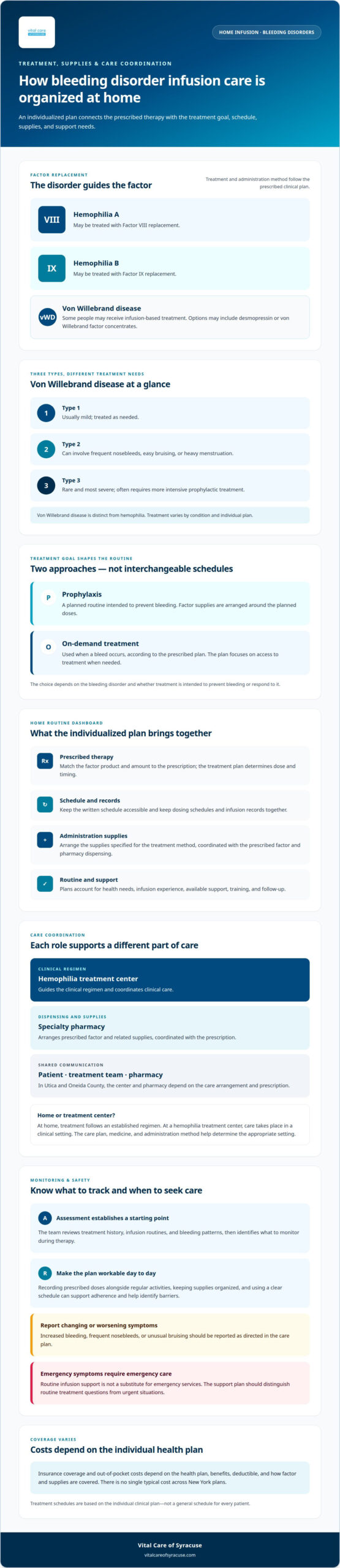
Prophylaxis and on-demand treatment serve different purposes. Prophylaxis is planned to help reduce bleeding risk; on-demand treatment is used in response to a bleed according to the care plan. Preventive treatment can’t guarantee that a bleed won’t occur, and it doesn’t replace instructions for responding to one. A general overview of Hemophilia discusses both approaches.
Personal experiences can also offer perspective on learning treatment skills at home. The video below shares a patient-centered discussion related to self-infusion and living with a bleeding disorder.
Prophylaxis and on-demand treatment serve different purposes
Both approaches may have a place in a person’s care plan, but they aren’t interchangeable. Follow the instructions for the preventive routine and the separate steps for a suspected bleed. If it’s unclear which instructions apply, or a treatment question comes up, contact the hematology team instead of adjusting the regimen yourself.
Who helps coordinate home hemophilia care in Utica?
Home treatment works best as coordinated specialty care. The prescriber and hematology team determine the clinical plan. Infusion clinicians support treatment administration and practical care needs, while patients and caregivers follow the instructions, keep relevant records, and raise questions or changes with the team. Clear communication helps everyone work from the same plan.
For people managing hemophilia prophylaxis at home Utica, the home setting can make a prescribed routine easier to organize around everyday responsibilities while clinical oversight remains in place. Vital Care provides hemophilia and bleeding disorder therapy in the Utica service area, with home-based and suite-based infusion care as part of coordinated support. Its role complements, rather than replaces, the patient’s hematology team. For more context, explore the bleeding disorder therapy guide.
Build a Consistent Home Prophylaxis Routine in Utica
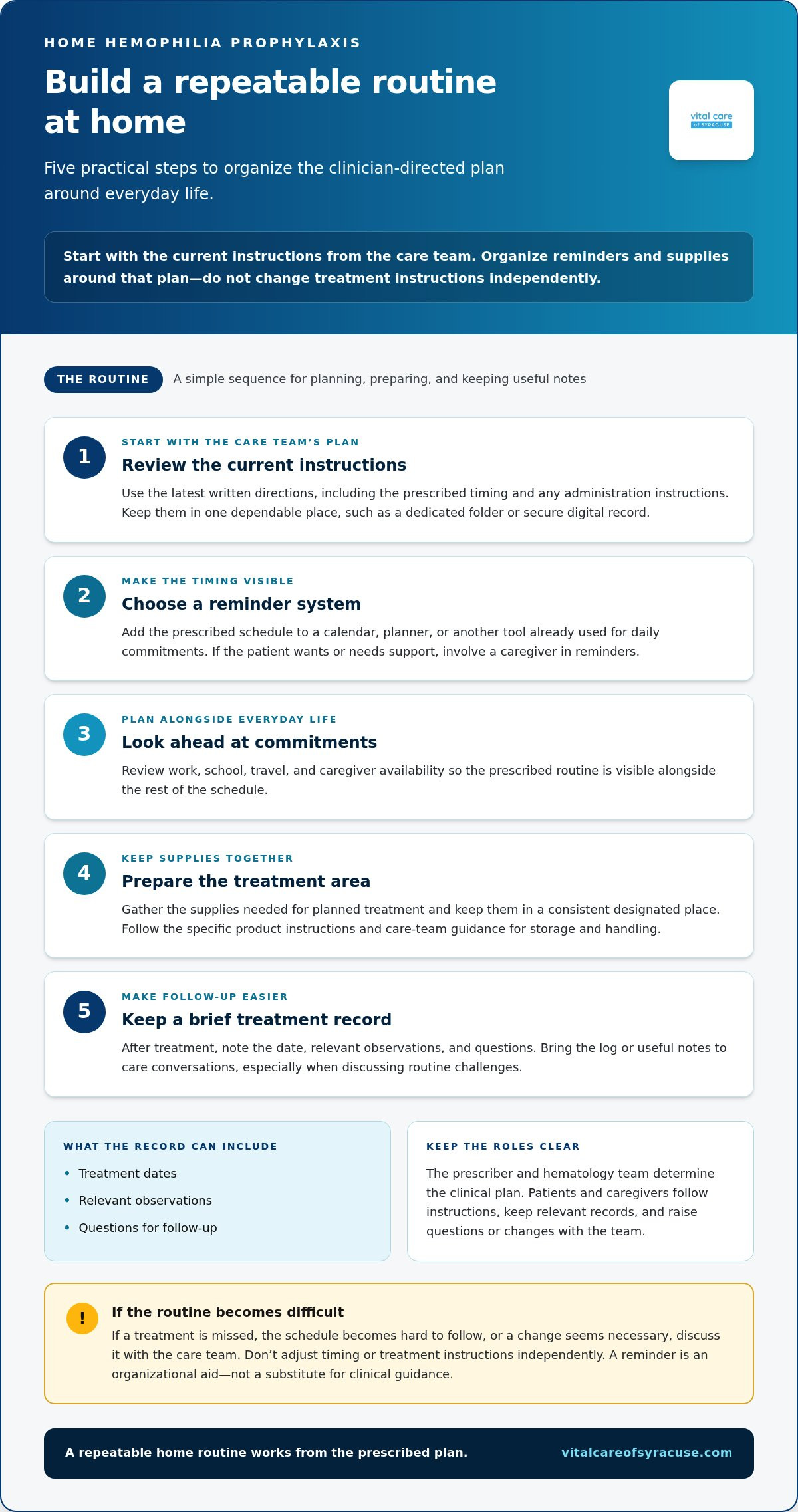
A repeatable routine makes treatment easier to track alongside work, school, caregiving, and other daily responsibilities. Start with the prescribed plan, then build reminders and supply organization around it. The goal is to make the clinician’s instructions easier to follow, not to change the treatment.
A useful routine should be simple enough to follow on busy days. The CDC Guidelines on Hemophilia Treatment provide background on hemophilia care, while the patient’s hematology team remains the source for personal instructions.
Turn prescribed instructions into a practical schedule
Keep the care team’s written instructions in one dependable place, such as a dedicated folder or secure digital record. Add reminders to a calendar or another system already used for appointments and daily commitments. Choose a system that reflects the prescribed timing, and involve a caregiver in reminders if the patient wants or needs that support.
- Review the plan. Use the current instructions from the care team, including the prescribed timing and any directions for administration.
- Choose a reminder system. Add the schedule to a calendar, planner, or other tool that fits the patient’s regular routine.
- Plan around commitments. Look ahead at work, school, travel, and caregiver availability so the prescribed routine is visible alongside daily plans.
- Prepare the treatment area. Gather the supplies needed for the planned treatment, following product instructions and care-team guidance.
- Make a brief record. After treatment, note the date and any relevant observations or questions for follow-up.
If the schedule becomes difficult to follow, a treatment is missed, or a change seems necessary, discuss it with the care team. Don’t adjust timing or treatment instructions independently. A reminder is an organizational aid, not a substitute for clinical guidance.
Organize treatment supplies and home records
Choose a consistent place for treatment supplies and keep them together as directed by the product instructions and care team. Storage and handling requirements can depend on the specific product, so follow the instructions rather than creating your own rules. A designated location also helps patients and caregivers find supplies without searching through unrelated household items.
- Keep current treatment instructions accessible with the supplies.
- Use a brief log for treatment dates, relevant observations, and follow-up questions.
- Bring the log or relevant notes to care conversations, especially when discussing routine challenges.
The record doesn’t need to be complicated. A few clear notes can help the patient, caregiver, and clinical team discuss what’s working and where further guidance may help. For Utica patients receiving hemophilia therapy at home, Vital Care’s home infusion support can be part of a coordinated routine.
Home, Infusion Suite, or Hospital: Compare Hemophilia Care Options
The appropriate setting for hemophilia treatment depends on the prescribed plan, the treatment, and the patient’s clinical circumstances. Home, an infusion suite, and a hospital each have different practical considerations. No one setting is automatically the right fit for everyone. The care team can help determine which is appropriate and revisit the decision as needs change.
Choosing home-based treatment doesn’t mean managing care without professional coordination. The prescriber and infusion clinicians remain part of the plan, while the patient and caregiver follow their instructions. For Utica patients, practical factors can include travel, privacy, and caregiver availability.
- Home: Treatment takes place in a familiar environment and may fit naturally around household routines. The patient still follows prescribed instructions and stays connected to the clinical team.
- Infusion suite: Treatment takes place in a dedicated care setting. It may suit a care plan that calls for treatment away from home while using an infusion service.
- Hospital: A hospital may be appropriate when the patient’s clinical circumstances or treatment plan call for that setting. The treating team guides the decision based on individual needs.
When home-based care may fit a patient’s routine
For some patients, receiving appropriate treatment at home can reduce the need to travel for each planned infusion and let the routine take place in a familiar space. Consider practical fit, including privacy, available support, and whether the home setup works with the care team’s instructions. Home treatment remains part of coordinated care, not a reason to alter the prescribed regimen or skip clinical follow-up.
Home care doesn’t guarantee a particular health outcome. Its suitability depends on the patient’s needs and treatment plan, and shouldn’t be judged by convenience alone. If circumstances at home change, such as caregiver availability or the ability to follow treatment instructions, share that with the clinical team so they can advise on the plan.
When suite-based or hospital care may be part of the plan
A suite or hospital may make sense when the clinical team determines that a different setting better fits the treatment or the patient’s circumstances. A general online checklist can’t make that individual decision. Discuss practical concerns, treatment requirements, and support in each setting with the care team, which can explain how the recommended setting fits the prescribed plan.
Vital Care provides home-based and suite-based infusion care, including hemophilia and bleeding disorder therapy for patients in the Utica area. These options can support different practical needs within clinician-directed care. Patients can also learn about Vital Care’s infusion services.
Prepare for Follow-Up, Treatment Disruptions, and Utica Logistics
Preparation can make follow-up conversations more focused and help patients spot practical challenges before they disrupt a routine. Keep treatment records and questions together, and use the care team’s contact and escalation instructions when a concern arises. For anyone managing hemophilia prophylaxis at home Utica, planning ahead can help fit treatment logistics around work, school, travel, and caregiver schedules without changing prescribed instructions.
Keep follow-up conversations useful and focused
Before a scheduled discussion with the clinical team, gather information that shows how the routine is working. A brief, factual record is easier to review than trying to recall details during the conversation. Include questions that need clinical guidance, especially if a recurring difficulty is making the prescribed plan hard to follow.
- Bring recent treatment records and note relevant observations.
- Write down questions about instructions, supplies, or a missed treatment.
- Describe changes in work, school, caregiving, or daily routines that affect treatment logistics.
- Share recurring challenges early, before they become harder to manage.
You don’t need to decide on your own what a record or symptom means. Use the follow-up to clarify questions with the care team, and don’t make treatment changes unless the team directs them. If a concern arises between planned appointments, follow the contact guidance provided by the clinical team.
Plan for home routines across Central New York
In Utica and across Central New York, appointments, seasonal travel, school calendars, and changing caregiver availability can affect a home routine. Vital Care of Syracuse serves patients in Utica, Syracuse, Albany, Rochester, Buffalo, Auburn, and Binghampton. Consider upcoming commitments early, especially if time away from home could affect access to treatment supplies or the usual routine. Planning means communicating in advance, not changing prescribed timing without guidance.
- Review upcoming travel, appointments, school events, or work changes with the care team when they may affect treatment logistics.
- Discuss supply coordination ahead of time if travel or a change in routine could affect what is needed and when.
- Keep the care team’s instructions and contact information accessible to the patient and any caregiver involved in treatment.
- If a disruption occurs, use the care team’s instructions for next steps instead of improvising a schedule change.
For urgent or severe symptoms, follow the individual emergency plan and seek emergency services as directed. Home infusion support is part of coordinated specialty care, not a substitute for emergency care. Patients and caregivers can connect with Vital Care about home hemophilia therapy support as they organize care in the Utica area.
How Vital Care Supports Home Hemophilia Therapy for Utica Patients
A home prophylaxis routine needs more than a calendar and a place to keep supplies. Patients and caregivers also need clear communication with the professionals involved in care and a shared understanding of each person’s role. Vital Care of Syracuse provides hemophilia and bleeding disorder therapy for patients in Utica as part of coordinated specialty care, connecting practical infusion support with the plan established by the patient’s clinical team.
The prescribing clinician determines the individual treatment plan, including the therapy and schedule. Vital Care supports infusion care within that plan; it doesn’t replace the hematology team or make independent treatment decisions. Home or suite-based care may be part of the support, depending on the person’s circumstances and plan. Patients and caregivers can discuss practical needs with the clinicians involved so expectations and instructions remain clear.
What coordinated support can mean for daily management
Personalized support starts with understanding the patient’s situation. A routine may involve a caregiver helping with preparation, a patient keeping treatment notes, or questions to raise with the clinical team. Clear communication helps everyone understand the instructions and discuss practical concerns, such as a routine that is difficult to manage around daily responsibilities.
Useful coordination can include:
- Sharing relevant treatment records and questions with the appropriate care professionals.
- Making sure patients and caregivers understand the instructions for their roles.
- Discussing changes in circumstances that could affect how the routine is organized.
- Keeping treatment decisions with the prescribing clinician and following the established care plan.
These steps can make the process easier to understand and organize, but they don’t guarantee a particular clinical outcome. Support should reflect the patient’s needs and circumstances, with the clinical plan guiding treatment. Home-based care is coordinated care, not a requirement to handle treatment alone.
A considered next step for Utica patients and caregivers
For people managing hemophilia prophylaxis at home Utica, Vital Care’s home-based and suite-based infusion care provides local support within a clinician-directed approach. The setting depends on the individual’s plan and circumstances. Patients and caregivers can learn about bleeding disorder therapy and home infusion support as they consider how local services fit into coordinated care.
Explore Vital Care’s local hemophilia and bleeding disorder therapy support for Utica patients. For urgent or severe symptoms, follow the patient’s emergency plan and seek emergency services as directed.
Make Your Next Care Conversation Count
A manageable home routine can grow from small, deliberate steps: keep current instructions accessible, note where everyday logistics feel difficult, and bring those observations to the next care conversation. You don’t need to solve every challenge alone. The hematology team can clarify treatment questions and guide decisions about an individual plan.
For families managing hemophilia prophylaxis at home Utica, a useful next step is to explore how coordinated infusion support can work alongside care directed by the clinical team. Vital Care’s hemophilia and bleeding disorder therapy supports patients and caregivers as they organize care around their circumstances, without replacing the prescriber’s role.
Learn about Vital Care’s hemophilia and bleeding disorder therapy and consider how local infusion support may fit into your care plan. Clear instructions, open communication, and support suited to your needs can help you approach the next step with confidence.
Frequently Asked Questions
Is hemophilia prophylaxis the same as treatment for a bleed?
No. Hemophilia prophylaxis and treatment for a bleed have different roles. Prophylaxis is planned preventive treatment intended to lower bleeding risk, while treatment for a bleed addresses a bleeding episode under the person’s care plan. Some plans include both, with separate instructions for each. Because products and directions vary, don’t assume one can substitute for the other. Ask the hematology team how the written plan distinguishes them.
Can hemophilia prophylaxis be managed at home?
Home management may be appropriate for some patients when the prescribed plan and clinical circumstances support it. For people managing hemophilia prophylaxis at home in Utica, suitability depends on individual needs, the treatment involved, and the support arranged with clinicians. Ask the care team what instruction, supply coordination, and communication are appropriate for your situation. Home treatment still involves clinical coordination; it doesn’t mean making care decisions alone.
What should I do if I miss a scheduled prophylaxis treatment?
If you miss a scheduled treatment, don’t double a dose or shift the next one based on general online advice. The right response depends on your prescribed treatment and personal plan. Follow any missed-treatment instructions already provided, then use the care team’s contact details for direction. Note when the treatment was missed and any relevant circumstances. If bleeding is serious or urgent, follow your emergency plan and seek emergency care.
Does prophylaxis eliminate the risk of bleeding?
Preventive prophylaxis is intended to reduce bleeding risk, but it can’t be assumed to eliminate every bleed. A person’s experience depends on individual circumstances and their care plan. If you have a concern, record what happened and when, along with any questions it raises. Share those details with the hematology team, which can interpret them in context and determine whether any care adjustments are appropriate.
Can I travel while managing hemophilia prophylaxis at home?
Travel may be possible, but planning should account for your prescribed schedule, treatment instructions, and product-specific handling requirements. Before arranging a trip, discuss the itinerary with your care team, especially if travel overlaps a planned treatment or changes where supplies will be kept. Follow the instructions for your specific treatment; don’t change timing or handling based on general travel tips.
Who should I contact about a new or severe bleed at home?
For a new or severe bleed, follow the emergency instructions in your individual care plan and use emergency services for urgent or severe symptoms. A home infusion provider isn’t a substitute for emergency medical services. For non-urgent questions about prophylaxis, a missed treatment, or follow-up, contact the clinician or care-team number named in your plan. Keep these contacts easy to find, including for caregivers who may assist.
Leave a Reply