



Receiving a life-sustaining treatment in the comfort of your own living room should feel like a relief, yet for many New Yorkers, the first thought isn’t about healing; it’s about the bill. Finding clear answers regarding insurance accepted for home infusion often feels like a full-time job you never applied for, especially with the shifting regulations of 2026. You shouldn’t have to choose between your clinical recovery and your financial peace of mind.
We understand that the fear of hidden medical debt and the confusion over prior authorization requirements can be just as draining as the condition you’re treating. This guide is designed to remove that weight from your shoulders by explaining exactly how coverage works in New York right now. We’ll walk through the latest 2026 Medicare payment rates, new precertification rules for private payers like Aetna, and how the specialized team at Vital Care of Syracuse acts as your personal advocate to handle the billing complexities on your behalf. By the time you finish reading, you’ll have a clear path forward and the reassurance that your care is in expert hands.
Key Takeaways
- Gain clarity on how your coverage is split between pharmacy and medical benefits, ensuring every part of your treatment is accounted for.
- Identify the major regional and national payers included in the insurance accepted for home infusion across Syracuse, Rochester, and Buffalo.
- Learn how your clinical diagnosis shapes your billing structure and what that means for long-term chronic care versus acute therapy.
- Navigate the 2026 verification process with confidence by understanding the essential steps from clinical referral to final benefit confirmation.
- Discover the peace of mind that comes with local financial advocacy, where dedicated experts manage the complexities of your insurance on your behalf.
What Insurance Covers Home Infusion Therapy?
Understanding the landscape of insurance accepted for home infusion starts with recognizing that coverage is rarely a single line item. Instead, it is a coordinated effort between different parts of your policy to ensure you receive hospital-grade care in your own bedroom. Most insurance providers view infusion therapy at home as a combination of pharmacy benefits for the medication and medical benefits for the professional services and equipment required to administer it.
This home-based model is increasingly favored by payers because it is often more cost-effective than a prolonged hospital stay or a visit to an outpatient clinic. By eliminating the overhead of a facility, insurance companies can focus their resources on the clinical monitoring and high-quality supplies you need to recover. For patients, this means your coverage typically extends to the specialized nursing visits, the delivery of sterile supplies, and the 24-hour clinical support that ensures your treatment remains on track.
To better understand how these policies are evolving this year, watch this helpful video:
The Difference Between Pharmacy and Medical Benefits
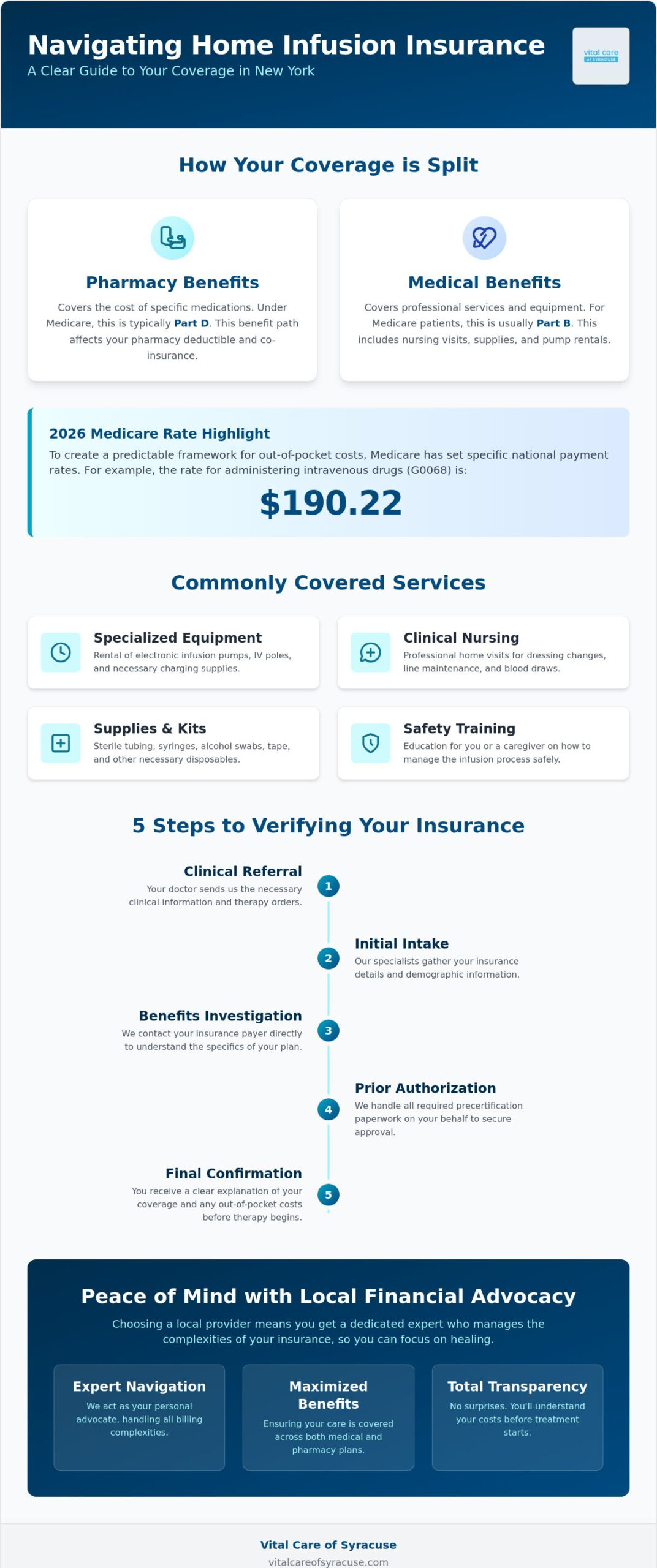
The billing process often splits into two distinct paths. Medications administered through a pump or into the vein are frequently billed under your medical benefit, similar to a doctor’s visit. For those on Medicare, this usually falls under Part B. However, other medications might be processed through your pharmacy benefit, or Part D. This distinction is vital because it determines how much of your annual deductible remains and what your final co-insurance will be. For instance, in 2026, Medicare has set specific national payment rates for home infusion administration, such as $190.22 for intravenous drugs (G0068), which helps provide a predictable framework for your out-of-pocket expectations. Our team at Vital Care of Syracuse navigates these silos daily, ensuring that your benefits are maximized across both categories.
Commonly Covered Infusion Services
When we verify your insurance accepted for home infusion, we look for coverage that encompasses the entire clinical experience. Most comprehensive plans cover the following essential services:
- Specialized Equipment: This includes the rental of electronic infusion pumps, IV poles, and any necessary batteries or charging cables.
- Clinical Nursing: Professional visits for dressing changes, catheter line maintenance, and blood draws are standard covered components.
- Supplies and Kits: Everything from sterile tubing and syringes to alcohol swabs and tape is typically bundled into the per-diem coverage.
- Safety Training: Insurance plans prioritize your safety, usually covering the initial sessions where our nurses teach you or your caregiver how to manage the infusion process confidently.
By focusing on these specific categories, we help you avoid the stress of unexpected costs, allowing you to focus entirely on your health and healing.
The New York Payer Landscape: Regional and National Plans
The insurance landscape across New York is uniquely diverse, requiring a provider who understands both the massive national networks and the powerful regional payers that dominate Central and Western New York. Whether you’re seeking care in Syracuse, Rochester, or Buffalo, the specific list of insurance accepted for home infusion varies significantly based on your employer’s location or your chosen retirement plan. Securing an “In-Network” provider is the most critical step you can take to protect your finances, as it directly impacts your annual out-of-pocket maximums and ensures that your care remains affordable throughout your recovery.
Vital Care of Syracuse maintains a deep commitment to working with both local and national networks, acting as a bridge between complex medical requirements and the personal needs of the individual. We prioritize transparency in our billing practices so that you can focus on healing rather than deciphering insurance codes. By maintaining strong relationships with regional representatives, we often bypass the administrative hurdles that slow down larger, national pharmacies.
Regional Payers: Excellus BCBS and MVP Health Care
Excellus BlueCross BlueShield and MVP Health Care are foundational to the Upstate New York market. For many in Syracuse and Utica, Excellus is the primary gateway to healthcare. In 2026, specific plans like the Medicare BlueVital (PPO) offer a $0 copayment for Medicare-covered home health visits, though patients should prepare for a 20% coinsurance for Part B drugs and durable medical equipment. Similarly, MVP Health Care members in the Rochester and Albany regions often find that local providers have established, streamlined authorization paths. These regional partnerships allow for faster processing times and more personalized financial advocacy than you might experience with a distant call center.
National Plans and Medicare/Medicaid
Beyond regional giants, national plans like UnitedHealthcare, Aetna, and Cigna play a vital role for New York families. It’s essential to stay informed about policy shifts, such as Aetna’s requirement for precertification for all Medicare Advantage members in New York as of March 1, 2026. This mandate includes in-home skilled nursing and related infusion services. For those utilizing New York State Medicaid, recent legislative changes effective August 26, 2026, mean that Managed Care plans are no longer subject to the same independent dispute resolution process for surprise billing as commercial payers. This shift makes it even more important to verify your provider’s status before starting therapy.
Medicare seniors in Syracuse and Utica must also distinguish between Part B, which covers many clinical services and certain medications, and Part D. If you feel overwhelmed by these distinctions, you can reach out to our clinical team to begin a personalized benefit verification. We’re dedicated partners in your health journey, ensuring that every detail of your coverage is explored to provide you with stability and peace of mind.
How Coverage Varies by Infusion Therapy Type
The logic behind insurance accepted for home infusion depends heavily on the clinical narrative of your recovery. While your policy remains the same, the internal criteria for approval shift based on whether you require a short-term antibiotic course or a lifelong nutritional support system. This distinction exists because insurance companies categorize risk and necessity differently for acute conditions versus chronic illnesses. Understanding these nuances helps you and your care team anticipate potential administrative hurdles before they impact your treatment schedule.
Your physician’s clinical notes serve as the essential evidence for “medical necessity,” which is the gold standard for every insurance approval. This documentation must clearly explain why home care is the safest and most appropriate setting for your specific diagnosis. Our team at Vital Care of Syracuse acts as a dedicated partner in this process, working closely with your doctor to ensure that every required detail is present in the clinical record. We believe that a precise, well-supported clinical file is the best defense against unexpected denials or delays in care.
Anti-Infective and Antibiotic Therapy Coverage
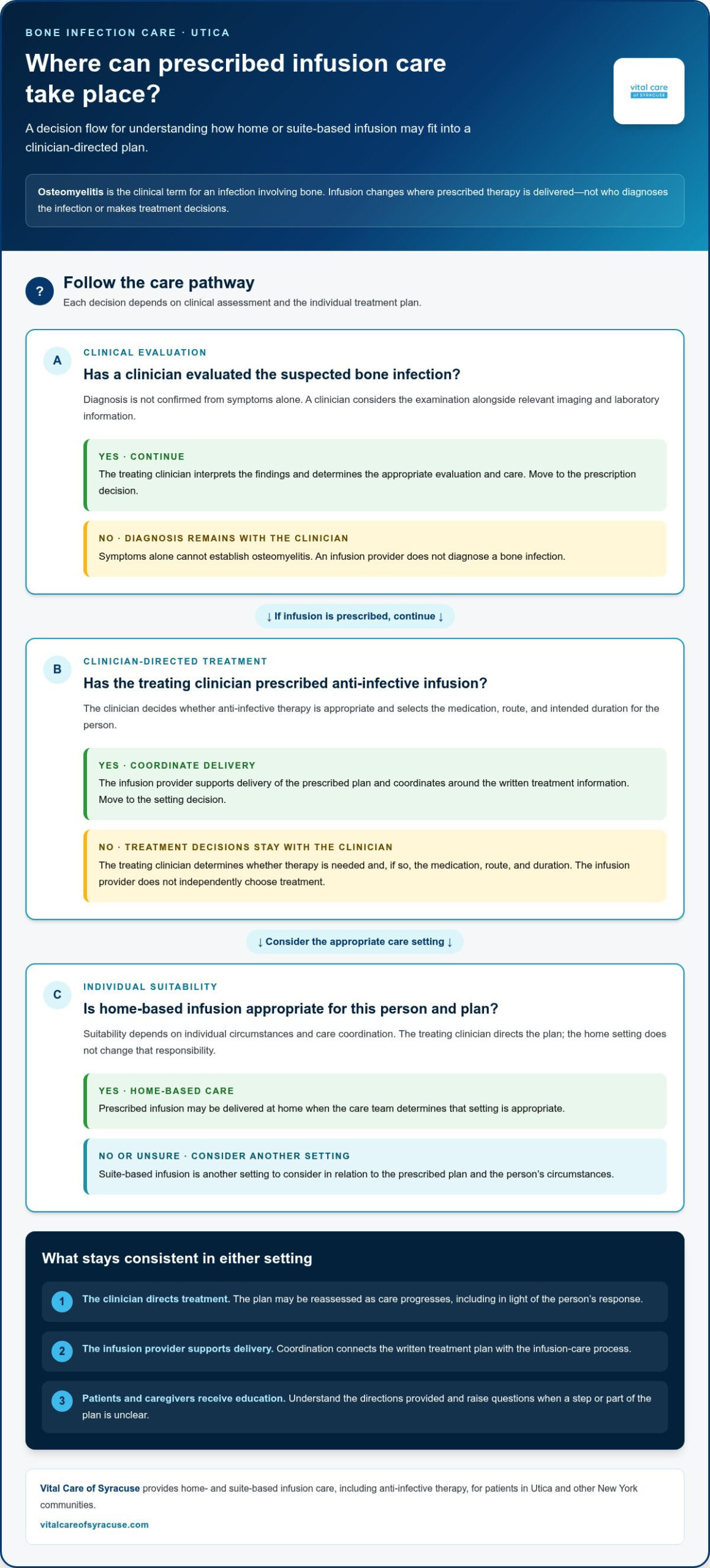
Short-term treatments, such as anti-infective therapy at home, typically operate on brief authorization windows. For conditions like bacteremia or osteomyelitis, insurance providers often grant initial approvals for 10-day to 6-week courses. These plans require frequent updates from your clinical team to confirm that the infection is responding to the medication. Because these therapies are often time-sensitive, we prioritize rapid benefit verification to ensure that your transition from the hospital to your home occurs without a gap in your antibiotic schedule.
TPN and IVIG: High-Cost Specialty Coverage
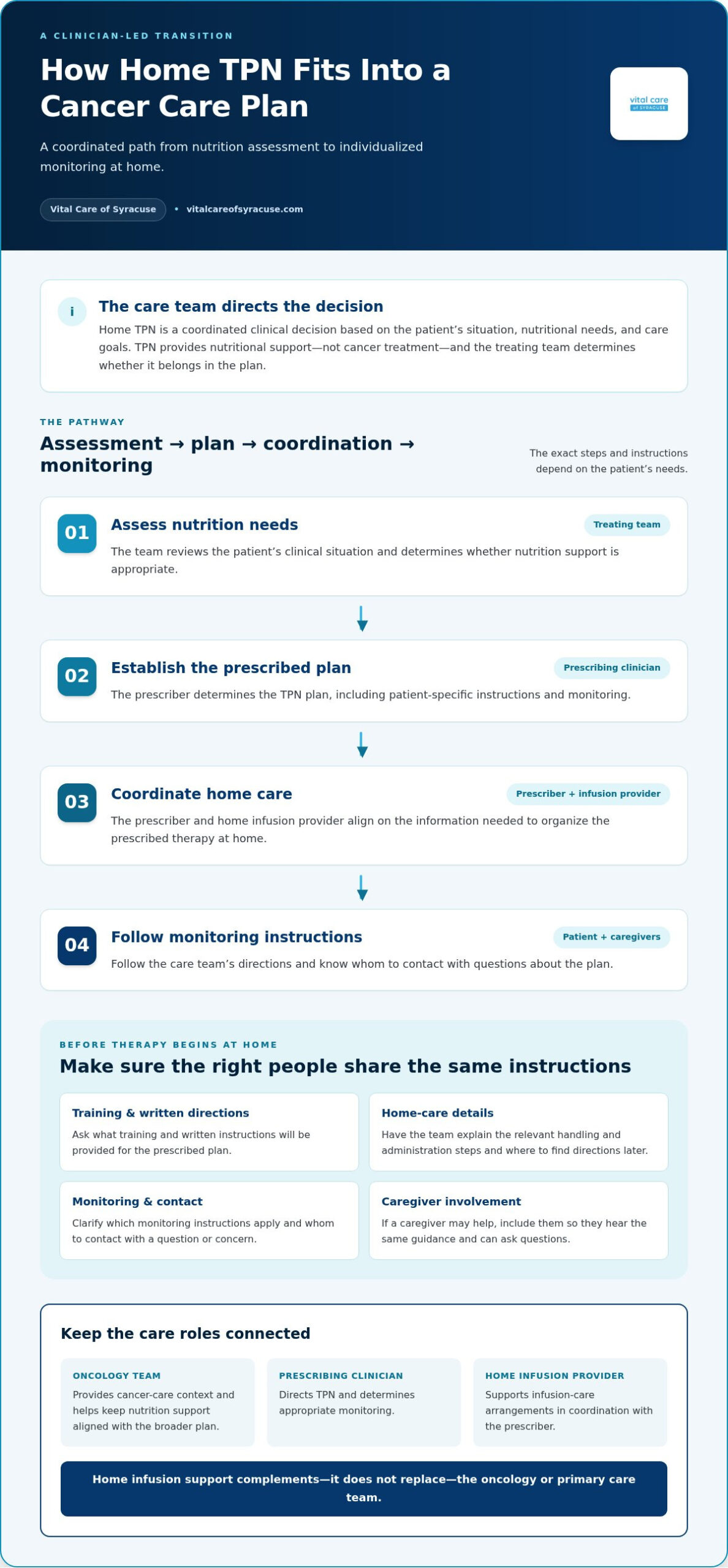
Complex treatments like home TPN for malabsorption in Albany require a deeper level of administrative precision. Parenteral Nutrition (TPN) and Immunoglobulin (IVIG/SCIG) therapies often involve “step-therapy” requirements, where an insurer may ask for proof that less intensive treatments were unsuccessful. For neurological conditions such as CIDP or Myasthenia Gravis, the clinical criteria are especially rigorous. We manage these complexities by maintaining high-register professional standards in our documentation, ensuring your insurance accepted for home infusion covers these high-cost specialty medications through the appropriate medical or pharmacy benefit silos. This steady, reliable hand in the billing process provides you with the peace of mind needed to focus on your long-term health goals.
5 Steps to Verifying Your Insurance for Home Infusion
The transition from a clinical setting to home care should be a moment of relief, not a source of administrative stress. We’ve refined a five step process that ensures your coverage is confirmed and your therapy begins without unnecessary delays. When we verify the insurance accepted for home infusion, our intake team performs a thorough audit of your specific policy to eliminate the fear of hidden medical debt. This methodical approach allows us to act as your protective advocate, ensuring every detail is managed with precision.
- The Referral: Your physician sends your prescription along with detailed clinical notes to our pharmacy. This documentation is the foundation of your claim.
- Benefit Verification: Our specialists contact your payer to confirm “In-Network” status and determine how your plan categorizes your specific therapy.
- Prior Authorization: We submit the necessary medical evidence to your insurance company to prove the necessity of home-based care.
- Financial Counseling: We sit down with you to discuss your specific copay, deductible, and any out-of-pocket responsibilities before care begins.
- Final Approval and Delivery: Once the payer gives the green light, we coordinate the first nurse visit and the delivery of your sterile supplies.
What Information You Should Have Ready
To expedite this process, it’s helpful to have your current insurance identification cards and any secondary coverage information available. Secondary insurance is particularly important for those on Medicare, as it often covers the remaining coinsurance for Part B medications. You should also provide the contact information for your primary care doctor or specialist so our team can quickly follow up on clinical requirements. Knowing your “Out-of-Pocket Max” for the current calendar year helps you understand the point at which your insurance will cover 100% of your treatment costs.
The Role of Prior Authorization
Prior authorization is often the most common delay in starting home infusion therapy. It’s a formal review process where the insurance company evaluates the clinical evidence before agreeing to pay for the service. Vital Care’s local team in Syracuse has a distinct advantage; we maintain direct lines of communication with regional carriers like Excellus and MVP. If a claim is initially denied, don’t lose heart. We manage the appeals process by providing additional clinical data or physician letters to clarify the medical necessity of your treatment. To begin this process today, contact our intake specialists and let our expert team handle the paperwork while you focus on your recovery.
Why Choose a Local Syracuse Provider for Insurance Navigation?
Choosing a partner to manage your care involves more than just clinical skill; it requires a deep understanding of the local economic landscape. While national providers often rely on distant call centers, Vital Care of Syracuse leverages long-standing relationships with Western and Central New York insurance representatives. This local presence allows us to verify the insurance accepted for home infusion with a level of nuance that national entities simply cannot match. We don’t just see a policy number. We understand the specific regional nuances of the New York payer market, ensuring your coverage is maximized from the very first day.
The benefits of a local home infusion company extend directly to the speed at which you can begin your therapy. Because we are integrated into the Syracuse, Rochester, and Buffalo health systems, our team can often bypass the administrative “red tape” that slows down larger, less specialized organizations. This regional focus ensures that your insurance accepted for home infusion is confirmed quickly, allowing you to transition from a hospital setting to your own home without missing a single dose of your essential medication. We act as a bridge between complex medical requirements and your personal needs, providing a voice of stability during a challenging time.
Compassionate Financial Counseling
We believe that financial stress should never be a barrier to healing. Our billing specialists provide one-on-one advocacy, helping you access manufacturer copay assistance programs and foundation grants that are often available for eligible patients. You’ll speak directly with a dedicated professional who knows your name and your specific clinical situation. By proactively identifying these resources, we provide a steady, reliable hand that protects your family’s financial well-being while you focus on your recovery. Our goal is to reduce the administrative burden so your primary focus remains on your health and comfort.
Seamless Transitions from Local Hospitals
Our team works in close coordination with discharge planners at prominent institutions like Upstate University Hospital and Rochester General. We strive to ensure that your insurance is fully verified and your supplies are ready before you even leave your hospital bed. This proactive approach eliminates the uncertainty that often accompanies a discharge, providing you with a structured and predictable path home. Our personality as a compassionate expert means we’re both technically proficient and emotionally present for every patient we serve. Contact Vital Care of Syracuse today to have our team verify your benefits and experience the peace of mind that comes from having a dedicated partner in your health journey.
Securing Your Health and Financial Peace of Mind
Understanding your benefits is the first step toward a stress-free recovery at home. We’ve explored how the New York payer landscape is shifting in 2026 and why having a local advocate makes all the difference in navigating those changes. From managing prior authorizations with regional carriers like Excellus to coordinating complex TPN or IVIG billing, the right support ensures you never have to choose between clinical excellence and financial stability. Finding a provider with the right insurance accepted for home infusion is essential for protecting your peace of mind during a vulnerable time.
As a locally owned and operated pharmacy in East Syracuse, Vital Care of Syracuse is proud to be in-network with major New York and national payers. Our dedicated patient advocates are here to handle the paperwork, appeals, and verification details so you don’t have to. We act as a steady, reliable hand to ensure your transition to home care is as seamless as possible. Let Our Experts Verify Your Insurance Coverage today so you can focus entirely on your healing. You deserve a partner who is both technically proficient and emotionally present throughout your health journey.
Frequently Asked Questions
Does Medicare Part B cover home infusion therapy?
Medicare Part B covers the administration of specific home infusion drugs and the necessary durable medical equipment, such as infusion pumps. For the 2026 calendar year, the national payment rates include $190.22 for the administration of intravenous drugs in the home. It’s important to verify if your specific medication is on the approved Part B list, as some therapies may instead fall under Part D pharmacy benefits.
What happens if my insurance denies my home infusion referral?
If a referral is denied, our intake team initiates a formal appeals process to advocate for your access to care. Denials often stem from missing clinical documentation or “step-therapy” requirements where the insurer requires proof that other treatments were unsuccessful. We work closely with your physician to provide the specific evidence of medical necessity required to overturn the decision and start your treatment.
Will I have a copay for my home infusion nursing visits?
Your responsibility for nursing copays depends entirely on your specific insurance plan and its “In-Network” status. For example, the 2026 Excellus Medicare BlueVital (PPO) plan offers a $0 copayment for Medicare-covered home health visits. We provide detailed financial counseling before your first visit so you understand any deductible or coinsurance obligations associated with your professional nursing care.
Do I need a separate insurance plan for specialty medications?
You typically don’t need a separate plan, but your existing insurance will process the medication through either your medical or pharmacy benefit silo. This is a common point of confusion when looking for insurance accepted for home infusion. We manage the coordination between these two benefits to ensure your therapy is covered correctly under your primary policy without requiring you to purchase additional coverage.
Can I switch my home infusion provider if they are out-of-network?
Yes, you have the right to switch to a provider that is in-network with your current insurance plan to minimize your costs. Staying with an in-network specialty pharmacy like Vital Care of Syracuse helps you avoid the higher out-of-pocket expenses associated with out-of-network care. We can assist with the entire transition process to ensure there is no interruption in your medication or nursing treatment schedule.
How long does it take to get insurance approval for home IV antibiotics?
Approval for acute treatments like IV antibiotics is often expedited and can be secured within 24 to 48 hours. Because infections require immediate attention, we prioritize these referrals to ensure you can start your medication course as soon as possible. For chronic therapies, the prior authorization process may take slightly longer, usually ranging from three to five business days depending on the payer.
Does New York Medicaid cover home TPN services?
New York Medicaid and Managed Medicaid plans do cover home Total Parenteral Nutrition (TPN) for patients who meet specific clinical criteria for malabsorption. It’s vital to note that as of August 26, 2026, Medicaid Managed Care plans in New York are no longer subject to the same independent dispute resolution process for surprise billing as commercial plans. We stay current on these regulatory shifts to protect you from billing errors.
Is home infusion cheaper than hospital-based infusion for the patient?
Home infusion is generally more cost-effective because it eliminates expensive hospital facility fees and overnight room charges. While your medication copay might remain the same, your overall out-of-pocket expenses are typically lower when receiving care in a home setting. This model is preferred by most insurance accepted for home infusion because it provides high-quality clinical outcomes at a significantly lower total cost to the healthcare system.
Leave a Reply