



Home infusion can be part of hemophilia care at home in Binghamton, NY. Clotting factor replacement may be given at home regularly to help prevent bleeding or during a bleeding episode. Hemophilia A involves a lack of functioning factor VIII, while hemophilia B involves a lack of functioning factor IX.
It’s understandable to want treatment that feels manageable without losing sight of safety and specialist guidance. This article explains how home infusions may fit into care for hemophilia A and B, what specialist support can involve, and how emergency planning and caregiver training can help organize treatment.
You’ll also learn how treatment schedules are determined, what to understand about infusion steps and complications, and when home care may need support from a broader bleeding-disorder care team.
Key Takeaways
- Understand how a treatment plan may use routine prevention or infusion during bleeding episodes, and what factors shape the schedule.
- See how coordinated bleeding-disorder care can connect patients with the clinical expertise and support their care may require.
- Learn which preparation steps and signs of vein access are important to discuss during home-infusion training.
- Explore how caregiver practice and a clear response plan can make home treatment feel more organized.
- Compare key differences in hemophilia A and B, including the clotting factors involved and the types of treatment used.
How is hemophilia treated with infusion therapy?
Factor replacement supplies the clotting factor the body lacks. A treatment plan may call for regular infusions or treatment during bleeding episodes.
In New York, factor replacement may take place at home or in a hospital. Follow the prescribed regimen and clinical infusion instructions for each treatment.
The cost is case-dependent and provided after a quote request; insurance or Medicaid coverage depends on plan terms and therapy eligibility.
In Broome County, home nursing and specialty-pharmacy care involve coordination among a hemophilia treatment center, infusion team, and prescriber. Their roles support factor delivery, infusion planning, and clinical guidance.
Factor Replacement at Home
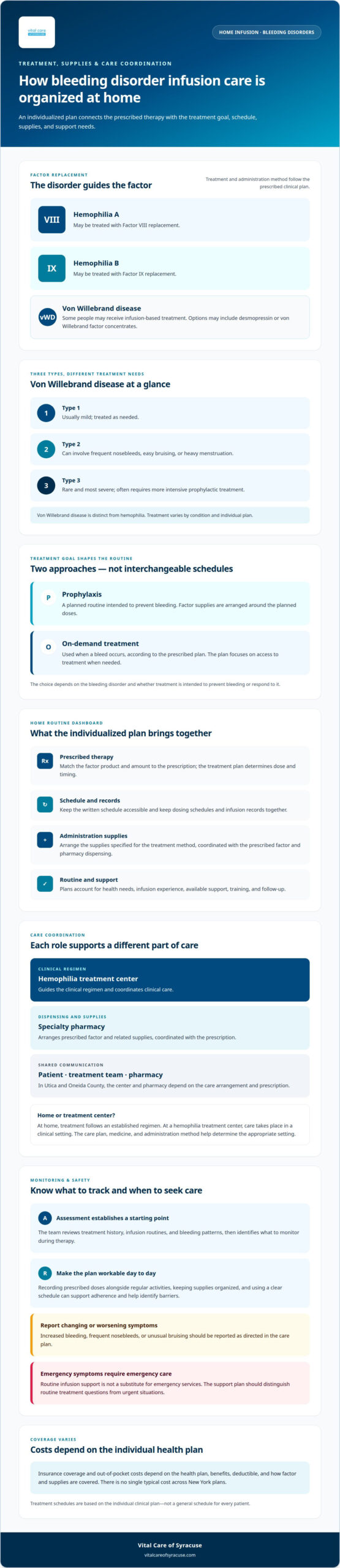
At-home clotting factor replacement delivers medication by infusion to help control or prevent excessive bleeding. Hemophilia treatment may use factor regularly as prophylaxis or during a bleeding episode. Early treatment at home can decrease the number of infusions needed for an episode. The treatment center’s plan should explain which approach applies and when to use it.
For hemophilia care at home in Binghamton, NY, the prescribed factor and instructions guide each infusion. Hemophilia A treatment may include Factor VIII replacement, while hemophilia B treatment uses Factor IX replacement. The plan should also explain how to record infusions and report bleeding or treatment concerns to the care team.
Factor Delivery and Supplies
Home delivery planning brings the prescribed clotting factor and related infusion supplies together, so each scheduled treatment can be prepared as directed. Organize medication and supplies by treatment date, and compare each delivery with the current prescription and infusion plan. This can help identify a supply mismatch before treatment begins.
Supplies may include the prescribed factor medication and materials needed for infusion. A hemophilia treatment center and specialty pharmacy may coordinate treatment needs and delivery. The delivery schedule should reflect the prescribed regimen and available supplies, not an assumed standard schedule. Store and handle medication according to its instructions.
Treatment Supplies and Schedules
Infusion schedules depend on whether factor is used for prophylaxis or on-demand treatment during bleeding episodes. Regular prophylaxis aims to prevent most bleeding episodes, while on-demand treatment responds to a bleed. The schedule and factor dose are specific to the individual treatment plan, so keep the written instructions accessible with the supplies.
Before each infusion, use the training provided for the medication, equipment, and prescribed route. For home vein access, the page advises inserting the needle at about a 30-degree angle, bevel facing up. A snug tourniquet can help enlarge a vein, and blood returning in the needle hub indicates proper vein access. Record the treatment and follow the care team’s instructions if access is difficult.
Multidisciplinary bleeding-disorder care
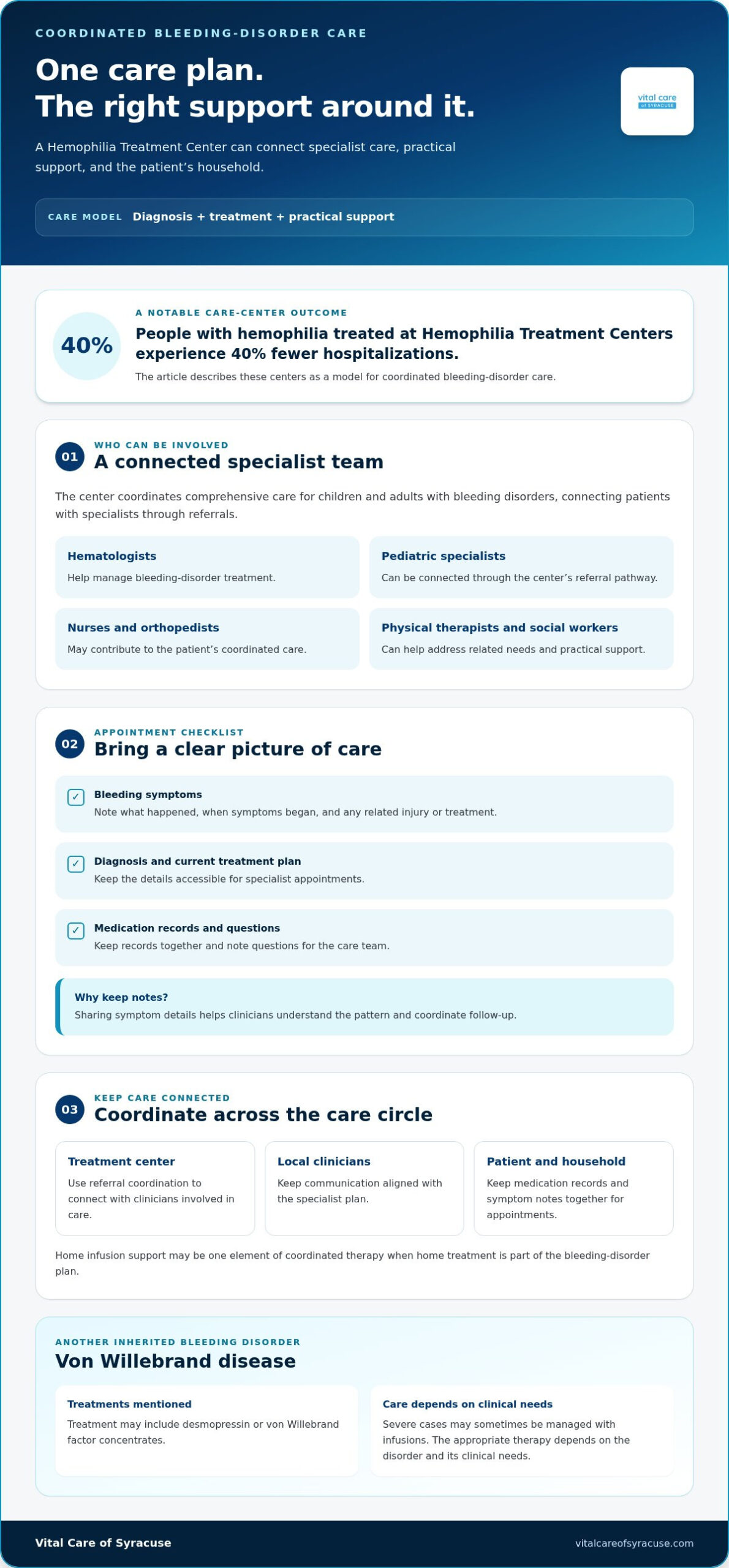
Bleeding disorders call for care that connects diagnosis, treatment, and practical support. Hemophilia Treatment Centers provide comprehensive care for children and adults, with specialist access coordinated through referrals.
For Binghamton patients, a Hemophilia Treatment Center is an established model for coordinated bleeding-disorder care. Its team can connect patients with hematologists and pediatric specialists through referrals. Care may also involve nurses, orthopedists, physical therapists, and social workers.
Hemophilia Treatment Centers coordinate care for hemophilia and von Willebrand disease. People with hemophilia who receive treatment at these centers experience 40 percent fewer hospitalizations. A hematologist helps manage bleeding-disorder treatment, while other specialists address related needs, such as joint concerns or practical support.
Symptoms can include prolonged bleeding after an injury, easy bruising, and increased risk of internal bleeding. Record symptoms, when they began, and any related injury or treatment. Sharing these details with the care team helps clinicians understand the pattern and coordinate follow-up.
Von Willebrand disease is another inherited bleeding disorder. Treatment may include desmopressin or von Willebrand factor concentrates; severe cases may sometimes be managed with infusions. The appropriate therapy depends on the disorder and its clinical needs, so keep the diagnosis and current treatment plan accessible during appointments.
If you have questions about which hematologist or pediatric hematologist to see, a coordinated referral pathway can help: a Hemophilia Treatment Center connects patients with specialists according to their care needs. The center can also coordinate referrals to nurses, orthopedists, physical therapists, social workers, and other specialists. Together, these roles bring medical care and everyday support into one plan.
UHS and Guthrie are names people may encounter when seeking care in the Binghamton area, but the care model described here centers on Hemophilia Treatment Centers and specialist coordination. A care plan can involve communication among the treatment center, local clinicians, and the patient’s household. Keep medication records and symptom notes together for appointments.
- Keep a concise record of bleeding symptoms, treatment dates, and questions for the care team.
- Bring the diagnosis and current treatment plan to specialist appointments.
- Use the center’s referral coordination to connect with clinicians involved in the patient’s care.
When home treatment is part of a bleeding-disorder plan, home infusion support can be one element of coordinated therapy.
A coordinated care plan can keep attention on the full range of bleeding disorders rather than only one diagnosis. Hemophilia Treatment Centers offer comprehensive care to children and adults with bleeding disorders. They also offer care for all types of bleeding disorders, including hemophilia and von Willebrand disease, bringing different conditions within the scope of comprehensive care.
Hemophilia impairs natural blood clotting and can cause prolonged bleeding after injury, easy bruising, and increased risk of internal bleeding. These possible effects make it important for care discussions to include the specific bleeding concerns a person experiences. Focusing on the disorder and the person’s treatment needs can help keep diagnosis and care clear.
Emergency preparedness and infusion complications
A written response plan helps patients and caregivers act consistently during home treatment. Include the prescribed infusion steps, clinical contacts, and instructions for bleeding episodes.
In Binghamton, people can access hemophilia care and home-infusion education through a Hemophilia Treatment Center. These centers coordinate specialist access by referral, helping connect training with the patient’s physician and treatment plan.
Prepare before an infusion, not during a stressful moment. Keep factor instructions, treatment records, and the care team’s response guidance together. The plan should clarify whom to contact about difficult vein access, a missed dose, or bleeding that continues after treatment. For children, caregivers can make the same written steps available to other responsible adults.
- Keep the current factor instructions and treatment log with infusion supplies.
- Record the date, dose, and reason for each treatment as directed.
- Make the physician’s instructions for bleeding episodes easy to find.
Vein access requires the technique taught by the clinical team. A snug tourniquet can help enlarge a vein before infusion. The guidance provided for home treatment describes inserting the needle at about a 30-degree angle, with the bevel facing up. Blood returning in the needle hub indicates proper vein access. Training should include how to respond when access is difficult, rather than encouraging repeated attempts beyond the taught steps.
Education should include practical rehearsal, not just a demonstration. Patients and caregivers can review the supplies, prepare the prescribed medication, follow the ordered infusion steps, and document treatment. For a child, the responsible adult should know where the treatment plan is kept and how to contact the care team. The physician’s instructions remain the reference for the individual regimen.
Complications call for a clear response pathway. If an infusion cannot proceed as trained, stop and follow the care team’s instructions for getting guidance. If bleeding occurs, follow the prescribed plan for that episode and record what happened. Hemophilia can increase the risk of internal bleeding, so the emergency plan should explain how to respond to concerning symptoms. Don’t substitute a home infusion for urgent medical assessment when the plan directs immediate evaluation.
For Binghamton families, a Hemophilia Treatment Center provides a framework for specialist coordination and referral-based support. Keep its clinical instructions with the home supplies, and review the plan whenever the prescribed treatment changes. Preparation helps patients and caregivers follow the right steps instead of relying on memory during an infusion or bleeding episode.
Caregiver training
Caregiver training turns a prescribed home-infusion plan into skills that can be repeated calmly. For hemophilia, a caregiver needs to understand the patient’s treatment instructions, recognize which supplies belong to each step, and know how to document a completed infusion. A pediatric patient may rely on an adult for these tasks, while an older child can gradually learn parts of the routine.
Practice with the medication and equipment used at home. The caregiver can review the written instructions, identify the prescribed factor, and rehearse preparing the supplies in the correct order. A teach-back approach can reveal unclear steps: the caregiver explains or demonstrates the process, then reviews any uncertainty with the clinical team before relying on the routine independently.
Training should also cover what to do if the usual plan cannot proceed. For example, the caregiver should know where the physician’s instructions are kept, how to record a missed or incomplete infusion, and whom the plan identifies for clinical guidance. Don’t improvise a replacement dose or change the schedule. Follow the patient-specific directions for bleeding episodes and escalation.
A useful home reference can include:
- The current treatment instructions and the name of the prescribed factor.
- A record of infusion dates, doses, and relevant observations.
- The care team’s guidance for difficult access, supply issues, or bleeding concerns.
- Instructions for sharing the plan with another trained caregiver.
Household coordination matters. If a relative or another responsible adult may help, they should learn the same steps and use the same written plan. For a child, parents can explain which adult is responsible during a particular routine and keep treatment records together. Consistent instructions help prevent confusion between caregivers.
Care can also involve transitions between home, a pediatric appointment, and a hospital. Keep the treatment record and current instructions available for each setting, so the care team can understand what was given and when. A caregiver should be able to describe the treatment routine without relying only on memory. That preparation supports clear communication with the physician and other clinical professionals.
Hemophilia is a genetic bleeding disorder, so families may have questions beyond infusion technique. Caregivers can write down questions about the diagnosis, clotting-factor treatment, or a child’s growing independence, then raise them with the treatment team. A structured training program can revisit skills when the treatment plan, supplies, or caregiver responsibilities change. The goal is not to replace clinicians, but to help caregivers carry out the prescribed routine and communicate accurately about care.
Hemophilia A and B
Hemophilia A and hemophilia B differ in the clotting factor the body lacks. Hemophilia A involves a lack of functioning factor VIII, while hemophilia B involves a lack of functioning factor IX. Knowing the type helps the care team select the appropriate treatment approach and explain which medication belongs in the plan.
Hemophilia A is the most common form, and severe cases are often managed at home. Treatment may use Factor VIII replacement, preventive prophylaxis, or on-demand therapy during bleeding episodes. The prescribed approach depends on the person’s treatment plan, including whether the goal is to prevent bleeds or respond to them.
Hemophilia B treatment may use factor IX replacement. In either type, the factor name matters: patients and caregivers should follow the current written instructions and match the prescribed medication to the plan. Nurses and other care professionals can help patients understand how treatment is organized and communicate changes or concerns.
Not every hemophilia A treatment is a clotting-factor infusion. Emicizumab, also called Hemlibra, is a preventive medication for bleeding episodes in people with hemophilia A. It’s given as an injection under the skin. This differs from factor replacement, so patients should know which prescribed medicine they use and its role in care.
Desmopressin acetate is another treatment that can help with blood clotting. It can be given through a vein or as a nasal spray. Its use is not interchangeable with factor VIII or factor IX replacement. The care team’s instructions identify the medication and route for the individual plan.
Hemophilia is more likely to occur in males, but the diagnosis and type guide care for each person. At an appointment, bring the treatment record and ask the hematology team to explain the factor involved, the purpose of each medication, and what the plan says about bleeding episodes. These details help families distinguish preventive therapy from treatment for a bleed.
Von Willebrand disease is a separate bleeding disorder, not hemophilia A or B. It may be treated with desmopressin or von Willebrand factor concentrates, and severe cases may sometimes be managed with infusions. Because the conditions and treatments differ, make sure the diagnosis is clear in records shared with clinicians and caregivers.
For care tailored to a hemophilia or bleeding-disorder treatment plan, explore hemophilia and bleeding disorder therapy.
During a review, ask the care team to identify each medicine by name and connect it to the written plan, rather than relying on memory or a general description. For desmopressin acetate, confirm which prescribed route applies: it can be given through a vein or as a nasal spray to help with blood clotting. Keep that explanation with the treatment record so patients and caregivers can refer to the same instructions.
If a medication name, route, or purpose is unclear, ask the hematology team to explain it before following the plan. Patients and caregivers can also ask how the instructions distinguish desmopressin acetate from factor replacement and what to do if the written record does not match their understanding. Clear, specific questions help everyone discuss the prescribed approach consistently.
Vital Care of Syracuse: Anti-infective Therapy
Vital Care of Syracuse provides Hemophilia and Bleeding Disorder Therapy for people whose prescribed care includes infusion support. This service is a relevant next step when home treatment needs to be coordinated with specialized clinical therapy and the patient’s existing care plan.
Vital Care of Syracuse also offers Anti-infective Therapy, Immunoglobulin (IVIG/SCIG), and Parenteral Nutrition (TPN). Each addresses a different medical need, so the appropriate service depends on the therapy prescribed for the individual. For hemophilia, have the treatment plan and questions about infusion support ready when discussing care.
For support with hemophilia or another bleeding-disorder therapy, contact Vital Care of Syracuse.
Take the Next Step Toward a Home-Care Plan
For families considering hemophilia care at home in Binghamton, NY, a useful next step is to bring the current treatment plan and practical questions into one conversation. Note which parts of the home routine are clear, where caregiver instruction would help, and what information needs to be shared with the clinical team. This can make discussions about treatment coordination more focused and personal.
Vital Care of Syracuse provides Hemophilia and Bleeding Disorder Therapy. Other offerings include Anti-infective Therapy, Immunoglobulin (IVIG/SCIG), and Parenteral Nutrition (TPN) for patients whose care plans call for those therapies. Start the discussion with your prescribed treatment and the support you need to carry it out at home.
When you’re ready to discuss hemophilia therapy and home infusion support, contact Vital Care of Syracuse. A thoughtful next step can help you approach care with greater clarity and confidence.
Frequently Asked Questions
Can hemophilia be managed at home with infusions?
Yes, home infusions can be part of hemophilia treatment when included in the person’s care plan. The decision involves the prescribed medication, the patient’s ability to follow the routine, and whether a trained caregiver is available when needed. For example, a family can discuss how treatment fits around school or work and how care instructions will be shared with another responsible adult.
How do I arrange home factor replacement therapy for hemophilia in New York?
Start with the prescribing clinician, who can coordinate the treatment plan with an infusion provider. Have the current prescription, diagnosis information, and insurance details ready to support coordination. Coverage varies by plan and therapy; the provider can assist with insurance verification, prior authorizations, and reimbursement coordination. Discuss how the prescribed factor and home-care plan will be organized before treatment begins.
What supplies, storage, and safety steps are needed for hemophilia treatment at home?
Use the factor medication and infusion supplies specified in the treatment plan, and follow the medication’s storage and handling instructions. Keep the directions with the supplies so the person preparing treatment can refer to the correct product information. Before starting, compare the medication with the prescribed plan and use only the technique taught during training. Record treatment details as directed, and keep the care team’s instructions accessible.
What New York rules apply to home infusion therapy for hemophilia?
In New York, factor replacement may take place at home or in a hospital. Follow the prescribed regimen and clinical infusion instructions for each treatment.
Leave a Reply