


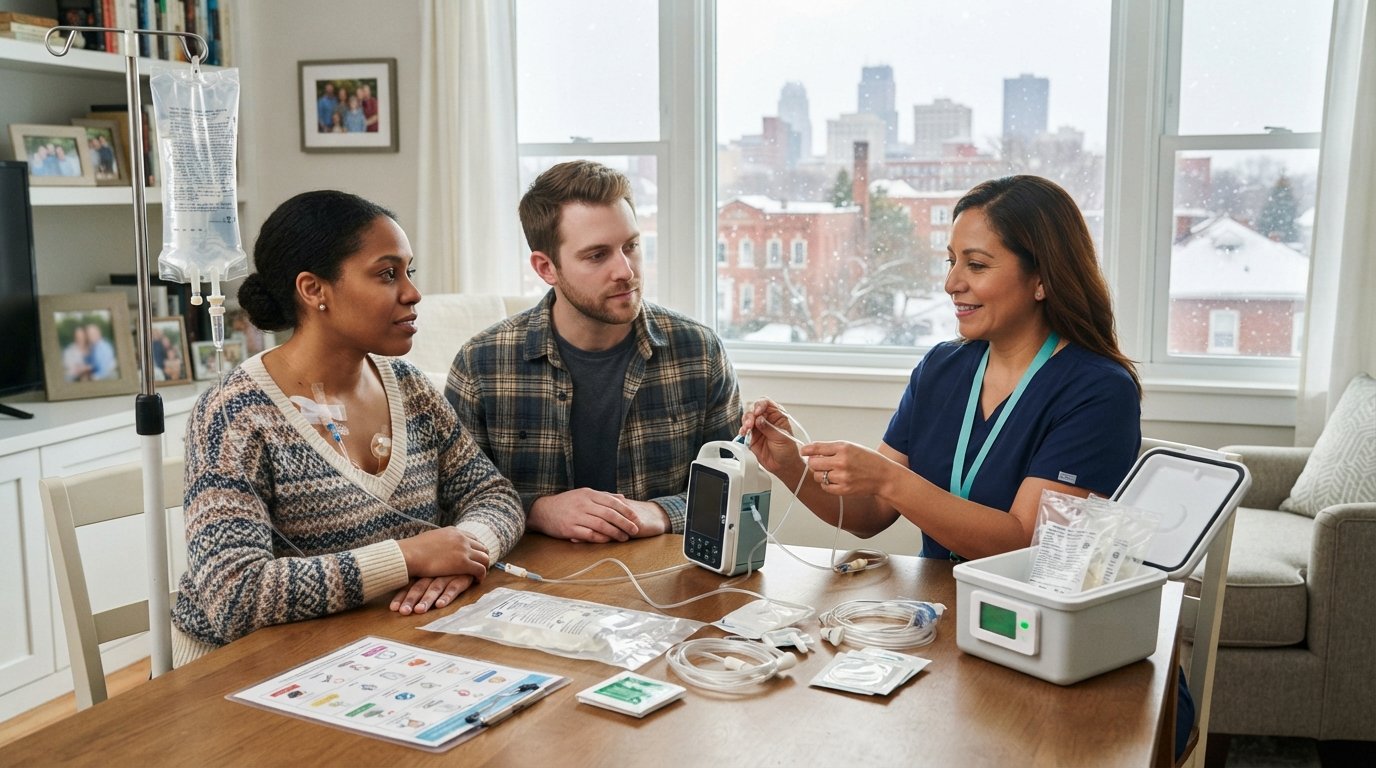
The greatest risk in home parenteral nutrition isn’t mastering the infusion pump; it’s relying on a distant corporate dispatcher hundreds of miles away when critical questions arise. When you need a specialized home TPN provider Rochester NY families can rely on, clinical safety depends on responsive regional coordination rather than an impersonal national call center.
Preparing to transition home from Strong Memorial, Rochester General, or Highland Hospital with a central line brings understandable anxiety. It’s completely natural to worry about central line infections, fluctuating electrolyte levels, and whether complex refrigerated deliveries will arrive on time in Upstate New York’s unpredictable weather.
This guide will help you identify an expert infusion pharmacy that ensures seamless hospital discharge coordination, individualized sterile compounding, and dedicated clinical monitoring every step of the way. Ahead, you’ll discover the essential safety standards to look for, key questions to ask potential teams, and how responsive local oversight restores comfort and confidence to your daily healing journey.
Key Takeaways
- How to evaluate sterile compounding standards and clinical pharmacist lab titration protocols to protect against catheter-related bloodstream infections.
- The critical criteria to look for when choosing a specialized home TPN provider Rochester NY families can trust for responsive, individualized care.
- Step-by-step strategies for coordinating seamless hospital discharges from Strong Memorial, Rochester General, or Highland Hospital directly to your home.
- Why regional delivery infrastructure and local clinical access provide greater reliability than distant national distribution centers, especially during Upstate winters.
- Practical guidance for mastering infusion pump operation, cold-chain nutrient storage, and central line maintenance with complete confidence.
Understanding Total Parenteral Nutrition (TPN) and When Home Infusion Is Needed
When the digestive system cannot process food, liquids, or oral medications, intravenous clinical nutrition becomes life-sustaining. Through understanding Total Parenteral Nutrition (TPN), patients and their families learn how custom formulations bypass the gastrointestinal tract entirely, infusing essential macronutrients, electrolytes, vitamins, and trace elements directly into the bloodstream. Working with a specialized home TPN provider Rochester NY clinicians trust allows individuals to step away from prolonged hospital stays and regain personal autonomy in their own living rooms.
Administering nutrition intravenously requires meticulous aseptic technique, dedicated vascular line maintenance, and frequent laboratory titration. To see how specialized home infusion empowers patients to regain their independence, watch this inspiring perspective:
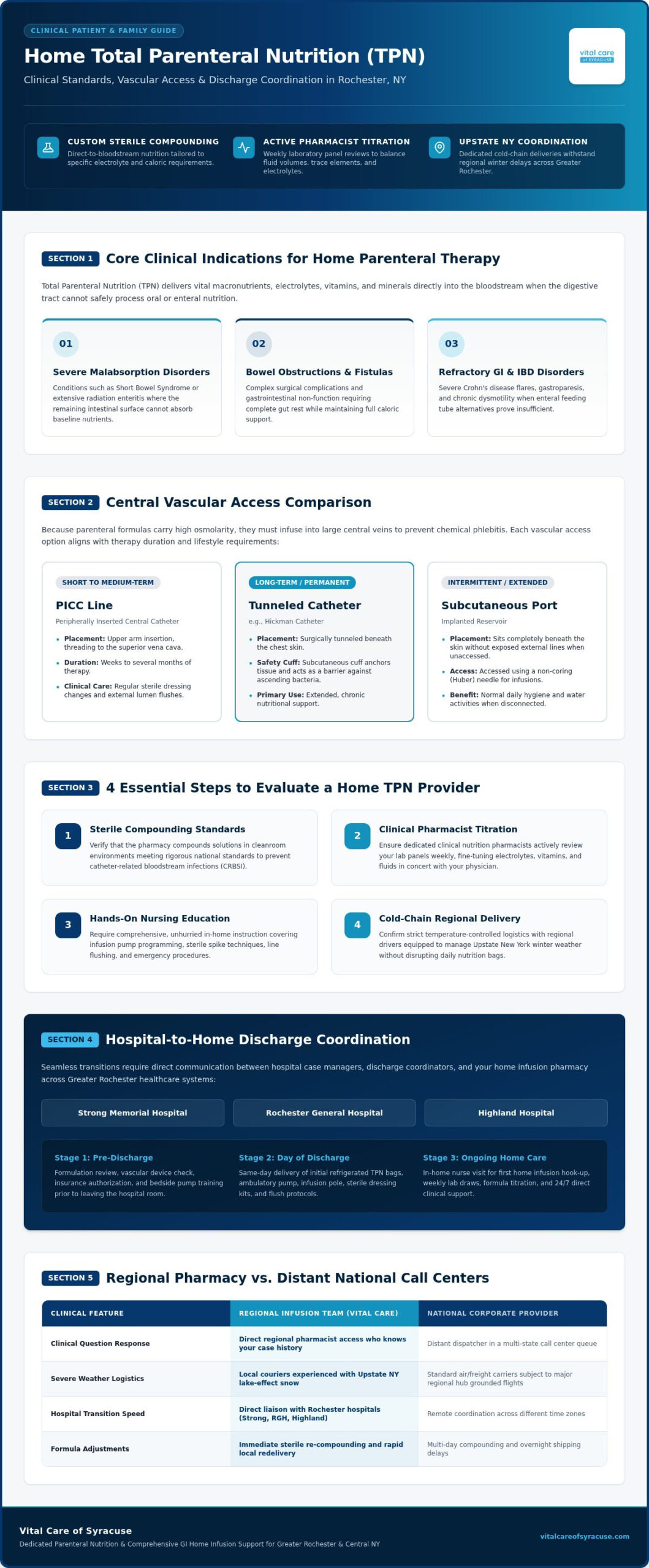
Core Clinical Indications for Home Parenteral Therapy
Home parenteral nutrition serves patients facing profound digestive failure where enteral feeding tube alternatives prove insufficient. Common clinical drivers include:
- Severe malabsorption disorders: Conditions like short bowel syndrome or severe radiation enteritis that prevent meaningful nutrient uptake.
- Intractable bowel obstructions and fistulas: Complex surgical complications requiring complete gut rest while maintaining full caloric intake.
- Refractory inflammatory bowel disease: Managing chronic nutritional deficits alongside comprehensive home infusion for GI disorders Rochester clinical teams provide for severe Crohn’s flares or gastroparesis.
Central Vascular Access: PICC Lines, Tunneled Catheters, and Ports
Because parenteral formulas carry high osmolarity, they must infuse into a large central vein to prevent chemical phlebitis. Peripherally inserted central catheters (PICC lines) are typically placed in the upper arm, offering a dependable solution for short- to medium-term therapies lasting several weeks or months.
For individuals requiring long-term or permanent nutritional support, surgeons place tunneled central venous lines, such as Hickman catheters. These lines feature a subcutaneous cuff that anchors tissue and builds a protective barrier against ascending bacteria. Implanted subcutaneous ports provide an alternative for intermittent or extended infusion schedules, sitting completely under the skin when unaccessed. A dependable home TPN provider Rochester NY families partner with ensures every supply kit, sterile dressing, and heparin flush aligns precisely with your specific vascular device.
Essential Criteria for Selecting a Home TPN Provider in Rochester, NY
Hospital directories often provide lists of home health agencies, but specialized intravenous nutrition requires far more scrutiny than standard outpatient care. Choosing the right partner means evaluating how an infusion pharmacy prepares, delivers, and clinically monitors your nutrition day after day. Families evaluating a home TPN provider Rochester NY based can use a clear four-step clinical framework to protect their health:
- Step 1: Specialized Sterile Compounding: Verify that the pharmacy compounds in state-of-the-art cleanroom environments following rigorous national standards to prevent microbial contamination.
- Step 2: Dedicated Pharmacist Titration: Confirm that clinical pharmacists actively review your lab panels weekly, recalculating electrolytes, trace minerals, and fluid volume alongside your prescribing physician.
- Step 3: Comprehensive Nursing Education: Ensure your care plan includes hands-on, unhurried bedside training for line flushing, sterile dressing changes, and ambulatory pump troubleshooting.
- Step 4: Temperature-Controlled Cold-Chain Logistics: Demand dependable regional couriers equipped to keep fragile lipid emulsions and amino acid solutions within strict temperature parameters year-round.
Sterile Compounding Standards and Customized Formulas
Every parenteral bag must be compounded in strict compliance with USP <797> cleanroom regulations. Because parenteral formulations provide ideal breeding grounds for bacteria, pharmacy hoods require continuous environmental monitoring and positive pressure air filtration. Beyond cleanliness, your daily formulation shouldn’t be static. Dedicated pharmacists adjust dextrose, sodium, potassium, and magnesium concentrations based on metabolic trends, while fine-tuning lipid schedules to protect long-term hepatic and biliary health.
Clinical Pharmacy Monitoring and Dedicated Patient Support
The transition to home infusion brings significant metabolic shifts. Experienced pharmacists scrutinize blood chemistries for subtle markers of refeeding syndrome, electrolyte depletion, or glycemic volatility. They consult directly with your gastroenterologist, surgeon, or oncology specialist to resolve issues before they escalate into hospital readmissions.
Direct communication makes all the difference. When an infusion pump alarms at nine in the evening or a delivery window needs shifting, you shouldn’t have to navigate endless automated call trees or wait on callbacks from distant corporate operators. You deserve direct access to clinicians who know your case by name. If you’re currently organizing home therapy, you can speak with a clinical infusion pharmacist to review personalized formula compounding and local support options for your family.
Navigating the Hospital-to-Home TPN Discharge Transition in Rochester
Walking out of the hospital with an active central line requires synchronized planning between bedside clinicians and outpatient specialists. Successful discharge planning doesn’t start on the day you leave; it begins forty-eight to seventy-two hours prior within the inpatient units of Strong Memorial Hospital, Rochester General Hospital, or Highland Hospital. A dedicated home TPN provider Rochester NY care teams rely on bridges this gap, working hand-in-hand with hospital social workers, discharge planners, and floor dietitians to make your arrival home calm and orderly.
Coordinating with Rochester Health Systems and Care Teams
Safe care handoffs depend on meticulous communication. The outpatient clinical pharmacy team coordinates directly with your attending physician to establish initial prescription orders and reconcile discharge laboratory baselines. This hands-on collaboration reflects the benefits of a local home infusion company, where clinical pharmacists actively participate in multidisciplinary handoffs rather than passively receiving faxes from afar.
Care transitions typically follow an intentional, step-by-step pathway:
- Direct Script Transmission: Prescriptions and clinical notes are reviewed immediately to verify compatibility, osmolarity, and infusion rates.
- Baseline Lab Reconciliation: Electrolyte levels drawn during your final hospital morning are analyzed to compound your initial home formulas accurately.
- Visiting Nurse Scheduling: Home health nursing visits are synchronized to coincide directly with your arrival, ensuring line flushes and your first home hookup proceed under professional guidance.
Insurance Verification, Authorization, and Equipment Arrival
Managing the administrative side of infusion therapy can feel daunting without proper guidance. Specialized clinical intake coordinators manage the prior authorization process, confirming benefit coverage across New York Medicaid, Medicare Part B, and commercial insurance plans. They obtain pre-approvals for the intravenous nutrients, specialized ambulatory infusion pumps, disposable administration sets, and weekly dressing kits before you leave the hospital room.
Delivery logistics are timed precisely. Your portable infusion pump, IV pole, alcohol disinfection caps, saline flushes, and refrigerated nutrition bags arrive at your residence before you walk through the door. This proactive timing eliminates the terrifying prospect of sitting at home waiting for essential calories while pump batteries tick down. With experienced logistical coordination from your home TPN provider Rochester NY partners, every supply item is unboxed, verified, and ready for your first night of rest.
Local Rochester Service vs. National Corporate Infusion Companies
When selecting a home TPN provider Rochester NY families often find themselves choosing between distant corporate conglomerates and dedicated regional infusion pharmacies. National providers frequently operate compounding facilities and fulfillment centers located states away, relying on third-party commercial parcel carriers. When you manage a complex, life-sustaining therapy, that geographic distance introduces unnecessary operational friction into your everyday routine.
Regional Logistics, Weather Resilience, and Supply Reliability
Living along the Lake Ontario snowbelt brings severe winter storms, lake-effect squalls, and sudden road closures across Western New York and Monroe County. National freight carriers routinely ground flights or cancel residential routes during severe weather events, putting patients at risk of missed nightly infusions. In contrast, regional providers maintain dedicated local delivery fleets and snow-ready couriers accustomed to upstate winter conditions.
Local teams implement practical safeguards to protect your care:
- Proactive Weather Dispatching: Early delivery staging ahead of forecasted winter storms ensures backup nutrition bags and infusion supplies remain in your refrigerator.
- Responsive Same-Day Adjustments: Rapid compounding turnaround allows quick updates when physician orders mandate formula changes following morning lab draws.
- Rapid Equipment Replacement: Direct courier drop-offs deliver replacement ambulatory pumps, battery packs, or sterile tubing sets right to your door if hardware malfunctions.
Personalized Clinical Care Versus Impersonal Call Centers
Reaching an out-of-state call center during a late-night pump occlusion alert is exhausting. You’re forced to repeat your medical history to an operator reading from a standardized triage script before being placed on hold for an on-call clinical specialist. That bureaucratic barrier creates unnecessary anxiety when minutes matter.
Working with a dedicated regional provider means your calls connect straight to the pharmacists and nurse coordinators who know your vascular access type, formula osmolarity, and infusion goals. This continuity fosters genuine clinical accountability. Rather than being treated like a barcode in a national distribution log, you work with professionals who actively invest in your daily comfort. If you are comparing care options across Monroe County, you can reach out to our regional infusion team to discuss tailored nutritional support and dependable Upstate delivery.
Partnering with Vital Care: Specialized TPN and Clinical Nutrition Support
Managing specialized intravenous nutrition at home demands absolute confidence in your clinical support system. As a locally owned franchise backed by the national Vital Care clinical network founded in 1986, Vital Care of Syracuse delivers advanced parenteral nutrition (TPN) across Monroe County and the greater Rochester region. We combine the technical compounding precision of a large specialty network with the warm, responsive advocacy of a regional health partner.
Our clinical pharmacists and nurse coordinators align directly with your local healthcare specialists. Whether you are followed by gastroenterologists at Strong Memorial, oncology teams at Highland, or colorectal surgeons at Rochester General, our staff collaborates with them to review lab panels, refine prescriptions, and ensure your daily therapy protects your nutritional health.
Dedicated Clinical Pharmacist Formulation and Laboratory Tracking
Every individual parenteral nutrition solution requires tailored compounding based on precise metabolic requirements. Our cleanroom pharmacists compound customized formulas containing exact ratios of dextrose, amino acids, lipids, and micronutrients. We don’t believe in one-size-fits-all nutrition.
Ongoing clinical safety relies on close laboratory oversight:
- Routine Chemistries: Tracking serum sodium, potassium, calcium, and magnesium ensures your balance remains stable as digestive demands change.
- Organ Function Monitoring: Evaluating hepatic markers and renal clearance allows our team to optimize trace elements and adjust lipid infusion rates over time.
- Specialist Collaboration: Regular consults with your physician ensure macronutrient ratios adjust smoothly as your recovery progresses.
Starting Your Home Infusion Journey with Confidence
Taking your first steps away from the hospital should feel empowering rather than overwhelming. Our dedicated intake team guides you through the entire insurance authorization process, confirming coverage across Medicare Part B, New York Medicaid, and private commercial plans before discharge occurs.
Once you are home, specialized infusion nurses provide detailed, unhurried bedside education. They walk through aseptic hand hygiene, sterile cap changes, central line flushing protocols, and ambulatory pump programming until you and your caregivers feel entirely capable. Having a dependable home TPN provider Rochester NY patients trust means never facing complex medical machinery alone. When you are ready to transition home with reliable, compassionate regional support, contact Vital Care of Syracuse today to coordinate your personalized parenteral nutrition plan.
Take the Next Step Toward Confident Home Nutrition Support
Transitioning to intravenous nutrition at home marks a major milestone in your recovery, but it doesn’t have to feel daunting. Protecting your well-being comes down to choosing clinical precision over distant dispatchers. With rigorous cleanroom compounding, routine metabolic lab tracking, and dependable cold-chain delivery across Monroe County, the right home TPN provider Rochester NY families trust turns a complex therapy into a manageable daily routine.
You don’t have to manage this journey alone. As a locally owned clinical practice backed by the trusted Vital Care national network established in 1986, our expert sterile compounding pharmacists create individualized nutrition solutions tailored to your body’s exact requirements. We provide seamless discharge coordination with all major hospital networks across Upstate New York, ensuring your equipment and medications arrive before you do. Connect with our clinical infusion team to coordinate compassionate home TPN services in Rochester and embrace your healing journey with complete peace of mind.
Frequently Asked Questions
How is total parenteral nutrition (TPN) administered safely at home?
Total parenteral nutrition is safely infused using an ambulatory electronic pump connected directly to a central venous access device, such as a PICC line or tunneled catheter. Before starting each daily infusion, you or your caregiver wipe clean preparation surfaces, perform thorough hand hygiene, check the refrigerated bag for clarity, and flush the catheter with sterile saline. Partnering with a dedicated home TPN provider Rochester NY families rely on ensures hands-on nursing instruction accompanies every step of your home routine.
Can patients sleep comfortably while their home TPN infusion runs?
Yes, most individuals receive cyclic infusions running over 10 to 14 hours overnight, allowing restful sleep while meeting daily caloric goals. Compact ambulatory pumps fit into padded bedside carriers or hang from quiet stands, with extended tubing providing ample room to turn safely in bed. Programmable taper-up and taper-down cycles gradually ramp infusion rates, which helps stabilize blood sugar levels overnight and leaves you unattached during daylight hours.
What steps prevent central line bloodstream infections during home TPN?
Rigorous adherence to aseptic technique remains the single most effective defense against central line-associated bloodstream infections. You’ll use alcohol-impregnated disinfection caps on all catheter hubs, scrub access ports thoroughly with chlorhexidine before every connection, and maintain completely dry, occlusive sterile dressings over insertion sites. If a dressing loosens or shows moisture, an infusion nurse replaces it immediately following sterile protocol to shield the entry site from ambient bacteria.
How quickly can a home TPN provider coordinate discharge from a Rochester hospital?
Clinical coordination typically takes two to three days once discharge orders are initiated at facilities like Strong Memorial or Rochester General. An experienced home TPN provider Rochester NY care teams trust works concurrently with hospital case managers, securing prompt insurance prior authorization, verifying laboratory values, and delivering compounded formulations alongside necessary equipment. This proactive preparation guarantees that supplies arrive at your doorstep before you leave the hospital ward.
What happens if a home TPN infusion pump alarms or malfunctions?
Infusion pumps feature clear visual displays and audible alerts that pinpoint common issues, such as air in the line, low battery voltage, or line occlusions caused by a kinked tube. Patients receive troubleshooting guides and direct phone access to clinical pharmacists who walk through resolution steps calmly. If hardware suffers a mechanical failure, regional couriers promptly dispatch a replacement programmed ambulatory pump directly to your home.
Does Medicare and commercial insurance cover home TPN in New York?
Medicare Part B, New York Medicaid, and major commercial insurance carriers routinely cover home parenteral nutrition when clinical documentation confirms permanent or long-term digestive tract failure. Coverage generally encompasses the sterile nutrition solutions, specialized infusion pumps, IV poles, and disposable tubing supplies. Clinical intake coordinators investigate your specific health plan benefits prior to discharge, ensuring all prior authorizations are finalized without unexpected financial friction.
How often are blood tests required while receiving home TPN?
Patients typically require weekly blood chemistry draws during the initial weeks of home therapy to track electrolytes, blood glucose, renal function, and liver enzymes. Once nutritional markers achieve steady equilibrium, testing frequency often transitions to every two to four weeks depending on your physician’s clinical assessment. Pharmacists review every lab result to recalculate electrolyte additives and trace minerals, ensuring formulas adjust as metabolic demands change.
Leave a Reply